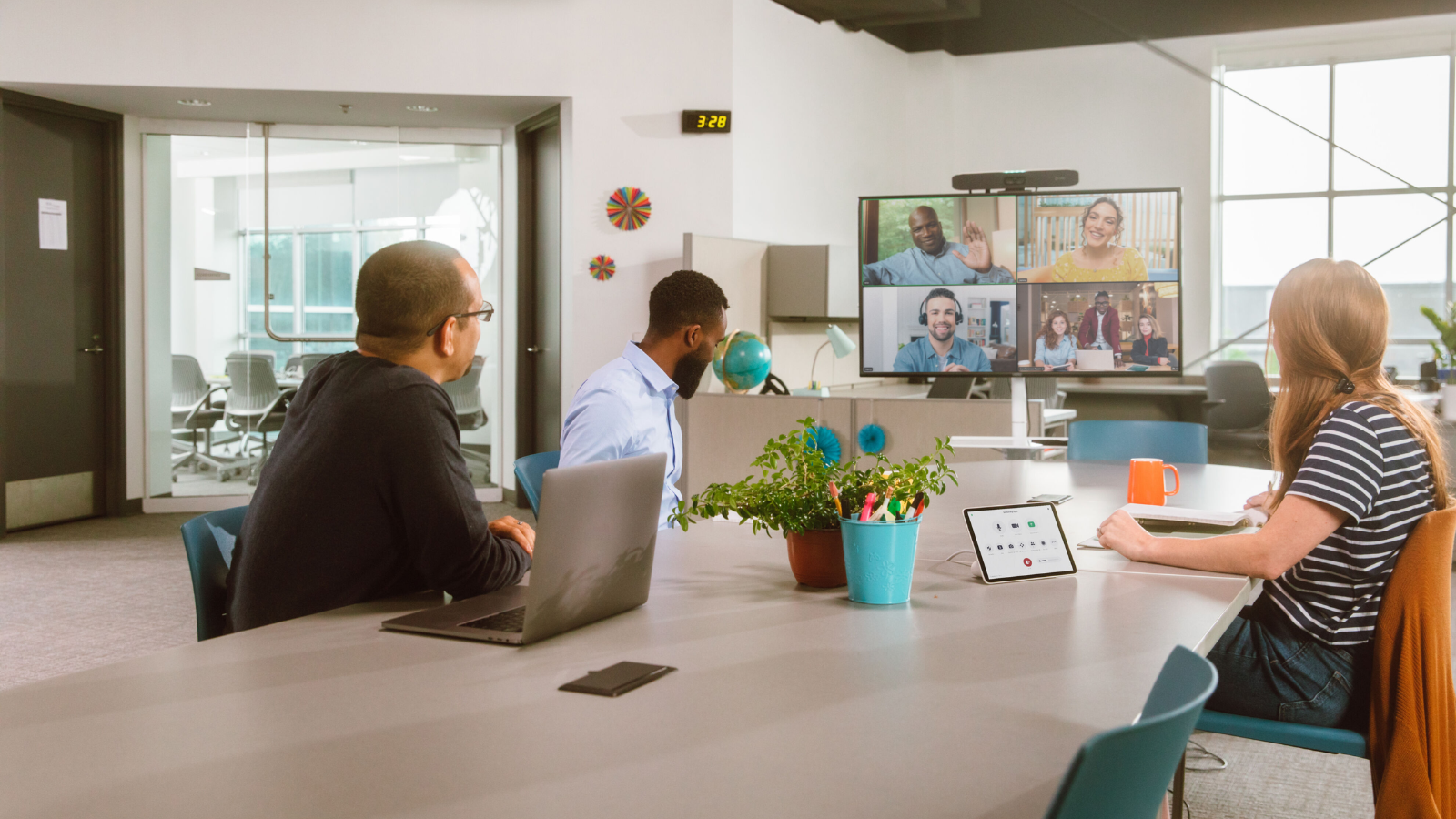
The hybrid meeting room continues to evolve as companies and employees prioritize flexible work. Organizations may be encouraging teams to return to the office part-time, but most agree that the future of work is hybrid.
Unfortunately, many meeting rooms still aren’t equipped for hybrid work. In fact, one study found 72% of employees are optimistic about returning to the office, but only 47% believe their work environments actively support hybrid workers.
The good news is there are plenty of ways for companies to transform the meeting space for hybrid team members, leveraging the latest immersive, intelligent, and inclusive tech.
Here’s why you need to invest in hybrid meeting rooms this year.
1. Flexibility, Adaptability, and Resilience
The modern workplace faces many challenges, from rapid employee turnover to talent shortages and budget restrictions. Hybrid meeting room technology addresses all of these challenges. A hybrid-first approach can allow employees to use their preferred devices and tools in meeting spaces with BYOM and BYOD tech.
Plug-and-play technology even empowers companies to transform any space into a meeting room without technical support. This means that instead of managing large meeting spaces, organizations can create more flexible focus rooms and ad hoc spaces for interactions.
Hybrid meeting rooms also give staff members the flexibility to choose how they’d like to attend a meeting based on various circumstances. For instance, with tools like Microsoft Places, teams can choose when to attend an office based on which other staff members will be present.
Hybrid meeting rooms also make offices more adaptable, ensuring team members can still participate in meetings when they cannot visit the office. This reduces disruptions in the workplace.
2. Hybrid Meeting Rooms Reduce Costs and Emissions
We’ve already noted one way hybrid meeting spaces can reduce costs: by enabling teams to use their own equipment and eliminating the need for dedicated meeting spaces. However, a hybrid-focused office design can also reduce costs in other ways.
Companies can use all-in-one tech and multifunctional displays to reduce the need for additional equipment in office spaces. They can experiment with hardware as a service and hiring options when they know they need additional tech for comprehensive meetings and training sessions.
Hybrid meeting room software can even give companies access to usage metrics and insights that help them allocate resources more effectively. Tools like Logitech Sync make it easy to monitor device and space usage in real-time. There are even tools that allow you to automatically switch off devices when they’re not in use, reducing energy expenses.
Plus, these tools also minimize carbon emissions, while hybrid meeting rooms, in general, reduce the need for travel, helping companies reach their sustainability goals.
3. Improved Engagement and User Experiences
Companies need to deliver exceptional experiences to encourage employees to return to the office, even part-time. Employees don’t want to return to the office to use meeting room equipment that’s completely different from what they have at home or difficult to set up.
To enable agile working experiences, vendors are producing convenient plug-and-play meeting room technologies that can easily sync with the software and devices employees already use. This makes launching a meeting extremely convenient and straightforward.
With the right software, employees can book spaces in advance, configure them to their specific needs, and eliminate the need for complex initial set-up experiences. This all leads to a better employee experience, as well as improved engagement during meetings.
If you take advantage of the latest meeting room technology, such as AI copilots, you can even eliminate common frustrations like the need to take notes during meetings. This means employees can spend more time focusing on the conversation.
4. Hybrid Meeting Rooms Boost Creativity
Creativity and innovation can thrive in a hybrid workspace. Hybrid meeting rooms don’t just allow people from different environments and sectors to easily connect and share ideas. They also make it easy for these team members to experiment with different concepts.