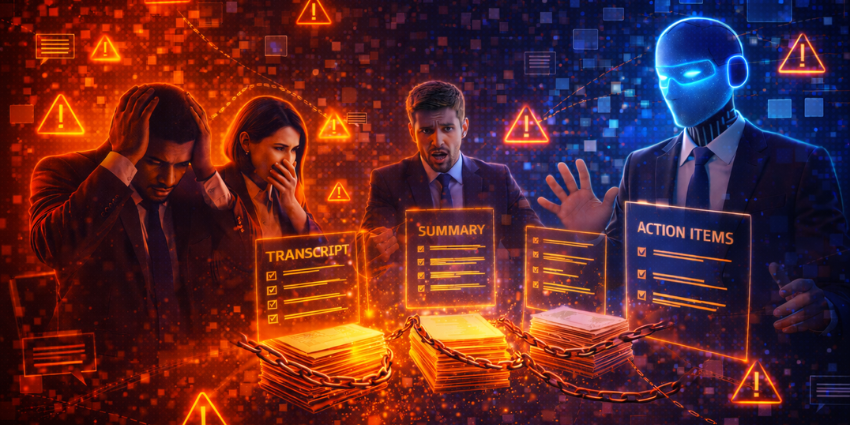
Meetings used to be fleeting moments. Someone took notes, someone else forgot them, and most conversations dissolved the moment the call ended. That’s not how things work anymore. Now every interaction across meetings, chat, documents, and workflows produces secondary data by default. Transcripts. Summaries. Action items. Draft follow-ups. Searchable knowledge.
The problem is, most compliance tools for UC and collaboration platforms focus on governing messages.
AI systems don’t care about messages. They extract meaning. They decide what mattered, what didn’t, and what should happen next. That gap is where AI data risks start to pile up.
Those risks are just growing now that Microsoft says about 71% of workers are using unapproved AI tools on the job. All the while, UC platforms are racing ahead with copilots that summarize, assign, and remember everything. The result is a growing class of AI artifact risks that live far longer than the conversations that created them.
The compliance nightmare isn’t just about rogue AI models. It’s also about the uncontrolled spread of AI-generated artifacts that persist, travel, and become evidence nobody meant to create.
Related Articles
- Why Unified Communications Is Your Next Big Security Blind Spot
- OpenAI’s Sam Altman Warns of Rising Cyber Risks from AI Agents
- How to Choose a UC Compliance Partner (and Avoid Regrets)
What Are AI Artifacts In Workplace Collaboration Tools?
AI artifacts in UC and collaboration aren’t the original conversation. They’re the byproducts. The secondary data created when AI systems listen, summarize, interpret, and act on what people say. Once you start looking for them, they’re everywhere.
Think about how meetings actually play out now. The AI pops in without anyone inviting it. It listens. It records. By the time the call wraps, there’s a transcript waiting, a tidy summary, a few highlighted moments someone swears they never emphasized, action items already assigned, and sometimes a draft follow-up or a ticket opened somewhere else entirely. None of that existed when the meeting started. All of it exists when it ends. That trail of output is what we mean by AI artifacts.
Common examples include:
- Meeting transcripts
- Summaries and highlights
- Action items and task assignments
- Generated drafts and follow-ups
- Searchable semantic knowledge layers stitched across conversations
What makes AI artifact risks different is how much judgment is embedded in each step. There’s a clear ladder here. First comes capture: raw transcripts and logs. Then interpretation: summaries, inferred priorities, decisions that sound more settled than they were. Finally, agency: drafted tickets, backlog items, and recommendations that move work forward.
Why Do Transcripts And AI-Generated Summaries Create Compliance Risks?
Traditional chat logs and call recordings are awkward by design. They’re chronological. They ramble. They include half-finished thoughts and dead ends. You have to work to extract meaning from them. That friction is a feature. It keeps context intact.
AI artifacts remove that friction entirely, and for a lot of leaders investing in UC and collaboration trends, that seems like a good thing.
They’re structured, portable, and easy to drop into an email, a ticket, a CRM record, or a shared channel. They’re built to travel, and that’s the heart of the problem. AI data risks don’t come from storage alone; they come from reuse.
Transcription isn’t the finish line anymore. Buyers expect summaries to trigger tasks. Notes to update systems. Meetings to turn into work objects automatically.
That’s where AI artifact risks escalate. Once an output can trigger an action, it stops being documentation and starts behaving like infrastructure. A summary shapes decisions. An action list implies commitment. A generated draft sounds authoritative even when the conversation was anything but settled.
This is also where Copilot governance starts to matter too. Because when AI artifacts plug directly into workflows, they don’t just reflect work, they become part of how work happens. Operational objects carry a very different kind of compliance weight than messy human notes.
AI Data Risks: How Does AI-Generated Content Affect Data Retention Policies?
Probably the biggest issue is that AI artifacts travel. A summary is faster to paste than a transcript. An action list feels safe to forward. A clean paragraph explaining “what we decided” slides neatly into a ticket or an email. That’s the derivative multiplier effect. The cleaner the artifact, the further it goes.
People copy meeting summaries into browser-based AI tools to rewrite them. They paste transcript snippets into prompts to “make this clearer” or “turn this into a plan.” Prompt-based sharing doesn’t look like file exfiltration, so traditional controls barely notice it.
The trust factor makes it worse. AI summaries look official. They read like decisions, even when they’re interpretations. In collaboration platforms, that polish carries weight. This is also why transcript risks aren’t limited to accuracy. Once a summary exists, it feels safe to reuse. Once it’s reused, it escapes the context that made it harmless in the first place.
Add in shadow AI, all the tools purchased outside IT, copilots living in browsers, forgotten bots in channels, and discoverability becomes structural. Nobody set out to leak anything. The system just made it easy.
Transcript Risks: When Accuracy Isn’t the Core Issue
Most conversations about transcript risks fixate on accuracy. Did the AI mishear a word? Did it confuse speakers? The bigger issue is granularity.
AI transcripts capture everything. The half-formed ideas. The speculative comments. The awkward pauses where someone says, “This isn’t ready yet,” right before tossing out a thought they’re still not certain about. In a live meeting, that nuance is obvious. In a transcript, it’s flattened into text and frozen in time.
Then compression kicks in. Summaries elevate some remarks and drop others. Action items turn loose suggestions into implied commitments. Context evaporates. What was brainstorming starts reading like a decision. What was uncertainty starts sounding confident.
Even reviewed outputs don’t escape this gravity. Once a summary becomes the thing people reference, it shapes memory. It becomes the working truth.
That’s why AI data risks tied to transcripts aren’t about transcription quality. They’re about how easily interpretation hardens into record, and how quickly that record starts speaking louder than the humans who were actually in the room.
The Persistence Problem: AI Data That Refuses to Die
Meetings end. Calendars move on. People forget what was said. AI artifacts don’t.
Once a transcript or summary exists, it rarely stays put. It gets auto-saved to cloud storage. Posted into a channel “for visibility.” Dropped into a ticket so someone can “take this offline.” Exported as a PDF. Indexed for search. Long after the meeting fades, the artifacts stick around, quietly accumulating context.
Projects close, but summaries persist. Employees leave, but their AI-generated notes remain searchable. A throwaway comment from a year ago suddenly resurfaces because someone searched a keyword and found a neatly packaged recap. No one remembers the tone. No one remembers the caveats. The artifact survives without the people who could explain it.
The problem is worse when organizations juggle multiple UC platforms, each with different storage, retention, and export rules. One conversation can splinter into dozens of derivative data points across systems that don’t agree on what’s authoritative.
That splintering makes AI artifact risks hard to contain. Which version matters? The transcript in storage? The summary in a channel? The action list copied into a task system?
Struggling with managing multiple platforms safely? Check our guide to multi-platform UC compliance.
Evidence Integrity & Source-of-Truth Breakdown
Once AI artifacts multiply, you don’t just have more records; you have competing versions of reality. The transcript says one thing. The summary emphasizes another. The action list implies decisions no one remembers formally agreeing to. Draft follow-ups harden assumptions that were never meant to leave the room.
Each artifact carries a different tone of intent.
That’s the core integrity problem. Which one reflects what the organization actually decided? Which one would a regulator, auditor, or opposing counsel treat as authoritative?
Ownership makes this worse. Who authored the summary? The AI did, but someone approved it, maybe. Who validated the action items? Who’s responsible if the artifact is wrong, misleading, or incomplete? These questions don’t have clean answers once AI artifact risks enter the picture.