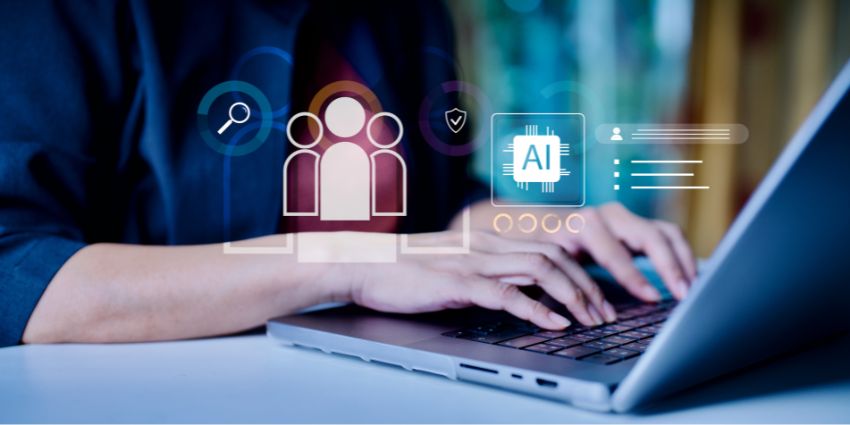
AI in talent management is moving fast from experiment to expectation. For HR leaders, that creates a real opportunity: faster hiring, better workforce analytics, stronger skills visibility, and more scalable employee development. But it also creates a problem. Too many organisations are buying AI recruitment tools and AI hiring software for speed while pushing governance, transparency, and bias mitigation into phase two.
That is the wrong order. In practice, AI in talent management only creates sustainable value when leaders build accountability in from day one. Otherwise, the same systems that promise better hiring and sharper workforce analytics AI can also create discrimination risk, compliance exposure, and reputational damage.
AI in talent management is not a cheat code for better people decisions. It is a multiplier. If your hiring process is fair, structured, and well-governed, AI can scale that. If it is opaque, inconsistent, or biased, AI scales that too.
Adoption is accelerating while trust still lags. In a recent Workday study, only 52% of employees said they welcome AI, while just 22% said their company had shared clear guidelines on responsible AI use.
The gap says a lot. Most enterprises are now past the “should we use AI?” stage. HR leaders now need to decide whether they can use AI to improve hiring and workforce outcomes without weakening fairness, trust, or defensibility.
What Is AI in Talent Management and How Is It Used Today?
AI in talent management refers to the use of machine learning, generative AI, and predictive models across the employee lifecycle. In practical terms, it means using software to support or automate decisions about attracting, hiring, developing, deploying, and retaining talent.
Common AI talent management use cases include:
- AI recruitment tools that support screening, job description creation, candidate matching, and interview coordination.
- AI hiring software that helps recruiters prioritise applicants and reduce manual admin.
- Workforce analytics AI that flags skills gaps, attrition risk, internal mobility opportunities, and hiring bottlenecks.
- Learning and development tools that recommend content, coaching, or next-best career moves.
- Talent intelligence systems that build skills graphs and support workforce planning decisions.
The growth case is clear. AI can reduce repetitive work, speed up decision-making, improve visibility into workforce capability, and help HR teams operate with more consistency at scale. Used properly, it can make talent processes more structured and less dependent on gut feel.
Still, many organisations mistake automation for objectivity. They assume that because a decision is model-assisted, it is inherently neutral or better. It is not. AI only improves talent decisions when the surrounding process is already disciplined.
Strong HR leaders should treat AI less like a magic feature and more like a high-impact operating layer. The point is not to automate everything. The point is to automate what should be automated, support what should be supported, and keep human accountability where judgement still matters most.
What Legal Risks Does AI Introduce into HR Processes?
The biggest legal risk is simple: an AI system can still discriminate even when nobody intended it to. That makes AI bias in recruitment tools a real commercial and compliance issue, not just an ethics talking point.
Where legal risk appears first
In hiring and broader talent management, risk usually shows up in five ways:
- Bias in screening or ranking, where some groups are disadvantaged by flawed data, poor proxy variables, or inconsistent evaluation logic.
- Opacity, where candidates or employees cannot understand how a decision was reached.
- Privacy overreach, where systems ingest more personal data than is necessary or appropriate.
- Over-automation, where managers stop exercising meaningful review over high-impact decisions.
- Weak vendor accountability, where buyers cannot evidence how a model was tested, governed, or updated.
Regulators are also getting more explicit. Under the EU AI Act, Annex III classifies systems used in recruitment, candidate evaluation, and employment-related decision-making as high-risk.
That changes the procurement conversation. HR AI compliance is no longer just about whether a tool works. It is about whether the organisation can defend how it uses the tool, how people review decisions, and how teams monitor risk over time.
For HR leaders, the real risk is not using AI. It is using AI without a defensible governance model, a clear accountability structure, and evidence that fairness has been tested rather than assumed.
How Can Enterprises Prevent AI Bias in Recruitment?
Enterprises do not reduce bias by buying a vendor that says its model is fair. They reduce bias by building a hiring process that is structured enough to test, challenge, and govern the output.
A practical anti-bias approach starts with process design before platform selection:
- Standardise the hiring journey. Define role requirements, scoring criteria, and interview stages clearly before AI enters the process.
- Separate support from decision authority. Let AI assist with recommendations, but do not let it become the unchallenged decision-maker.
- Test for adverse impact early. Check bias before rollout and again after deployment.
- Review your input data. Historical hiring data often reflects older preferences, inconsistent manager behaviour, or legacy bias.
- Create override and appeals processes. Recruiters, managers, candidates, and employees need a path for review when outcomes look questionable.
- Monitor real-world performance. A model that performs well in a demo may behave differently across regions, roles, or candidate groups.
HR leaders also need a mindset shift. Stop asking whether AI removes bias entirely. That is not a serious benchmark. Ask instead whether AI reduces inconsistency, improves evidence, and surfaces patterns earlier than a purely manual process would.
If the answer is yes, that is useful. If the answer is “we do not really know because the tool is a black box,” that is a buying red flag.
What Governance Frameworks Should HR Leaders Implement?
The best governance framework for HR AI is not a long policy document that sits untouched in a shared drive. It is a working operating model that tells the business who approves, who monitors, who challenges, and who owns the consequences.
For most enterprises, a strong governance framework for HR AI should include: