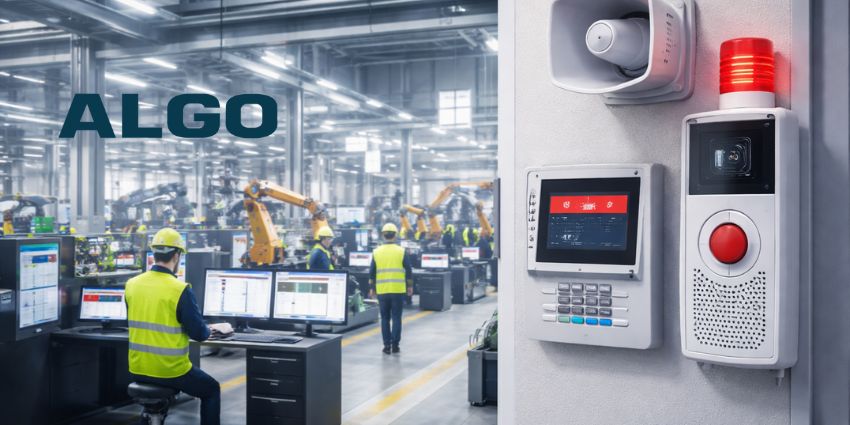
Industrial facilities have undergone significant changes over the past decade. The scale of the mega-warehouses introduced by companies like Amazon demonstrates the type of scale new manufacturing plants, distribution centers, and logistics operations now deal with.
Yet while physical infrastructure has evolved to meet these modern demands, communication systems within these facilities often haven’t kept pace. Many still rely on the same legacy PA systems traditionally used to coordinate daily operations and broadcast safety alarms.
The problem with this approach becomes painfully clear during emergencies. As Ryan Zoehner, CEO at Algo, explains, “The vast majority of organizations are not relying on input from their legacy systems,” meaning alarms triggered in the warehouse aren't relayed to anyone in the back office. This siloed alert system allows safety events to unfold without an adequate response.
Yet a new generation of network-connected IP devices can now harmonize industrial alerting, giving companies the opportunity to respond correctly by closing the gap between factory floor alarms and back-office communication.
The Critical Gaps in Legacy PA Systems During Emergencies
When a worker suffers an injury on the factory floor, time is critical, and the response must be immediate and coordinated. However, when an alarm is triggered in an environment with a legacy PA system, the way this situation often unfolds highlights the fundamental limitations of the infrastructure.
When the alarm sounds through the legacy system, it alerts only those within earshot of the warehouse speakers. In a facility stretching hundreds of meters or more, large portions of the workforce may never hear the alert. More critically, there’s no way for the back office to immediately know what’s happening. Someone must then contact the office separately, explain the situation, and hope the right people are notified to coordinate the response, such as shutting down equipment or calling for medical assistance.
Post-event reporting presents its own challenges. Without automatic logging or documentation, incidents must be reported manually to the back office, health and safety teams, and other relevant parties. That reconstruction process can be messy, a process Ariel Posvolsky, Director of Customer Success Engineering at Algo, likens to piecing together a version of events from the "breadcrumbs that are left.”
Across every level, from workers distant from the incident to those in the office, the legacy system’s inability to alert people outside its immediate proximity is the core issue. Fortunately, modern IP-based endpoints offer a fundamentally different approach, one that connects rather than isolates, automates rather than relies on manual intervention, and ensures comprehensive coverage rather than leaving gaps.
How IP Endpoints Bridge the Communication Gap
Modern IP-based paging systems fundamentally change emergency response. These systems create a seamless connection with the broader company technology stack, such as unified communications and mass notification platforms, so that alarms are delivered to factory workers via audible and/or visual alerts, and to staff beyond the reach of on-site speakers through email, text messages, or desktop notifications.
Algo's IP Endpoints, working in partnership with unified communications platforms, ensure that when a worker triggers an emergency protocol, it’s sent to all connected devices. This ensures that every worker receives an alert regardless of their proximity to an endpoint, as "one of the best ways to get announcements to areas lacking speaker coverage is to get them to the radios staff are always carrying,” Ariel Posvolsky explains.
The reach of these alerts is further amplified when considering that these alerting endpoints integrate with UC platforms. Not only does an emergency alert simultaneously broadcast to all speakers and connected handsets, but it can also immediately notify the back-office team via the UC platform. This allows centralized teams to enact high-level responses, such as emergency shutdowns, without waiting for manual escalation. Everyone who needs to know is informed instantly, through the channels they already monitor.