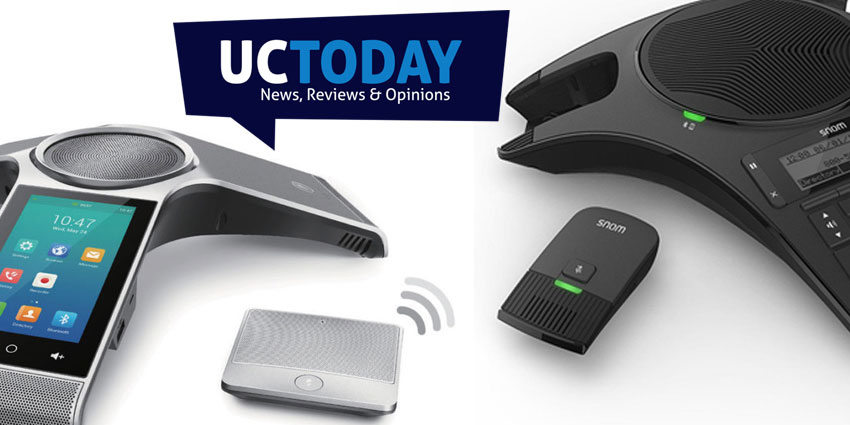
Conference phones are a crucial part of what makes the average business tick. Without a conference phone, you'd struggle to ensure comprehensive collaboration between the modern and diverse workforces of the current professional environment. Almost every business - no matter their size or background, uses a conference phone on a semi-regular basis.
If you're one of the many companies who rely on conference phone endpoints to thrive, then choosing the perfect system will be no small concern. After all, you might still be using the phone you pick today, five years from now! To empower you to make a more informed choice, we've put together this simple guide, outlining the most important features in a conference phone purchase.
To view a complete list of our latest conference phone reviews click here
The Critical Components of a Conference Phone
There are several points you'll need to think about when choosing the ideal conference phone, but one of the most important by far is intelligibility.
Let's face it, muffled words and phrases are a waste of crucial time in a meeting room environment. A conference phone needs to be able to distinguish each voice in the room clearly, and effectively, to help you collaborate in a streamlined, productive manner. Any lack of quality could lead to confusion and other problems in the workplace. So, how do you search for better clarity? Begin by looking at the following points:
- Reverberation: This refers to the amount of echo between the person speaking, and the conference phone microphone. Reverberations make it harder to understand the conversation in question, and can be affected by features throughout the room, such as hard walls and ceilings
- Amplitude: This is the measure of how loud a talker can seem to a listener. Quieter voices are more difficult to understand, and the range of your conference phone will have a huge impact on how well the microphones can pick up speech throughout the room
- Bandwidth: This is the range of speech bandwidth that can be carried from the speaker, to the listener. Traditional analogue phones carry about 20% of the frequencies in a human Some newer IP phones can carry frequencies at a much higher rate, of around 22kHz
- Interaction: This indicates the ease with which participants can naturally interact with one another during a conference call. It's important to make sure that people can communicate organically, to allow for a natural flow of communication
- Noise: This refers to the sounds picked up by your conference phone microphone that isn't intended to be used as part of the conversation. Noise can refer to the sound of people eating in the background, the noise of a fan on a projector, or anything else that might get in the way of the clarity of your conversation
The good news is that a high-quality conference phone should be able to manage most of these problems for you. In fact, many of the options available on the market today offer impeccable audio quality, designed to pluck voices out of a conference room environment with ease.
Analogue or VoIP?
When selecting a conference phone for your modern meeting room environment, you may also need to decide whether to choose "VoIP" systems or an analogue phone. An analogue, or proprietary conference phone is similar to a standard deskphone. It simply plugs into the analogue port for your phone and connects through a standard phone line network.