Frontline workers have largely been an afterthought in the enterprise AI rollout. Most Copilot features like meeting summaries, email drafting, and document generation are built around desk-based workflows. The nurse who needs to check a care protocol mid-round, or the warehouse supervisor who needs to know what happened on the previous shift, hasn't had much to work with.
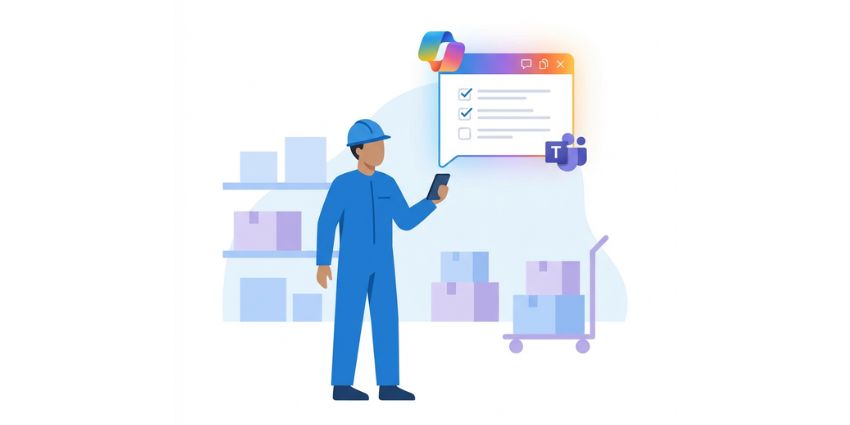
Microsoft's answer is Frontline Agent, now in public preview. It lives in the Teams chat rail, requires no new app, and does two things: it finds operational information from an organisation's SharePoint and Teams content, and it helps workers catch up on communications and draft shift handovers.
What Microsoft Frontline Agent actually does
Two core jobs define the product. The first is knowledge retrieval, where the agent searches approved SharePoint sites and Teams channels to answer questions about policies, procedures, product details, or safety guidance. The second is shift coordination, summarising unread messages, pulling out action items, and drafting end-of-shift handovers based on Teams activity from the previous 12 hours.
The multilingual support means workers can ask questions in their preferred language even when the underlying documents are in another.
Abbie Sweeney, a programme leader on the Microsoft 365 Copilot team, summed up the intent, telling Microsoft's Voices from the Frontline: AI in Action podcast series:
"The goal isn't automation for its own sake. It's removing everyday friction so workers can focus on customers, patients, and guests."
Why Microsoft is betting on frontline AI
Microsoft recorded its biggest ever quarter for Microsoft 365 Copilot seat adds in Q2 FY2026, up over 160% year-on-year, reaching 15 million paid seats. CFO Amy Hood confirmed that seat growth came "primarily in our small and medium business and frontline worker offerings."
So while frontline is Microsoft's next major Copilot expansion opportunity, it has also proven the hardest segment to convert. Knowledge workers have obvious Copilot use cases in email, documents, and meetings. Frontline workers need something faster and simpler, and Frontline Agent is Microsoft's attempt to close that gap.
The research backs the need. Microsoft's own data shows 80% of frontline workers want to use AI to find information faster. The demand is there. The challenge has always been building something that fits how frontline work actually happens: on shared devices, on mobile, under time pressure, mid-shift.
The governance catch that IT teams shouldn't overlook
The "out-of-the-box" framing is appealing, but Microsoft's own setup documentation flags an important caveat. Without configuration, the agent draws responses from all SharePoint content each user can access. In organisations where knowledge bases are fragmented, outdated, or inconsistent, which covers most large frontline operations, this creates a real accuracy risk.