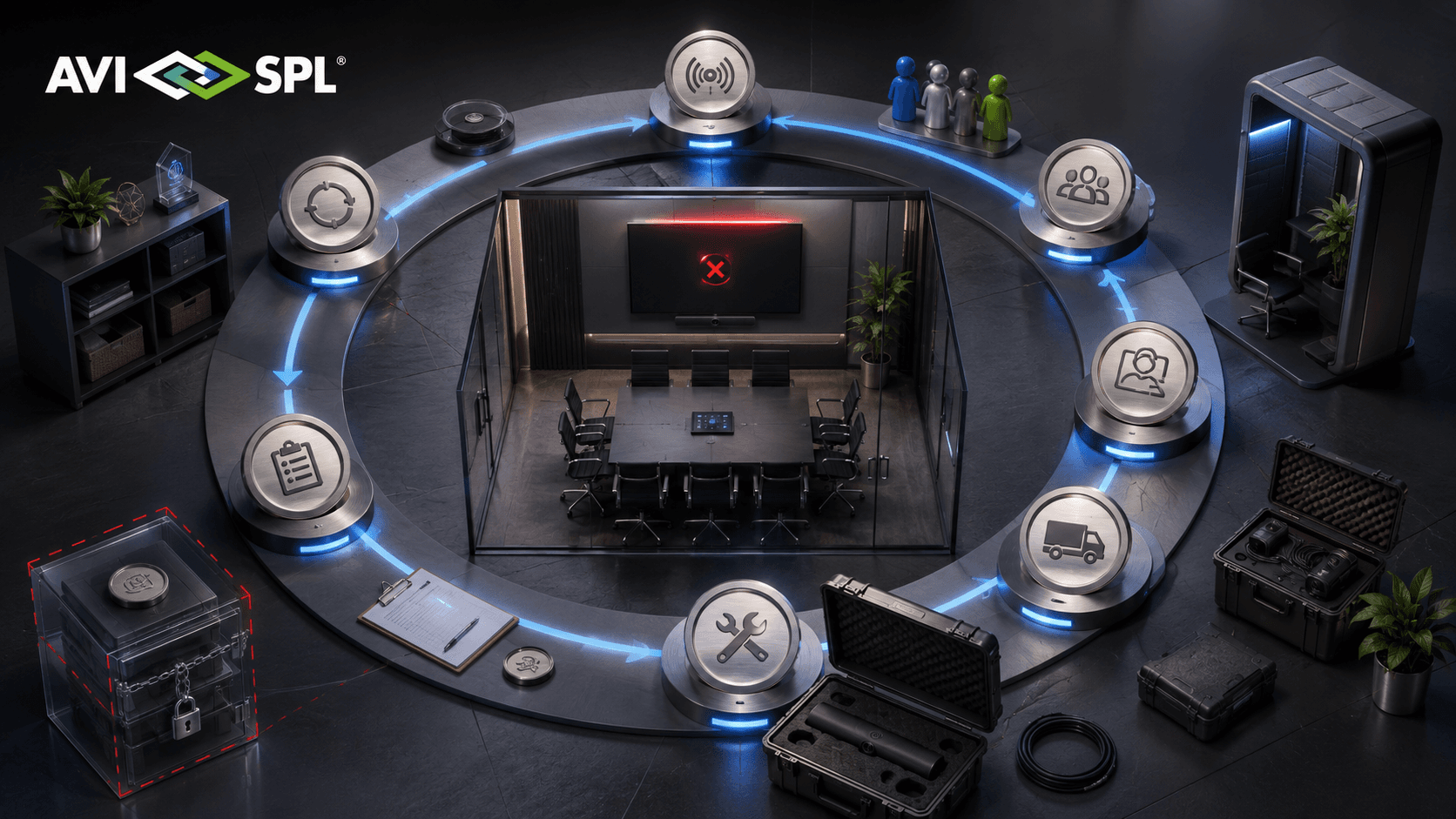
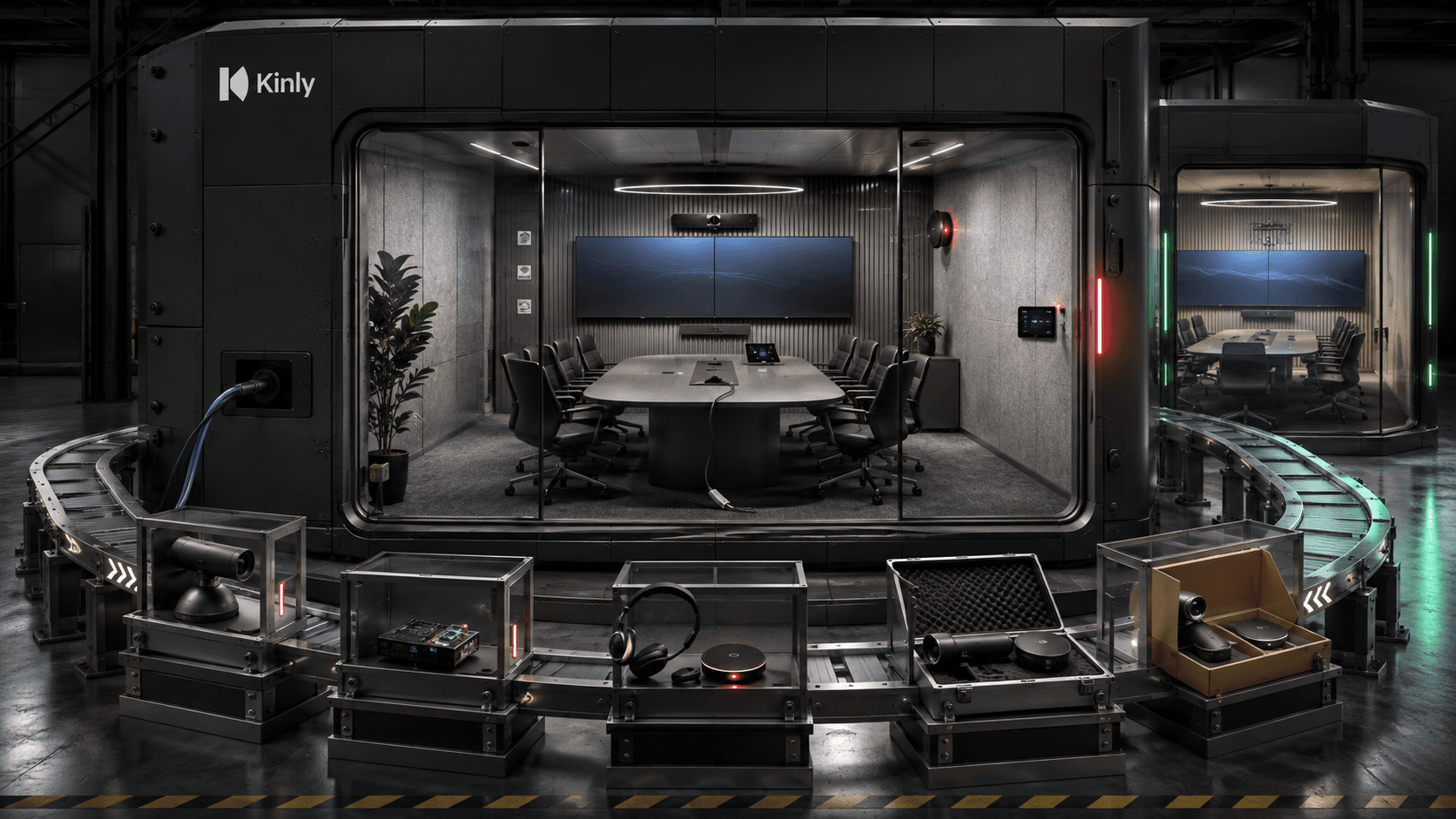
AVI-SPL’s core offer for multinational buyers is a controlled AV/UCC rollout that moves from reference design and local site delivery into 24/7 support. DWX sets the planning priorities, Symphony supplies monitoring, and Enterprise Managed Services runs the estate after go-live. Buyers still need written answers on country coverage, acceptance, data access, and customer-owned delays.
The easiest part of a global meeting-room rollout is the room everyone sees on launch day. The camera joins the call, the display wakes up, and the executive sponsor gets a clean demonstration. Six months later, the harder questions start. Who owns a failed device in Zurich? Did the replacement in Sydney follow the approved design? Does the support desk know what was handed over in Costa Rica?
AVI-SPL sells its AV integration and deployment model into that gap. The company’s main proposition isn’t a particular screen, camera, or collaboration platform. It’s the program around those products: global standards, local installation, Microsoft Teams, Zoom, or Cisco Webex configuration, acceptance testing, and a support model that carries the decisions made during deployment into day-two operations.
That proposition became easier to inspect in 2026. AVI-SPL introduced its Digital Workplace Experience (DWX) Framework on June 16, expanded its footprint beyond 85 operating locations on June 17, and broadened Enterprise Managed Services on June 19.
The promise is one AV and collaboration environment, even when the estate crosses hundreds of rooms and several countries.
TL;DR: What Should Buyers Expect From an AVI-SPL Deployment?
- The core product is the operating model: AVI-SPL combines global AV/UCC deployment with Enterprise Managed Services. DWX is the planning layer, and Symphony is the monitoring software.
- The strongest public proof covers scale: an AVI-SPL case study describes more than 400 rooms across 30 offices in 18 countries, with a three-day planning workshop and a two-to-three-month Teams transition.
- The biggest risk sits between teams: construction, network, identity, licensing, procurement, security, and local access can delay a rollout even when the room design is finished.
- The contract needs to name the Symphony tier, every supported country, acceptance tests, data-export rights, customer-owned dependencies, and the evidence required before managed services accepts the estate.
What Are You Buying From AVI-SPL, and Where Does the DWX Framework Fit?
Buyers aren’t purchasing AVI-SPL’s proprietary room stack. They’re buying a global delivery and operations program built around platforms such as Microsoft Teams, Zoom, Cisco Webex, Neat, Logitech, Biamp, and Sony. AVI-SPL stands out through project control, local delivery coverage, Symphony monitoring, and the handoff into managed services.
The product names can blur together in a proposal, so the first job is separating them. DWX doesn’t replace deployment. Symphony doesn’t replace the service desk. Enterprise Mission Critical isn’t a premium meeting-room support package. Each has a narrower job.
| AVI-SPL element |
What it does |
What buyers should verify |
| Global AV/UCC deployment |
Sets reference designs, coordinates procurement and installation, configures the UCC platform, and manages rollout waves across countries. |
Which entity contracts, buys, installs, accepts, and supports each named site. |
| DWX Framework |
Connects workplace design, AV, UC, building technology, security, data, AI, and support decisions to business and employee needs. |
Which measurable decisions DWX changes before equipment is ordered. |
| Enterprise Managed Services |
Runs monitoring, incident handling, cloud and voice administration, preventive maintenance, reporting, and lifecycle planning after go-live. |
The exact service scope, SLA, country coverage, exclusions, and escalation path. |
| Symphony |
Provides AV/UCC monitoring, asset visibility, analytics, workflows, integrations, and API access according to the selected tier. |
The licensed tier, paid integrations, data ownership, and export rights at contract exit. |
| Enterprise Mission Critical |
Designs fusion centers, control rooms, and Global Security Operations Centers through AVI-SPL’s XTG division. |
Whether the project actually involves a mission-critical operating environment. Most meeting-room buyers do not need it. |
AVI-SPL introduced the DWX Framework on June 16, 2026. SVP John Bailey said it connects workplace technology spending with the outcomes executives value most. That’s a useful pitch, but it isn’t a deliverable. Buyers should ask whether the engagement ends with a utilization baseline, a room-standard decision, or a measurable support change.
Key Takeaways
- The core offer is deployment plus operations. Hardware brands remain replaceable parts of the design.
- DWX should produce decisions and measures before purchase, not another discovery presentation.
How Does AVI-SPL Standardize A Global AV/UCC Deployment?
AVI-SPL sets a global reference design and project-control model, then uses regional teams to handle local buildings, procurement, regulation, language, and site access. The buyer keeps one central program view, but consistency depends on the exception process. A room that looks standard can still behave differently because of network, tenant, calling, or local equipment choices.
The company expanded into Costa Rica, Australia, and Switzerland in June 2026, taking its operating footprint beyond 85 locations. That gives the global claim more substance, but an office pin on a map doesn’t prove service coverage. The proposal should identify the legal entity and delivery route for every country in scope.
There’s a market reason to care about that control. JLL’s 2026 occupancy benchmark covered 84 organizations and 716 million square feet. Global office utilization reached 56% against a 74% target, while 45% of respondents named system compatibility as a barrier to AI adoption in occupancy planning. Room and space data only help when sites measure the same things in the same way
AVI-SPL’s strongest public deployment case comes from a vendor-produced study of an unnamed global technology security company. The rollout reached more than 400 rooms in 30 offices across 18 countries and five continents. It included a three-day Teams Rooms workshop, a seven-room conversion phase, and a Microsoft Teams transition completed over two to three months.
The International Development Research Center offers a named comparison. The Canadian federal research funder used AVI-SPL to introduce Microsoft Places and Teams panels across roughly 70 rooms in six buildings spanning six countries. Both cases show that the tough work starts well before installation, with accounts, policies, administration, training, monitoring, procurement, regional logistics, and office architecture all needing attention.
Key Takeaways
- Global standardization needs an exception register, not a promise that every room will be identical.
- The strongest public case shows the scale AVI-SPL can coordinate, but buyers still need named references with comparable countries and platforms.
Should enterprises standardize or diversify collaboration systems? Find out here.
What Happens Between Design Approval And Go-Live?
The deployment moves through governance, discovery, reference design, a representative pilot, rollout waves, measurable acceptance, and a formal service handoff. Each stage needs a buyer owner as well as an AVI-SPL owner. A project can be physically complete while Teams, Zoom, Webex, identity, calling, security, monitoring, or support routing remains unfinished.
| Stage |
AVI-SPL work |
Buyer resources |
Common blocker |
Proof before moving on |
| Contract and governance |
Confirms scope, countries, commercial route, governance, escalation, and reporting. |
Executive sponsor, procurement, legal, global program lead. |
Different regional contracts or unclear accountability. |
Signed responsibility matrix and country-by-country delivery plan. |
| Discovery and standards |
Audits rooms, networks, platform requirements, infrastructure, and local exceptions. |
AV/IT, facilities, network, identity, security, platform administrators. |
Site conditions or customer prerequisites discovered after ordering. |
Approved reference design, dependency log, and exception register. |
| Pilot |
Builds and tests representative room types and the operating process. |
Local site owner, service desk, business users, security and network teams. |
Pilot rooms are too simple and fail to expose harder sites. |
Signed pilot report covering room, platform, monitoring, support, and failure tests. |
| Rollout waves |
Procures, stages, installs, configures, documents, and manages change control. |
Regional procurement, local facilities, site contacts, platform administrators. |
Construction delay, customs, stock substitution, access restrictions, licensing. |
Wave completion pack with approved substitutions, defects, and remaining actions. |
| Acceptance |
Tests calls, audio, cameras, sharing, controls, interoperability, monitoring, ticketing, and recovery. |
IT, service desk, security, business sign-off owners. |
A successful demonstration is treated as full acceptance. |
Measurable acceptance record and defect threshold. |
| Managed-services handoff |
Loads assets and configurations, confirms alerts, routing, access, escalation, and reporting. |
Service owner, help desk, vendor management, security, and data owners. |
Support receives incomplete records or unenrolled devices. |
Formal service acceptance with a complete asset and configuration baseline. |
AVI-SPL added Microsoft Places Configuration Services and made its Real-Time Design approach available for FastTrack solutions on April 16, 2026. Those additions could catch room-design and workplace-data problems before installation. AVI-SPL hasn’t published a standard time-saving, though, so buyers should ask which room types qualify for FastTrack, what the design review produces, and whether Places configuration is separately priced.
The customer also has work to do. Network readiness, identity, resource accounts, platform licenses, calling, firewall rules, construction, room power, and local approvals need dates and named owners. When those dependencies sit outside the project schedule, every delay starts to look like the integrator’s fault or the customer’s fault. The contract should make the boundary visible.
Key Takeaways
- Installation and UCC enablement need separate owners, dates, and acceptance tests.
- A representative pilot should test the design and the handoff process before the same defect reaches another rollout wave.
What Changes After Go-Live Under Enterprise Managed Services?
Once the project goes live, Enterprise Managed Services takes over monitoring, incident handling, cloud and voice administration, reporting, maintenance, and lifecycle planning. AVI-SPL broadened that service in June 2026 so one model could cover rooms, collaboration tools, voice, signage, devices, users, and supporting infrastructure.
Symphony provides the operating layer. Standard covers core AV/UCC monitoring and asset visibility. Premium adds ITSM and manufacturer-platform connections. Professional adds APIs, AI functions, workflows, and configurable analytics. Buyers should ask what is covered, which integrations cost extra, and whether data and asset records remain exportable at contract exit.
AVI-SPL also reported lower Office 365 Integration and Infrastructure Management pricing in April 2026, plus tiered Cloud Administration pricing, but published no figures. Proposals should show the unit basis, volume thresholds, and integration charges.
The service case gained more support in 2026. AVI-SPL received SOC 2 Type II attestation for the company and Symphony in February, then became a global Authorized Logitech Service Partner in July. Neither replaces contract detail. Buyers still need answers on hosting, privileged access, spares, dispatch, restoration targets, subcontractors, and deletion.
Geographic coverage needs checking. AVI-SPL materials cite more than 60 countries in one place and more than 80 in another. The statement of work should name covered countries, support hours, response targets, travel charges, and the local delivery model.
AI is still a supporting act. AVI-SPL’s February 2026 work with Sol Rashidi suggests a sharper focus on governance, but public proof of quicker triage, stronger alerts, or predictive maintenance remains scarce. Buyers should ask for a live example and one documented result, such as response time, ticket reduction, or alert accuracy, before giving AI much weight.
Key Takeaways
- Name the Symphony tier, integrations, data rights, and service boundaries.
- Treat certifications as assurance, not performance proof.
- Keep AI out of the core case until AVI-SPL can show measured results.
What Should Buyers Put in the Contract Before Signing?
The contract should turn AVI-SPL’s global-service pitch into specific obligations for each country and project stage. Buyers need named owners, measurable acceptance criteria, customer dependencies, substitution rules, handoff requirements, data rights, and references from projects with a similar room count, platform mix, geography, and construction risk.
| Issue |
Question to ask |
Evidence to request |
| Country coverage |
Who contracts, procures, installs, accepts, dispatches, and supports each country? |
Legal entities, partners, service hours, response targets, and travel charges. |
| Reference design |
What is fixed, and who approves local exceptions? |
Design pack, exception register, and decision rights. |
| Dependencies |
Which network, identity, licensing, construction, security, and access tasks belong to us? |
Owner, due date, impact, and escalation route for each dependency. |
| Substitutions |
What happens when approved equipment is unavailable? |
Pre-approved alternatives and cost, technical, and schedule approval rules. |
| Pilot and acceptance |
Which room types and failure conditions will be tested? |
Acceptance script covering room performance, UCC setup, monitoring, routing, and recovery. |
| Handoff |
What must be complete before managed services accepts a room or site? |
Asset records, final configuration, alert enrollment, known defects, and support documents. |
| Symphony and data |
Which tier and integrations are included, and can we export our data? |
Licenses, API rights, export format, retention policy, and deletion certificate. |
| SLA and reporting |
What is measured: uptime, meeting quality, response, restoration, or all four? |
Definitions, exclusions, sample reports, service credits, and escalation thresholds. |
| Security |
Where is data stored, and who can access the environment? |
SOC 2 reports, architecture, access controls, logging, retention, and incident process. |
| References |
Who has completed a comparable multinational rollout? |
Two named customers with similar countries, platforms, room counts, and constraints. |
Key Takeaways
- Buyers need the contract to state exactly what AVI-SPL owns and where that ownership ends.
- A reference that includes delays and blockers is more useful than a polished case study with no dates.
Does the AVI-SPL Model Hold Together After Go-Live?
AVI-SPL belongs on the shortlist when the estate crosses countries, room types, hardware brands, and collaboration platforms, and the buyer wants one program to cover deployment and day-two support. Its 2026 announcements make that offer easier to understand. The public evidence is strongest on scale and breadth, not independently verified service outcomes.
A single office with a standard room pattern may not use enough of AVI-SPL’s global machinery to justify the complexity. A multinational buyer has a better case, provided the proposal names the people, countries, tests, tools, and data rights behind the pitch.
The most revealing reference question isn’t whether the rooms worked on launch day. It’s what broke later, who noticed first, and how the handoff held up.
FAQs
How long does a typical AVI-SPL deployment take?
AVI-SPL doesn’t publish one standard timeline because the answer changes with room count, construction readiness, regional procurement, network and tenant work, and the amount of variation allowed. Ask for a comparable rollout broken into discovery, pilot, rollout waves, acceptance, and handoff, including the customer-owned dependencies that caused delay.
Does AVI-SPL only work with large global enterprises?
AVI-SPL can serve smaller customers, although its biggest advantage appears when rooms and collaboration platforms are spread across countries. The company now has more than 85 operating locations and provides round-the-clock remote support backed by onsite coverage in over 60 countries. For a single office, some of that reach may never be used. A local integrator could offer a simpler fit.
What's the difference between standard Managed Services and Enterprise Mission Critical?
Enterprise Managed Services runs everyday AV, UC, voice, cloud, room, and signage environments through monitoring, administration, incident management, and lifecycle support. Enterprise Mission Critical is a separate XTG practice for fusion centers, control rooms, and GSOCs where cyber, physical, and operational information must reach decision-makers inside a purpose-built environment.
How mature is AVI-SPL's AI strategy, versus just an advisory hire?
The February 2026 appointment of Sol Rashidi gives AVI-SPL a defined program for AI governance and investment priorities. What’s missing publicly is a clear record of operational results. Buyers should ask for an example where AI changed a live rollout, improved monitoring, shortened an incident, or produced a better support outcome. An executive adviser alone doesn’t prove that the work has reached the service desk.
Can AVI-SPL manage a mixed environment of Teams, Zoom, and Webex?
Yes. AVI-SPL now presents Teams, Zoom, and Webex management as part of the same enterprise service, even when the customer also has mixed room hardware and collaboration endpoints. That doesn’t make every platform identical to support. The buyer should pin down access requirements, license ownership, specialist coverage, monitoring depth, and the SLA attached to each environment.