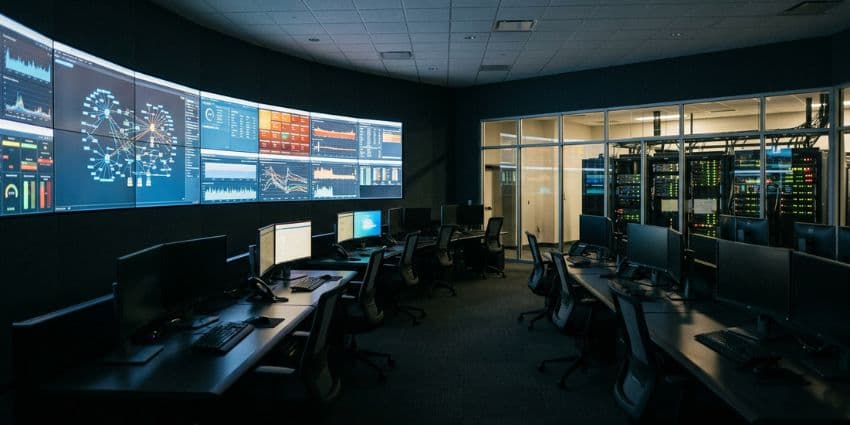
Picture the NOC at 11pm on a Tuesday. Three engineers are staring at dashboards. The monitoring platform has fired 1,400 alerts in the last hour. Somewhere in that noise is the signal that matters, and the odds of finding it are not good.
According to the 2026 State of Production Reliability and AI Adoption Report by NeuBird AI, 77% of on-call teams receive at least ten alerts per day, yet 57% report that fewer than 30% are actionable. Research from incident.io puts weekly volume at over 2,000 alerts per team, with only 3% requiring immediate action. The cost of that noise is concrete: 44% of organisations experienced an outage in the past year directly linked to a suppressed or ignored alert, and 78% experienced at least one incident where no alert fired at all.
The instinct is to blame the engineers. The problem is the tooling. The modern enterprise network is now a complicated web of cloud platforms, edge devices, branch offices, home internet connections, and on-premises systems. Traditional NOCs, built around dashboards, manual correlation, and static rules, were never designed for it. AIOps is the bet that machine learning can do what those tools cannot.
Why Static Thresholds Are Failing Hybrid Network Teams
The logic of legacy monitoring is simple: set a threshold, fire an alert when it's crossed. Packet loss above 5%? Alert. Latency above 200ms? Alert. It worked when networks were flat and relatively predictable. In a hybrid environment spanning SD-WAN, cloud gateways, SaaS applications, and remote endpoints, it creates an alert avalanche that bears no useful relationship to what is actually wrong.
Up to 60% of alerts can be classified as false positives, according to analysis from Tata Communications. The deeper problem is architectural: static thresholds fire at fixed values regardless of context. A spike in jitter at 2am on a Sunday is a different problem from the same spike during an all-hands call. Legacy tools treat them identically. Dynamic thresholds learn normal behaviour over time and only alert when deviations are meaningful, which is a fundamentally different way of defining what an incident is.
Joe Vaccaro, VP of Product Management for Networking at Cisco, described the result for most enterprise IT teams in February 2026:
"This is what we hear your modern IT operations look like: complex disparate systems, multiple teams, and multiple tools with escalating problems and tickets."
The answer AIOps vendors offer is a single observability plane. Platforms ingest telemetry across every layer of a hybrid environment, on-premises hardware, AWS, Azure, GCP, SD-WAN, and correlate it in one place. A latency spike on a SaaS application caused by a routing issue in the SD-WAN layer and a concurrent constraint on an Azure VPN gateway no longer generates separate alerts in three different tools. It surfaces as a single incident, with context.
How AIOps Spots Network Degradation Before Users Notice
Correlation solves the noise problem. Prediction solves something harder: catching the early signatures of an outage before it becomes one. Subtle jitter increases. Gradual packet reorder rates. A CRC error count climbing slowly on a single interface. None of these individually trips a traditional threshold. Together, they are often the first sign that something is about to fail.
This matters acutely for voice and video quality. A 10ms increase in jitter that would never register as an alert can still degrade a call to the point where users drop off or stop joining. By the time a threshold fires, the damage to quality of experience is already done, and in a hybrid work environment, that damage lands directly on productivity and on IT's credibility with the business.
Vaccaro says:
"AgenticOps starts with cross-domain telemetry — networking, cloud, internet, and security — distilled into operational intelligence. Agentic capabilities draw from signal, not noise."
Neil Kulkarni, Senior Director of Product Management for Wireless at Cisco, says:
"AgenticOps creates AI-powered workflows that predict issues before they impact users, recommend optimal configurations based on real-world data, and execute routine tasks autonomously. The result? Network teams shift from constant troubleshooting to strategic innovation while users experience always-on connectivity that simply works."
Juniper takes a similar approach through its Mist AI platform, now integrated with HPE's Aruba portfolio following HPE's $13.4bn acquisition of Juniper Networks. The platform includes a Large Experience Model with Marvis Minis: digital twins that simulate user-to-cloud sessions to predict performance issues before they occur. Before Mist AI, IT teams operated in a loop of reactive troubleshooting. Problems surfaced through user complaints, and root cause analysis relied on guesswork. After deployment, live telemetry replaces that guesswork with structured, predictive responses.