JPL Telecom's journey into webcams has quite an interesting story behind it. While many other endpoint manufacturers jumped on the webcam bandwagon following the onset of the pandemic, for JPL, the recent turn of events has simply fitted into the company's existing roadmap.
"In 2018, we started noticing that webcams were the way forward," shares Jonathan Nuttall, UK Sales Manager at JPL Telecom.
"We started working on our very first webcam a good 12 months prior to COVID, and the R&D process was about 80% done by the time it had hit. So, it was quite an easy choice for us to speed it up and go to market with the camera sooner than planned."
Vision Plus: The Beginning
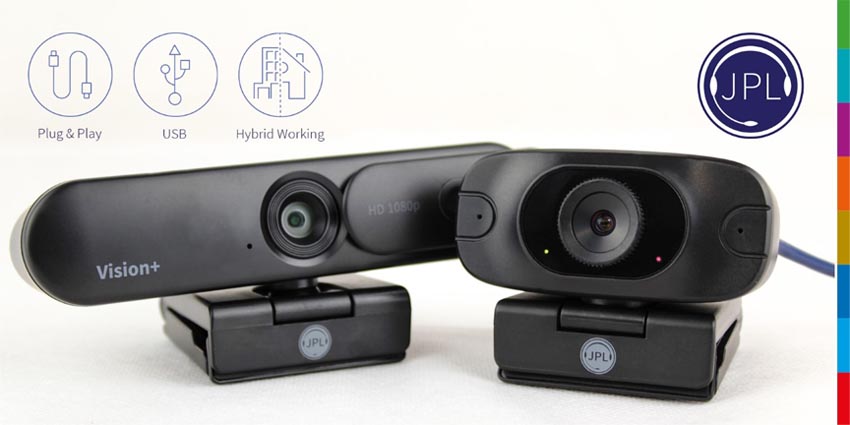
JPL's first webcam, the one they went to market with only four months into Covid, was the Vision Plus: a £100 Plug and Play camera with an extra-wide viewing angle, two built-in dual stereo microphones, a noise suppression mechanism and a few other perks.
"Originally we were going to release it with a 75° viewing angle lens, but we realized that the new reality required something slightly different," Nuttall shares.
"We made a few rapid changes and eventually released it with a different lens that had a 96° viewing angle, to cover the two-meter social distancing rule. It was the widest angle we could have with an undistorted view at that time."
Two years into Covid, the Vision Plus continues to enable safe video conferencing experiences in offices and huddle rooms around the world. However, realizing the growing diversity of use cases, JPL decided that a single webcam model wasn't enough.
Vision Mini: The Evolution
In December 2020, the Vision Mini came along. The new webcam had all the same key features as the Vision Plus, with a few tweaks born out of close attention to end-user feedback.
"The Vision Plus was great for enterprises, but we saw that there were many people at home needing webcams, and £100 was a bit too expensive for them. With the Mini, we scaled it down to £50," Nuttall says.
Another adjustment made in the Vision Mini was narrowing down the viewing angle.
"It was a bit before blurred backgrounds became a thing, so the way to avoid unnecessary items in the background was by narrowing the field of view," he explains.
"Keeping the camera Plug and Play was important to us, which meant we couldn't have people using software to narrow it down, so we decided to bring out the Mini with a 67° viewing angle."