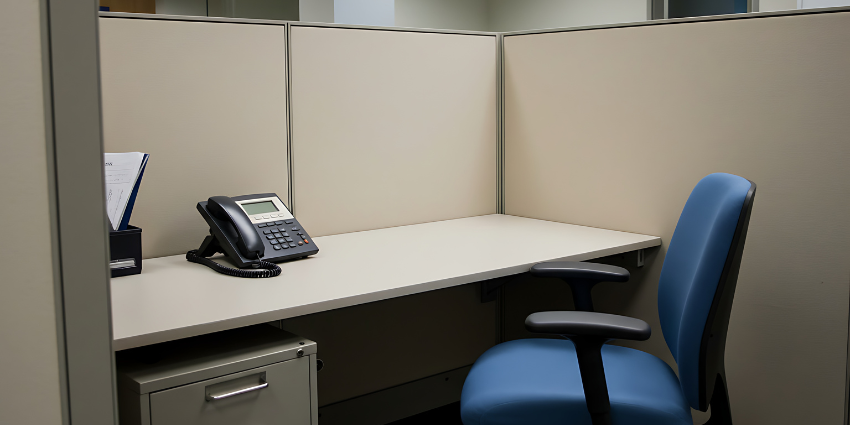
Every April 28th, National Cubicle Day marks one of the modern era's most quietly influential inventions — the office cubicle. What began as a bold reimagining of work has become a symbol of office evolution. It still shapes conversations around employee productivity today.
Read More:
- Are Your Offices Underused? What Workplace Data Reveals Now
- The Workplace Management Gap Is Widening – Here Are 5 Stats That Prove It
- Roundtable: AI Meeting Rooms, Hybrid Work, and the Future of Collaboration
The Man Behind the Partition
The cubicle's origin story is one of ambition meeting commercial reality. In the 1960s, Robert Propst was director of research at furniture manufacturer Herman Miller. He looked at the standard office landscape and saw a system working against its own people. Row upon row of identical desks. Private rooms reserved only for managers. According to The Wall Street Journal, Propst wanted something far more dynamic - a workspace that could flex around the demands of a working day.
His first attempt was the Action Office, launched in 1964 alongside industrial designer George Nelson. But Propst went back to the drawing board. The Action Office II launched in 1968. It was colorful, modular, and built from affordable plastics and laminates. It could be reconfigured in countless ways. Workers would stand, spread out materials, pin documents to walls, and adapt their space as needed. Propst genuinely believed this flexibility would drive stronger employee productivity.
As The Wall Street Journal reports, the companies that adopted his design had different priorities. Real estate prices were climbing. Businesses discovered the modular system could divide floors into compact, stackable workstations. More employees. Less space. The cubicle farm was born. The irony was sharp: an invention designed to liberate workers became the symbol of corporate conformity.
Office Evolution: From Cubicle Farms to Hybrid Ecosystems
National Cubicle Day isn't just a quirky design anniversary. It's a prompt to examine how far office evolution has come - and how far it still needs to go.
After the cubicle's mass adoption, workplaces cycled through open-plan floors, hot-desking, and agile zones. Each shift reflected new assumptions about employee productivity. Open offices promised collaboration. Many delivered noise instead. Hot-desking promised flexibility. Without the right data, it created friction.
Hybrid work has pushed office evolution into its most complex chapter yet. Research shows global average building utilization has reached 53% - the highest since before 2020. Workers are returning. But their expectations have shifted. They no longer want a place to simply sit. They want an environment that supports how they actually work.
Workplace management solutions are how enterprises are responding. Modern approaches now span space optimization, workforce analytics, employee experience platforms, and productivity tools. The focus has moved from managing desks to managing outcomes. Real-world results reflect this, as per UC Today's reporting on real-life use cases of this technology. For example, some organizations have prevented millions in unnecessary renovation spend through occupancy analytics. Others have increased productive working hours by over 20% through smarter scheduling.
The core insight is simple. Employee productivity isn't about how long someone occupies a workstation. It's about removing friction. Unreliable meeting rooms, misaligned space, and poor utilization data are the productivity killers of the hybrid era. They require systemic solutions - not furniture decisions.