I wake up before I’m ready to be awake.
Not because I chose to. Because the vibration on my wrist decides I’ve had enough sleep. It’s not an alarm anymore — it’s a verdict. A soft, steady pulse that doesn’t stop until my hand moves, until my eyes open, until the system gets what it came for.
It’s not an alarm anymore — it’s a verdict.
“Good morning, Rob,” my alarm agent says, close and calm, like it’s standing at the side of the bed.
The ceiling lights don’t turn on. They fade in, gently, like I’m being introduced to the day rather than thrown into it. The air feels warmer too — a few degrees more comfortable than it should be at this hour.
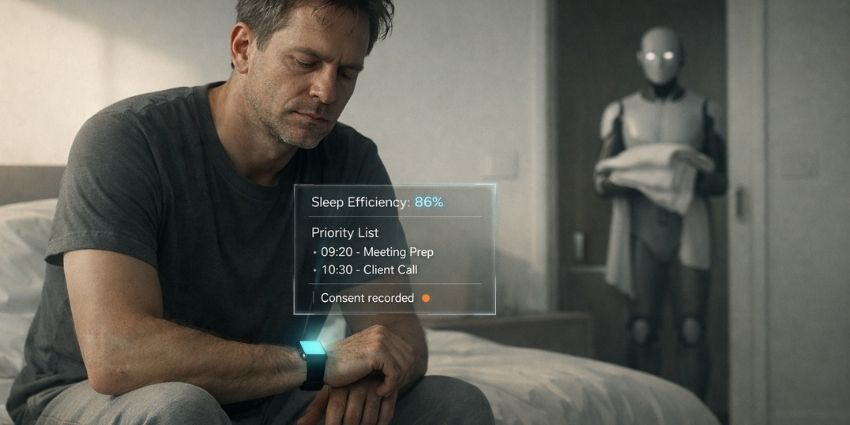
A translucent panel appears above the bedside table. Not on a screen. In the air. A clean, floating list that follows my gaze as if it’s attached to my attention.
Sleep: 6h 41m (efficiency: 86%) Recovery: Moderate Mood forecast: Stable Friction risk: Low
I stare at the last one.
Friction risk.
A number for how likely I am to be difficult.
Friction risk. A number for how likely I am to be difficult.
“Your first priority is scheduled at 09:20,” the agent continues. “I’ve already adjusted the start time by nine minutes — the other assistant requested it. No conflicts detected.”
I sit up, feeling the familiar pressure behind my eyes — that half-second when you’re trying to remember what day it is, who you are, and what you promised to do.
“Would you like the kettle boiled?” it asks.
I don’t answer. I breathe, I blink, I hesitate — and that’s enough.
“Kettle is on. Standard mug. Oat milk. Coffee strength reduced by twelve percent based on sleep efficiency.”
Somewhere downstairs, I hear the soft click of something turning on, then the quiet rush of water. The house moves like it has a nervous system now. Like it’s been awake for hours, waiting for me to catch up.
I swing my legs out of bed. The floor is warm under my feet. It always is. It’s such a small detail, but it’s the kind of detail that makes you stop noticing details at all.
A second panel appears in the air.
Breakfast options (optimised):
- Eggs (expiry in 2 days)
- Greek yoghurt (expiry in 4 days)
- Strawberries (consume today)
- Granola (opened 12 days ago; quality declining)
It’s not telling me what I can eat.
It’s telling me what the system would prefer I don’t waste.
I head to the bathroom, and the shower starts before my hand reaches the dial. Steam rises in a controlled sheet, temperature locked in at the exact setting I always end up choosing anyway. The whole routine feels like the house is trying to be helpful — but helpful in a way that doesn’t leave room for debate.
Halfway through washing my hair, the agent speaks again.
“I’ve queued your morning news digest for breakfast. Your two favourite sources have breaking updates in your priority topics. You’ve been mentioned in one post.”
“By who?” I ask, then realise how automatically I’ve started speaking out loud to an invisible system, like it’s a person in the room.
“LinkedIn. A contact you engage with frequently. Sentiment positive.”
That makes me smile, briefly, before I remember how strange it is that even my micro-dopamine hits come with metadata.
I step out of the shower.
And the day becomes physical.
A humanoid robot stands there holding a towel.
It’s not dramatic. It’s not threatening. It’s… professional. Smooth faceplate. Soft-lit eyes. Neutral posture. Like a hotel concierge trained to appear exactly when needed and vanish when not.
It holds the towel open like it’s welcoming a child out of a swimming pool.
“Good morning,” it says, and the voice is the same voice as my agent, but now it has a body. A shape. A presence.
The agent is no longer ambient. It’s standing in front of me.
I pause, dripping on the mat, suddenly aware of my own awkwardness — the human kind. The kind that doesn’t fit neatly into a system designed to remove uncertainty.
The robot adjusts its stance slightly, calculating the towel angle so I don’t fumble. It places it around my shoulders with a precision that feels… intimate without being affectionate.
“Your preferred Monday workwear is prepared,” it says.
A wardrobe panel glows softly. Another holographic overlay flickers into view beside it with a neat list and confidence bars, as if my clothes are now predictions.
- Navy overshirt (92% match)
- White tee (89% match)
- Black trousers (87% match)
- Trainers (81% match; weather adjustment applied)
It’s not asking what I want to wear.
It’s telling me what I’ll choose — and it’s annoyingly accurate.
The robot selects the overshirt and lays it out. There’s a moment where I think about picking something else out of pure stubbornness, just to prove I can.
But I don’t.
It doesn’t force you. It makes resistance feel unnecessary.
As I brush my teeth, the robot lifts a hand and a faint, cool line of light sweeps across my face and neck.
“Health scan running,” it says casually. “Hydration low. Minor inflammation markers elevated. No urgent flags.”
No urgent flags.
I rinse my mouth and stare at my reflection. For a split second I imagine a different version of this morning — one where I’m still in control, one where my body isn’t being silently monitored like a machine with maintenance requirements.
The robot adjusts my collar when I pull on the overshirt. A tiny tug, a smoothing motion. The kind of micro-correction you’d only get from someone who loves you — or someone who’s been instructed to perfect you.
“Children’s wake-up sequence initiated,” it says.
“I didn’t ask—” I start.
“You typically request wake-up at 07:22 on Mondays. Today requires 07:18. I’ve started gently.”
It asks. But only after it’s already done it.
It steps back slightly as if giving me space, but the space feels staged.