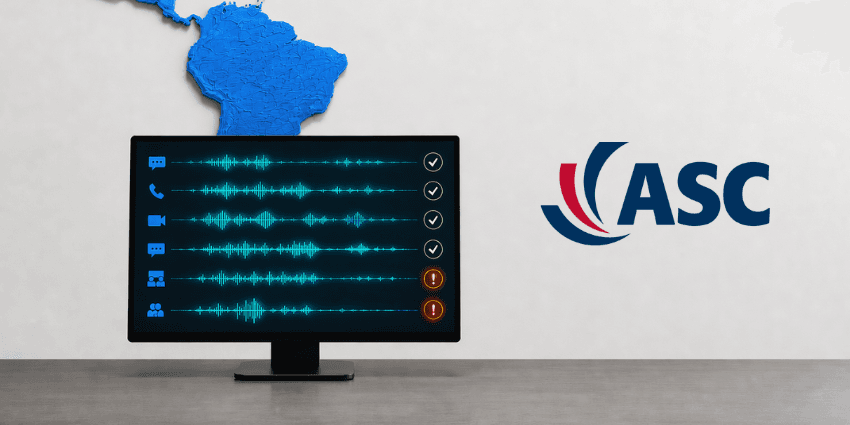
ASC Technologies has expanded its certified compliance recording and AI data analytics solution for Webex Calling to the United States, South America and Central America, with additional regions planned.
The new availability gives regulated organizations a route to record Webex Calling communications while using regional instances and geo-separated data storage.
That will matter to multinational businesses in sectors such as financial services and healthcare, where compliance, retention and data-residency requirements are often shaped by local rules as well as global policy.
Dr. Gerald Kromer, CEO of ASC Technologies, said:
"With the launch in the US and South and Central America, we are laying the foundation for a globally uniform compliance strategy for international companies.”
At a Glance
- ASC’s certified Webex Calling compliance recording and AI analytics solution is now available in the US, South America and Central America.
- The rollout is built around regional recording and geo-separated data storage, with further expansion planned.
- ASC sees AI as a way to help compliance professionals prioritize potentially higher-risk interactions, rather than replace their judgement.
For ASC, however, the significance of the announcement is not simply that another regional instance is available. It is the opportunity to apply a more modern model of compliance review to the communications platforms employees already use.
Why Is Compliance Recording Becoming an AI Review Challenge?
Recording customer communications has long been a requirement in regulated industries. But the communications that need oversight no longer sit neatly in one channel. Customer interactions can take place through calling, chat, video and other collaboration tools, creating a far larger body of information for compliance teams to retain and assess.
Kromer described that change in an recent podcast interview:
“Compliance, it’s no longer just about voice recording. Customer communication… is no longer just voice over the phone today. It’s via video. It’s via chat. It’s via email. And all of this communication needs to be documented for the purpose of investor protection.”
The challenge is not only capture. It is review. Manual teams can assess only a limited proportion of a growing communications estate, particularly when a business operates across regions, languages and customer-facing teams.
Kromer said manual review may cover only “3–4%” of conversations in some environments, while AI can analyze a much broader population and help reviewers identify interactions that warrant closer attention.
“The AI tells you which conversations are suspicious. And then let your colleagues… focus on those conversations.”
The distinction matters. AI-assisted review does not remove the need for human compliance expertise. It can help teams search, prioritize and investigate at a scale that random sampling alone cannot support, while people remain responsible for interpreting context and reaching a final judgement.
What Does ASC Bring to the Compliance Workflow?
For UC leaders, the compliance challenge is rarely just recording a call. It is keeping track of communications as they move across collaboration platforms, meeting regulatory obligations, and giving compliance teams a practical way to find the conversations that need review.
ASC’s Recording Insights is designed around that full workflow. Across platforms including Microsoft Teams, Zoom, RingCentral, and Genesys, ASC positions the platform as a way to capture communications, store them securely, and make the resulting data easier to search and assess.
From Conversation to Compliance Review
A modern UC compliance workflow is not one task. It is a connected process that takes a communication from initial capture through to informed human review.
Compliance Stage
What It Means for UC Teams
1
Capture
Record relevant customer and employee communications across the organization’s approved collaboration environment.
2
Retain
Store communications securely for the required retention period, supported by encrypted exchange, tamper-proof archiving, and multi-regional Azure storage.
3
Find
Give authorized teams a way to search, retrieve, and play back interactions relevant to an audit, investigation, or customer query.
4
Analyze
Use AI-supported functions, including transcription, translation, summaries, and sentiment analysis, to make a growing communications archive easier to assess.
5
Investigate
Route potentially relevant interactions to compliance professionals, who can apply policy knowledge and human judgment to the final review.
Why This Matters for UC Teams
The practical value is not autonomous compliance decision-making. It is reducing the distance between a recorded interaction and an informed human review.
As UC estates become more complex, that can mean broader review coverage, quicker access to relevant communications, and less time spent manually searching through recordings. The result is a compliance model designed to support modern collaboration, rather than sit separately from it.
Before deploying, buyers should confirm the exact capabilities available for their region and configuration — especially recording scope, retention, search, analytics, investigation workflows, and data residency.
AI Makes the Communications Record More Important
As AI becomes part of customer service, sales, and internal collaboration, the governance challenge is not limited to a single prompt or output. A conversation can evolve over time, draw on meeting transcripts or summaries, and produce new content that may be shared elsewhere in the business.
That makes a reliable communications record more important for UC and compliance teams. In UC Today’s roundtable on behavioral risks in the age of AI, Irwin Lazar, President and Principal Analyst at Metrigy, said traditional governance tools were built for a different communications environment.
“Traditional systems ... were designed for file management, for tracking email, for tracking IM. The world has changed in terms of the amount of content that’s being generated [and] the way that people are interacting with one another.”
Lazar also highlighted the growing importance of records that can be reviewed after the fact, particularly as AI systems begin to interact with other systems and take on more actions.
“How do you secure those conversations? How do you log them, make them auditable and so on? I think [that] is a real blind spot for many organizations today.”
Organizations need to know what was said, what information was used, how a conversation developed, and whether a sensitive interaction can be retrieved for review.
That is where the full compliance workflow matters: capture relevant communications, retain them securely, make them searchable, apply appropriate analysis, and route higher-risk interactions to qualified people for investigation.
A Buyer Checklist for Adding Compliance to a UC Stack
Choosing a compliance solution is not just about whether it can record a call. The right questions span deployment, policy, data, security and day-to-day operations. That applies whether an organization is assessing ASC or any other provider.
- Channel coverage: Which calling, chat, video, screen-sharing and contact-center interactions need to be captured, and which are supported today?
- Regional controls: Where will recordings, metadata, analytics data and backups be stored, processed and accessed?
- Retention and retrieval: Can teams apply appropriate retention policies, legal holds, search and playback processes across the required communications?
- AI governance: What does the system flag, how are alerts reviewed, and where does human decision-making remain mandatory?
- Identity and administration: How does the solution integrate with the organization's UC administration tools and identity environment?
- Migration: Can legacy recordings be moved while preserving the audit trail, retention requirements and access controls that underpin compliance?
The answers will differ by sector and jurisdiction. But this is increasingly the procurement conversation: not merely whether a platform records communications, but whether it helps an organization govern a modern, multi-channel communications environment responsibly.
What ASC’s Regional Rollout Signals
The new availability in the Americas is a practical expansion for Webex Calling customers. It is also part of a wider shift in compliance technology toward cloud-native, region-aware platforms that can combine recording with analysis.
For enterprises, the underlying lesson is straightforward. Cloud collaboration can expand how and where people communicate with customers. Compliance infrastructure needs to evolve alongside it — with clear data controls, reliable capture and a review model that makes human expertise more focused, not less important.
UC Awards 2026
Explore the UC Awards 2026 Categories
Discover the technologies, teams, and innovators being recognized across the unified communications industry — including compliance, governance, AI, customer experience, and collaboration.
Explore All UC Awards 2026 Categories
Read More
Frequently Asked Questions
What has ASC announced for Webex Calling?
ASC has made its certified compliance recording and AI data analytics solution for Webex Calling available in the United States, South America and Central America, with further regions planned.
Why does regional data storage matter for compliance recording?
Regulated organizations often need to meet local requirements for where communications data is stored and managed. Regional instances and geo-separated storage can help support a global compliance model while accounting for local data rules.
How can AI support compliance review?
AI can help teams analyze a larger volume of communications, identify interactions that may need attention, and prioritize human review. Compliance professionals remain responsible for interpreting context and making final decisions.
What should organizations ask when choosing a UC compliance solution?
Organizations should assess recording scope, regional data residency, retention, encryption, access controls, search, analytics, and investigation workflows. They should also confirm the capabilities available for their UC platform, region, and deployment configuration.
Why is a communications record increasingly important in the AI era?
As AI becomes part of customer service, sales, and internal collaboration, organizations need reliable records that can be retained, searched, analyzed, and reviewed. This supports auditability, governance, and informed human investigation when sensitive interactions require attention.