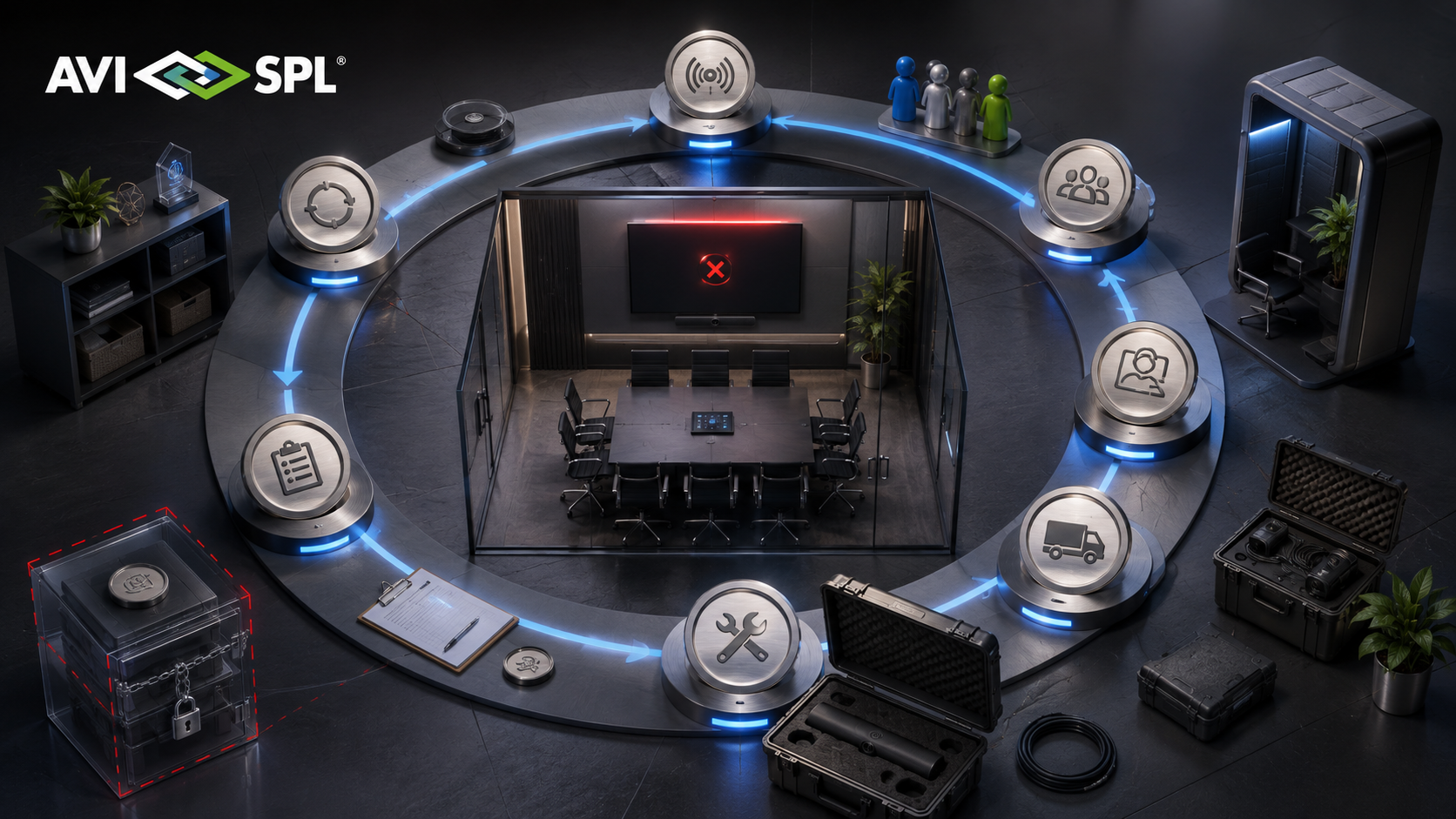
Meeting room device management has become increasingly complex. Previously, IT admins would manually check hardware in a limited number of spaces to ensure everything was updated and secure. Today, devices are spread across an ever-growing number of collaboration environments, across floors, buildings, and global office locations, and are supported by sophisticated, IoT-enabled management solutions that offer expanding features and numerous customizable integration options.
To optimize their infrastructure, IT decision-makers are increasingly focusing on vendor consolidation—centralizing IT products and services through a smaller number of trusted vendors capable to support dynamic collaboration use cases and needs. This approach streamlines operations, reduces costs, and simplifies the complexities inherent in managing a multi-faceted IT environment. Vendor consolidation is not merely a trend but a strategic necessity, facilitating cohesive ecosystems that allow for seamless integration and superior support.
As organizations look to consolidate, they face a choice between leveraging traditional Remote Monitoring and Management (RMM) tools and adopting vendor-specific cloud management solutions. Here we give a detailed comparison and delve into the critical considerations around these two types of tools to help you make informed choices that align with your objectives.
Use Cases & Differentiation
RMM tools have long stood as the cornerstone of IT service management. Offering a unified platform with extensive capabilities, they enable integrators and large organizations to monitor and manage diverse IT and AV infrastructures, networks, and cloud environments. Solutions such as AVI-SPL Symphony, Diversified Pulse, Utelogy U-Manage, N-able RMM, ConnectWise Automate, and Datto RMM provide comprehensive oversight across various brands and device types, ensuring efficient management of all equipment within complex infrastructures.
In contrast, the growing sophistication of vendor-specific management solutions presents an enticing alternative. Leveraging deep integration with IoT-enabled hardware and software, these tools deliver advanced functionalities tailored to a specific vendor's ecosystem. Vendor-specific tools are advantageous and offer an optimized management experience particularly for large educational institutions or corporate environments standardized on equipment from a single or few vendors. Examples of such proprietary tools include ShureCloud, Q-SYS Reflect, AMX RMS, AWS Management Console, Azure Portal and Google Cloud Console.
Integration Capabilities
Vendor-specific tools typically limit integration to devices from the same manufacturer. They excel at offering advanced features and optimizations for those specific devices but lack the ability to integrate seamlessly with hardware from other brands. In the realm of cross-platform integration, however, solutions like ShureCloud are advancing with cloud-to-cloud initiatives, specifically targeting commonly used platforms like ServiceNow for service ticketing when issues are detected, adding a layer of automated support within a specialized Shure ecosystem.
Conversely, RMM tools provide extensive integration capabilities, allowing users to monitor and manage devices from numerous manufacturers. This is advantageous in complex, mixed-brand environments, providing a single pane of glass for managing all devices. However, achieving this unified view often requires extensive, custom programming and setup.
Customization and Flexibility
Vendor-specific tools often shine through their highly specialized features and settings tailored to the manufacturer’s devices, but may offer limited customization options beyond that ecosystem. RMM tools, on the other hand, are designed to offer extensive customization and flexibility, enabling users to adapt to various organizational requirements and operational nuances with custom alerts, reports, and dashboards.
Security Considerations
Security is another critical aspect where these tools differ significantly. Vendor-specific cloud management platforms provide robust security features designed for the devices they manage. However, organizations with strict security policies, like large financial institutions, might prefer RMM tools for their ability to monitor solutions within an internal network, avoiding the exposure of AV devices to the internet. RMM tools can be deployed on-premises or in the cloud, offering flexible security configurations to meet stringent requirements.