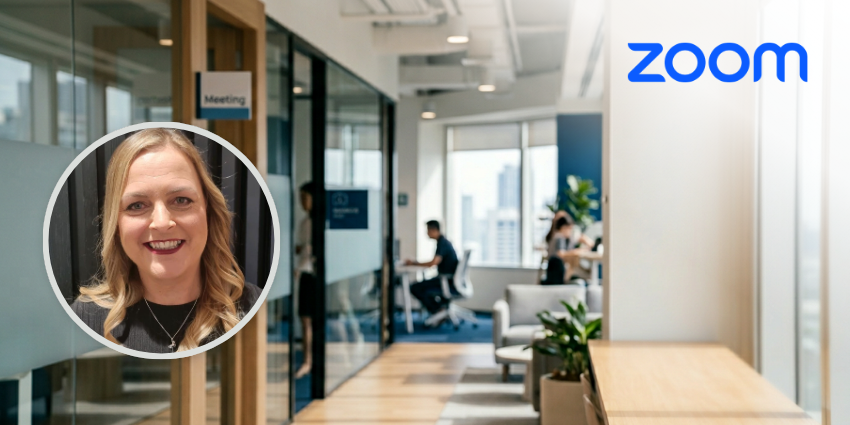
When Louise Newbury-Smith joined Zoom as Head of UKI last May, she came with two decades of industry experience, a track record of building high-performing teams, and a healthy dose of self-awareness. "Taking on a new role is both exciting and scary," she says, echoing the Meg Whitman philosophy she's long admired: that a new job should scare you a little. "Primarily because you want to do the right thing by all the people that have invested their careers here."
What she didn't fully anticipate was just how much Zoom would surprise her.
"I thought I knew Zoom from the outside, from competing with Zoom over a number of years," she admits. "But what really blew my mind was the scope of the platform beyond the traditional chat and phone and video that I was fully expecting."
Read Next: Zoom Launches AI Companion 3.0: The Next Evolution of Agentic AI
Zoom: Moving beyond the meeting room
It's easy to think of Zoom as a meetings company. It's a perception Newbury-Smith is dismantling, one customer conversation at a time. The platform's AI Companion, bundled free with any paid licence, does far more than summarise calls: booking meeting rooms, managing desk reservations, handling visitor check-ins, creating agendas based on past discussions, and converting meeting notes directly into tasks.
"For me, it makes my life easier even from desk booking," she says. "Our visitor management, automatically checking me in, finding meeting rooms for me, creating agendas, turning meeting notes into tasks. The list goes on."
That breadth is increasingly shaping Zoom's go-to-market strategy in the UK. Newbury-Smith's teams are now organised around specific verticals like manufacturing, retail, and logistics: industries that represent the next frontier for the platform.
"Frontline worker solutions are really powerful in scenarios such as large-scale retail, manufacturing, logistics, where you've got people out in the field being able to use the Zoom platform and be truly connected to the rest of their organisation."
The front office and back office, she argues, don't really have hard boundaries anymore. At least not on Zoom.
AI as colleague, not overhead
The conversation around AI in the enterprise can often feel abstract. Newbury-Smith prefers to keep it grounded. When asked whether AI tools like meeting summaries risk becoming a crutch, something people absorb uncritically rather than engage with meaningfully, she reframes the question.
"Are you seeing less mistakes as a result of using an AI tool across your working day? What's the benefit?" she says.
"People have got a great deal of confidence in meeting summaries because that's been around for a while: you can see the summary, you can see all the detail, you've got the recording."
The more interesting frontier, in her view, is agentic AI: systems that don't just report on what happened, but actively make decisions within workflows. Here, trust is earned through partnership.
"What our customers are doing is looking at how they're operating today, looking for the opportunities to improve, working on that with us in a true partnership, leveraging the tools within the platform, and then checking and validating the outcomes together so that everyone has confidence before we go live."
She reaches for a phrase that's been circulating within Zoom's leadership. "Automate the predictable and humanise the unpredictable. I think that's a really great way of looking at the use of AI generally."
The council that changed the conversation
Theory only gets you so far. For Newbury-Smith, the most compelling arguments for AI-powered communication come from the field, and one recent example has clearly stayed with her.
A local council visited Zoom's London Executive Briefing Centre in Holborn, under pressure to cut costs and do more with stretched resources. The Zoom team expected the usual brief: efficiency gains, headcount rationalisation, cost reduction. What they heard was different.