
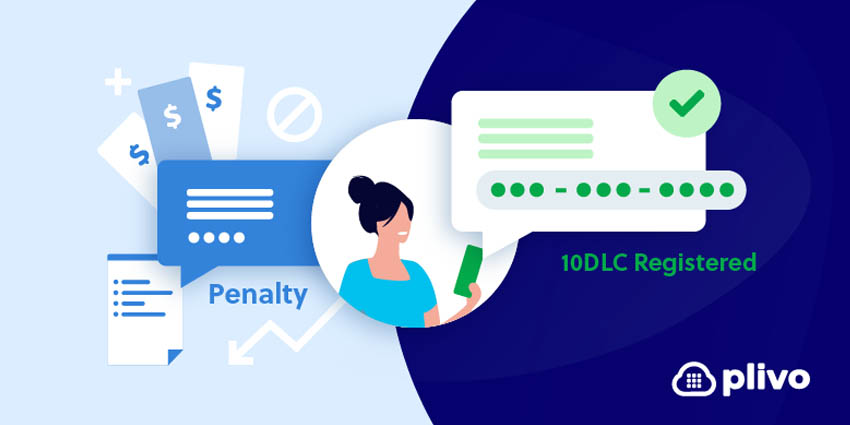
Businesses have been using SMS text messaging to communicate with their customers for years, even though regular phone numbers weren’t built for high-volume business messaging. "Long code numbers were never designed for mass texting,” according to Plivo Product Manager Ayush Anand. “Short codes, the carriers’ solution for business messaging, were introduced in 2003, but they’re expensive to acquire and cost more to lease on a monthly basis than long codes, so businesses continued using long codes for SMS.”
Over time, however, legitimate business communications over long codes have been joined by an increasing volume of junk messages. Messaging spam annoys consumers, which has led mobile carriers to crack down on the problem to protect their customers.
To combat junk SMS, network operators now offer a new service called 10-digit long code (10DLC) that’s designed to reduce spam texts and increase consumer trust.
Before 10DLC, carriers’ preferred solution for application-to-person (A2P) texting was short code numbers — five- or six-digit numbers that could be used for high-volume messaging. 10DLC offers higher messaging throughput for registered numbers and better deliverability than unregistered long codes at a lower price than short codes, making it a great choice for businesses looking to improve their communication strategies. With this improved deliverability, businesses can reach more customers more quickly with their messages.
"To enable 10DLC capabilities, message senders need to provide information regarding their business and use cases to the operators,” Plivo’s Anand says.
“Once approved, they get much higher throughput, lower cost, and better deliverability"
Those are important considerations for anyone considering how to implement a corporate SMS strategy.
Throughput — Businesses should consider how many messages they need to send during a given interval. Unregistered long codes support only a few dozen transactions per minute (TPM), which is quite low. With the new service, vetted businesses can get up to 4,500 TPM.
Vetting — Companies can have their brands and their campaigns (use cases) vetted to gain that high level of throughput. All of the major US carriers use an agency called The Campaign Registry to approve and vet applications.


