

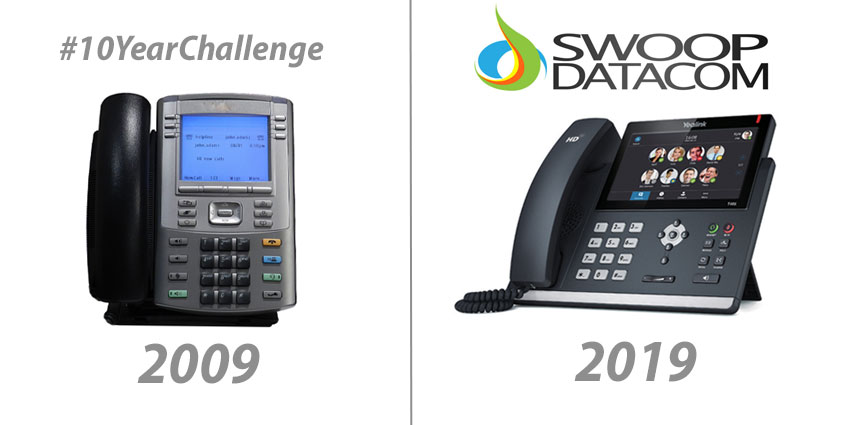
2019 began on an interesting note. As the communications industry looked into the future, discussion predictions for AI, and disruptive tech, the social media space looked back. The #10YearChallenge had people of all ages sharing pictures of themselves from 10 years ago and commenting on how much they had changed.
This new online trend got the team at UC Today thinking about how communications have transformed in the last decade, and how far we've come over the years. To discuss our very own UC #10YearChallenge, we connected with John Bennett, the CEO of Swoop Datacom.
With zero-touch provisioning tools like ForgeServe, Swoop is one of the companies leading the way to the future of communications. However, John has been in the industry long enough to see a lot of crucial changes.
How Have Phone Systems Changed in the Last 10 Years?
His long-standing history in the communications industry makes Bennett a fantastic person to comment on the evolution of UC and the modern phone system. "I started in the early days of SIP. I came from a telecoms background, transitioning dial-up minutes, and I saw the arrival of the first IP PBX."
John told me that phone systems were a tough market to get into a decade ago. IT and telecoms companies simply didn't mix and implementing anything into a business was a far more complicated process. "You needed engineers with a lot of experience, and a lot of cabling. The process was time-consuming, expensive, and very manual."
Today, companies like Swoop Datacom are tackling many of the complexities of the phone system installation. With ForgeServe and service management solutions, the gaps between IT and telecoms companies are getting narrower. However, for a long time, installing a SIP system meant understanding how to use everything from media gateways to session border controllers.
"You needed countless training courses from every provider you bought from. With SIP, you could get a gateway from one company, a router from another, a handset from another and so on"
"Engineers had to understand the basics of all of those systems, and how to bridge the gaps between them. We used to have a 2-day training course just on implementing an IP PBX. That was just the software arm - it didn't include gateway installation or endpoint provisioning."
Has SIP and Connectivity Become Easier to Manage?
[caption id="attachment_17972" align="alignright" width="240"] John Bennett[/caption]
Bennett told me that many aspects of the phone system puzzle have become simpler today. "Now that we can offer things like zero-touch provisioning, systems are much easier to implement."
One change worth noting is in the complexity that used to be familiar with SIP connectivity. John noted that ten years ago, it was challenging even to calculate the bandwidth required for a business. "A lot of the time, data and voice didn't run independently from each other. This meant that calls got dropped and quality was lost every time a large piece of data was sent out. It took companies a long time just to figure out how to split voice and data traffic."
On top of that, there were issues with codecs that people used to reduce their packet sizes, which prompted another loss in audio quality. "There was a lot of confusion, and so many people who didn't know how to deploy connections effectively. The smallest problem could easily cause jitter and lost calls. It also took a lot of time for people to figure out what was going wrong with their systems. It got to a point where people were buying ISDNs to back up their SIP phone strategy."
Importantly, John noted that SIP technology had remained the same, it just wasn't used properly in the past. "The deliverables are the same; it's the service providers that are changing."


