Unified Communications (UC) lives or dies on two things: how well you run the service, and how reliable the network is underneath it.
That is why infrastructure upgrade readiness is not just a tech refresh, it is an employee experience decision.
In this guide, I’ll walk through three common “banana peels” that trip up buyers, and I’ll split each one into service management (ITSM) and connectivity so your plan is balanced.
Along the way, we’ll weave in an ITSM implementation checklist, a practical connectivity adoption plan, and a simple way to approach ITSM ROI planning without turning it into an unnecessary headache.
Keen to explore Service Management & Connectivity further?
- The Service Management & Connectivity Market Map: 12 Vendors You Should Know
- How Service Management & Connectivity Tools Actually Improve Productivity
- The Top Service Management & Connectivity Events to Attend in 2026
1) Managing Interoperability: The Hidden Tripwires in Infrastructure Upgrade Readiness
Service Management (ITSM):
The biggest early mistake is treating IT service management as a standalone tool. In UC, tickets, changes, and alerts need to flow between your service desk and the systems employees actually use. This means Teams, Zoom, calling, meeting rooms, and Wi-Fi.
If those connections are missing, teams end up copy-pasting between tools, and incidents bounce around with no clear owner.
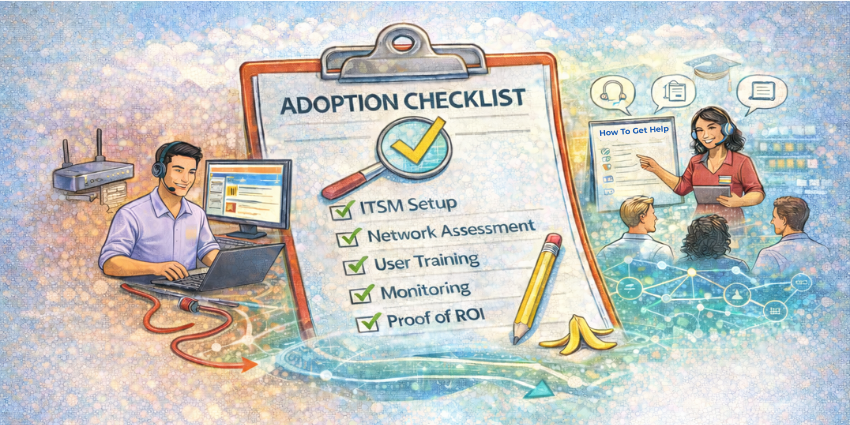
A practical ITSM implementation checklist for enterprise UC service operations usually starts with:
- Confirm what data your ITSM platform needs (assets, users, locations, critical UC services).
- Decide what must integrate on day one (identity, monitoring alerts, UC admin portals).
- Map “who owns what” before the rollout, not during the first outage.
Connectivity:
UC is real-time, so connectivity issues hit people in the moment. Guidance from Microsoft highlights that real-time media quality is heavily impacted by end-to-end network connectivity. Buyers are advised to assess capacity and performance for peak usage, not best-case conditions.
If you are using Teams heavily, Microsoft also provides a Network Assessment Tool to measure key call-impacting metrics like loss, jitter, and round-trip time to the nearest edge.
This is where avoiding risk during hybrid UCaaS transformation becomes practical: run a pre-rollout network assessment, then create a lightweight connectivity risk assessment 2026 that answers, “Where will calls fail first, and what is our fallback?”
It’s also worth grounding this in outage reality. Uptime Institute reporting shows many outages are often tied to power, network, software, and human factors. That is exactly why interoperability and change control matter: one misstep in the stack can ripple into UC downtime.
2) Employee Buy-In: Building a Complementary Culture
Service Management (ITSM):
ITSM only improves work if employees use it. You ideally want to avoid people still relying on their friend in the IT department or raising issues in random channels. Otherwise, your shiny new platform becomes a reporting dashboard for a reality that is happening somewhere else.
Guiding employee buy-in starts with accepting that this is a change program as much as a tooling program.
This program includes establishing visible leadership support, simple training, and clear “what’s in it for me?” messaging for end users and IT teams.
Make the cultural goal simple: fewer back-and-forth messages, faster fixes, and clearer ownership.
What will 2026 and beyond look like for UC infrastructure? Check out our trends roundup to catch a glimpse of the future of service management & connectivity.