A lot of leaders are starting to ask the same question: “How do we actually make immersive tech useful?” Spatial computing has slipped out of the lab and into leadership conversations. It now comes up in the same breath as hybrid work and AI productivity plans.
IDC already predicted shipments of AR, VR, and smart-glasses devices would rise about 39 percent before the end of 2025, reaching close to 14 million units. The focus isn’t really on games anymore. It’s on how companies are using this tech to reshape how people talk to each other, learn new skills, and get work done together.
We’re at a breaking wave for enterprise adoption, the moment when extended reality stops being a demo and starts driving ROI. The Apple Vision Pro 2 is just one of the devices earning the most attention, at least in the rumor mill.
If Apple can make spatial collaboration seamless, it could redefine how organizations connect, learn, and grow in the next decade.
Quick Context: The First Vision Pro
When Apple unveiled the first Vision Pro in early 2024, the reaction was split down the middle. Tech lovers saw the future. Finance teams saw a $3,499 experiment. Both were right.
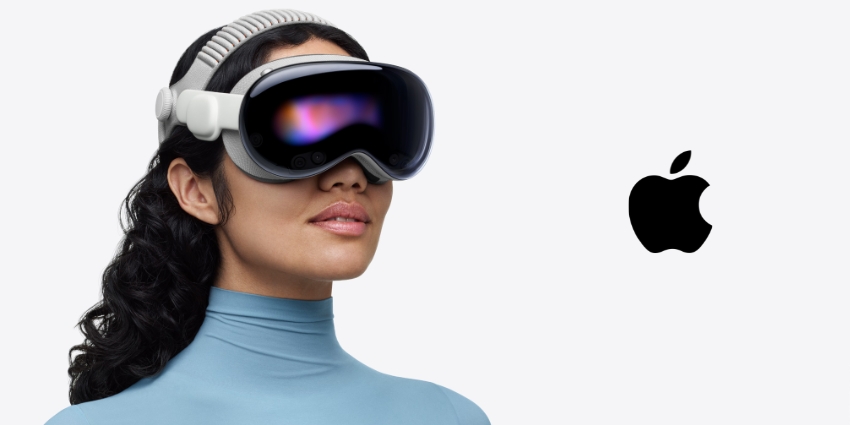
The headset wasn’t built to flood the market; it was a statement piece. Apple called it a “spatial computer,” not a VR device, and that distinction mattered. It was about proving a new interface for work. Early adopters in architecture, healthcare, and product design discovered they could visualize data and collaborate in ways that flattened distance entirely.
Still, adoption came with caveats. Long sessions weren’t always comfortable, battery life hovered around two hours, and IT leaders wondered how a premium headset fit into existing workflows.
Yet, for many businesses testing the technology, the experience was transformative enough to keep exploring. Reviews captured that duality: breathtaking innovation balanced against early-stage practicality. The hardware showed what’s possible; the enterprise world has been waiting for Apple to make it scalable.
The Apple Vision Pro 2: The 2025 Upgrade
For a while, there was hope that a brand-new headset would launch soon. Mark Gurman suggested that Apple’s roadmap included launching a new headset at the end of 2026. What’s actually happened so far is the release of not an Apple Vision Pro 2, but a “tweaked” version of the original.
The 2025 refresh looks the same on the outside, but inside, it’s a different machine. The new model runs on Apple’s M5 chip. That’s the same silicon powering this year’s MacBook Pro line, with a 10-core CPU, 10-core GPU, and a 16-core Neural Engine. Users get faster rendering, crisper visuals, and smoother multitasking for complex spatial workflows.
The display also now supports 120 Hz refresh rates, which makes a big difference in long meetings, and the new Dual Knit Band fixes one of the first model’s biggest complaints: comfort. Apple even sells it as a standalone accessory, signaling that the company is listening to enterprise feedback.
Battery life has stretched to about 2.5 hours, three for video playback. Storage starts at 256 GB and runs up to 1 TB, while Wi-Fi 6 and Bluetooth 5.3 handle the wireless heavy lifting.
Beyond the hardware specs, the software has improved too. VisionOS 26 adds smarter Personas, better window management, and shared virtual scenes. These are all features designed for collaboration rather than solo use. Apple paired the launch with new enterprise-focused demos that showcased multi-app workspaces and spatial productivity tools.
So, What is the Apple Vision Pro 2 Now?
If the upgraded model is Apple’s warm-up act, then the Apple Vision Pro 2 is the show everyone’s waiting for. The problem? No one’s quite sure when the curtain will rise, or what will be behind it.
Reports point to two parallel tracks: a lighter, less expensive Vision Pro 2 aimed at broader enterprise adoption, and a wired-Mac variant designed for high-performance environments like medical imaging, aviation, and advanced simulation.
Both models will hopefully be a bit more lightweight, particularly if the company considers getting rid of features like “Eye Sight” mode, which most users avoided in the first place. The simpler version might be a lot cheaper too.
If Apple can reduce the price of its headset to something like $2,000-$2,500, it might achieve better sales results going forward – something it’s obviously been struggling with so far.
If rumors throughout the year are anything to go by, future devices may also include:
- A faster processor: By the time Apple releases the Vision Pro 2 (if it ever does), the next-generation M4 processor should be available.
- Lens and screen upgrades: Apple will likely use OLED screens in its new headset for brighter images (with less battery consumption).
- Enhanced AI: Given the ever-increasing focus on AI in the XR world, there’s a good chance we’ll see plenty of this technology in the new headset. We might see the introduction of a brand-new generative AI assistant specifically designed for the Vision Pro.
No one seems to know the exact schedule. Some reports say Apple could start production late in 2025, while others think early 2026 is more likely. It depends on how soon the company finishes its new lens and cooling design. A few insiders believe the redesign has slowed because Apple’s attention has shifted to a different project, a pair of AI-powered smart glasses that might end up reshaping its entire wearable lineup.