
Good news travels fast, and bad news travels faster. Or at least it should.
In an emergency situation, every second counts in giving first responders and those at risk the alerting that they need to save lives.
For years, companies like Singlewire have provided their customers — who range from campuses to offices to the federal government and beyond — with emergency mass notification systems aimed at getting the relevant warnings and information out as fast and widely as possible.
Speaking with Singlewire’s UCaaS Channel Development Manager Brice Drogosch, he tells UC Today that, “Our customers need a system that can reach everybody in as many ways as possible in under a second, and in a way that they cannot ignore.”
“What we found is that just sending an SMS or an email is just not attention grabbing enough,” he says, explaining that, “What we need is an old-fashioned fire alarm that uses everything from lights to sound.”
If there is a weather or manmade event putting their people at risk, then organizations need a reliable way to trigger and send alerts out while assisting security teams in providing the fast and effective response that can make the difference in saving lives.
For years, Singlewire relied on Cisco’s phone system for much of their operations, though with some additional patched in services for features like paging. But now, like in every other industry, Drogosch’s clients are making their transition to the cloud — and that means gaining more features and flexibility.
“Our customers are moving more of their voice service to the cloud,” he says, noting that while the cloud has clear advantages, many solutions lack the key features like paging, hooking into a PA system, or other critical systems that clients need and do not want to replace.
“We have over 10,000 customers today,” says Drogosch, “85% of them are going to move to the cloud, and they’re not just picking Cisco [as their UCaaS provider]. So we need to make sure that we can support them on whatever service they are using.”
To help Singlewire meet their customers where they are, which for many of them means on Microsoft Teams, Drogosch has expanded his company’s partnership with leading UCaaS solutions provider CallTower. In mid-December, the two companies announced that CallTower would now be offering Singlewire’s InformaCast emergency notification system to customers using both Cisco and Microsoft. It is available now through the CallTower Connect customer portal.
The InformaCast and CallTower Partnership
As described above, this notification system helps get the word out quickly when something dangerous is afoot.
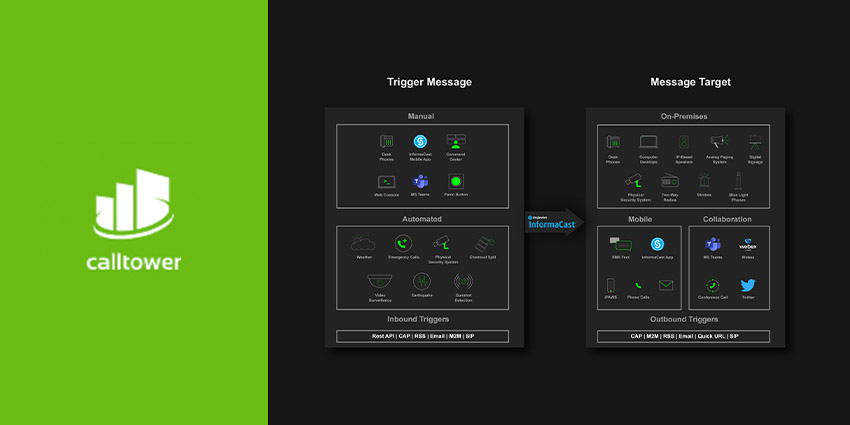
Worst case scenarios can be for an active shooter or weather emergency where panic buttons, either physical or activated on someone’s phone, — and even IoT systems with sensors — are activated. More tame fare can even be for school bells and less catastrophic events.
Whatever the trigger, the system provides a “one-to-many” communication, sending out the alerts that are sure to be noticed, fast. But in contrast to the more legacy systems, this newer system allows for security teams to define more actions.
Examples include sending alerts out through landlines, mobile, SMS, tween, on-prem systems like PA systems and signage, and even collaboration systems like Teams.
A person on the scene can use their mobile device as a panic button, alerting first responders both locally and through 911, and getting the ball in motion for reacting to the incident. Being able to mark yourself as safe via your cell phone is very important as well because it can be fed into the incident response system and viewed more efficiently by security managers.
Using their centralized incident response management platform, security personnel can launch a Microsoft Teams room that comes preloaded with all of their security plans ready to go.



