

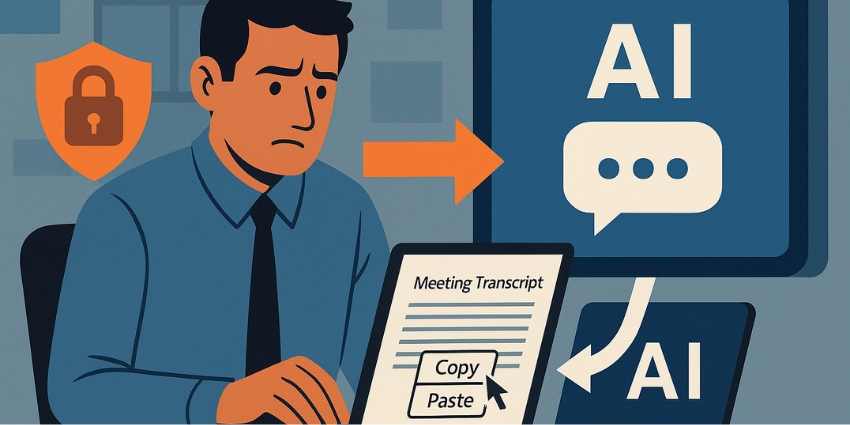
As someone who thrives on productive, seamless collaboration, I know firsthand how tempting it is to grab that perfect meeting transcript and drop it into ChatGPT for a quick summary. If you're an IT leader, security professional, or decision-maker trying to balance innovation with protection, this article is for you—because your employees are already using AI, whether you know it or not.
The Shadow IT Reality Check
A recent discussion among IT managers on Reddit (more than 27k views) sparked a conversation that many of us have been dreading : employees are copying meeting transcripts from Teams, Zoom, and other platforms and pasting them directly into third-party AI tools like ChatGPT. Since 2021, there has been a 28% average increase in monthly insider-driven data exposure, loss, leak, and theft events, and this trend shows no signs of slowing down.
One IT manager summed it up perfectly:
This screams Shadow IT—staff leveraging AI behind the scenes, without permission, policies, or oversight.#
The question that keeps security professionals up at night? Are we sleepwalking into a compliance minefield?
The answer, unfortunately, is yes. While 99% of companies have data protection solutions in place, 78% of cybersecurity leaders admit they've still had sensitive data breached, leaked, or exposed. And with AI tools becoming more ubiquitous, the attack surface is expanding rapidly.
The Microsoft Teams Paradox
Here's where it gets interesting—and frustrating. Microsoft Teams already offers sophisticated AI-powered transcription and summarization through Copilot, yet 11% of files uploaded to AI applications have sensitive corporate content in them and less than 10% of enterprises have implemented data protection policies and controls on data going into these apps.
As one Reddit commenter noted, "Teams already offers a seamless way of providing these transcripts and meeting summaries. Use that and the issue goes away." But the reality is more complex. Recording and transcription are also unavailable for the meeting to prevent Microsoft 365 Copilot from accessing sensitive information in many organizations due to compliance concerns.
This creates a perfect storm: employees need AI-powered summaries to stay productive, but corporate policies often restrict the very tools that could provide them safely. So they turn to the path of least resistance—free, public AI tools that offer no data protection guarantees.
The Generational Divide
The data reveals a concerning pattern: companies are more concerned about data security breaches from Generation Z and Millennials falling victim to phishing attacks (61%), oversharing company information online (60%), sending company files/data to personal accounts/devices (62%), and putting sensitive data into GenAI tools (58%).
But here's the twist—respondents also believe senior management (81%) and board members (71%) pose the greatest risk to their company's data security, likely due to having wide-reaching access to the most sensitive data. As one commenter wryly observed, "The biggest offenders are always management."
The Cost of Complacency
The financial implications are staggering. Cybersecurity leaders estimate that a single event would cost their company $15 million, on average. In 2023, the global cost of cyber attacks was estimated at a staggering 8 trillion USD, projected to rise to 9.5 trillion USD in 2024 and further to 10.5 trillion USD by 2025.


