Dreamforce - Salesforce's biggest annual event - comes at a point when its customers are being asked to make bigger decisions about AI, data, CRM, sales operations, and collaboration. The technology is moving beyond individual copilots and isolated pilots. Salesforce’s “Agentic Enterprise” message is about connecting people and AI agents across the systems where work gets done. For enterprise teams, this Salesforce event is not just about headline product announcements. It is an opportunity to test what is working in production, hear from organizations using agents at scale, and ask practical questions about data, governance, adoption, cost, and measurable value. This Dreamforce guide covers what has been announced so far, who should attend, and how to get ready before the full agenda is released.
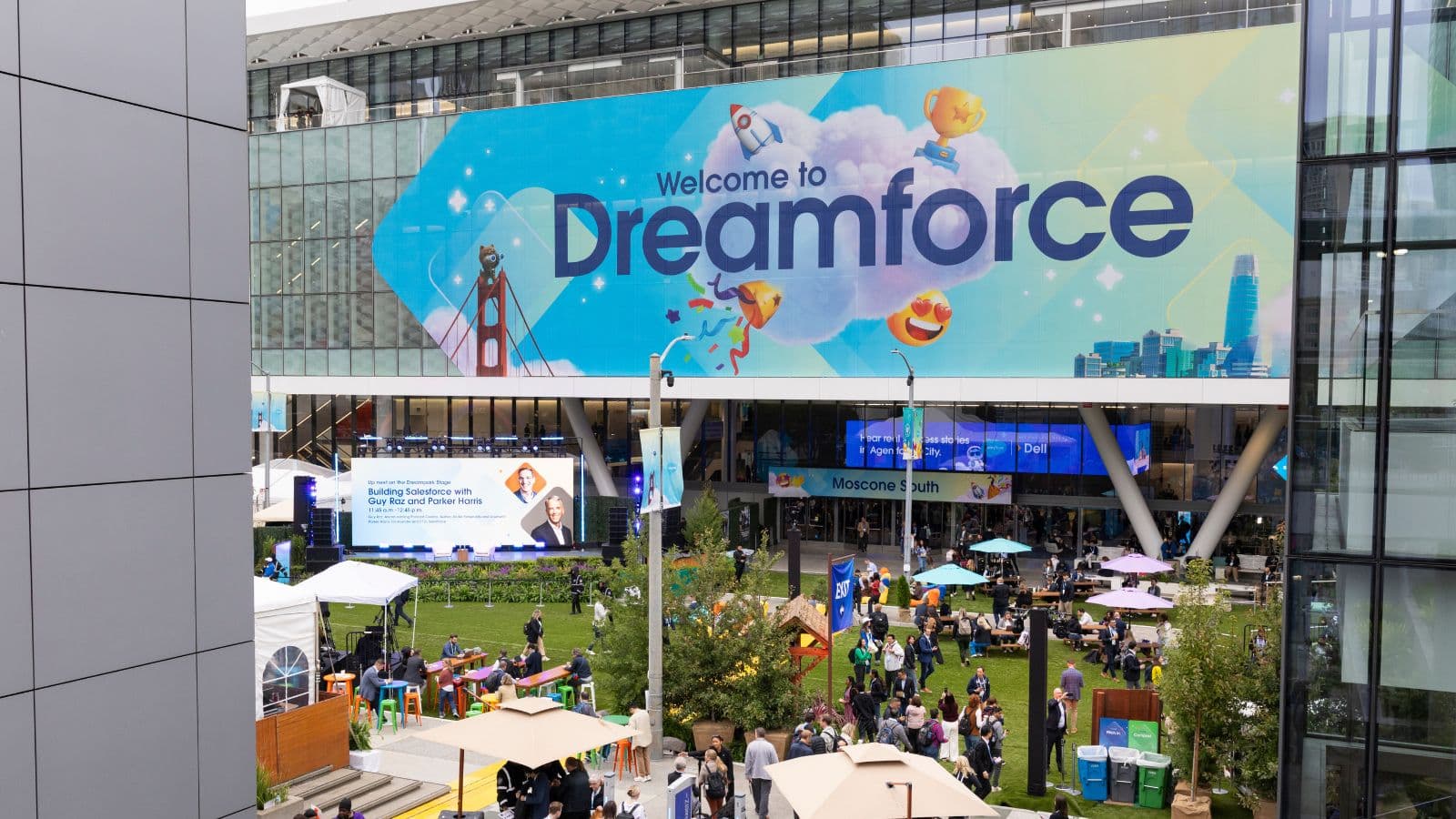
What is Dreamforce 2026? Salesforce’s annual event takes place September 15-17, 2026, at the Moscone Convention Center in San Francisco. The event focuses on Salesforce’s Agentic Enterprise strategy, with product announcements, customer use cases, hands-on learning, peer networking, and a free virtual program on Salesforce+ from September 15-18.
In This Guide
Dreamforce 2026 at a Glance
Event: Dreamforce 2026 In-person dates: September 15-17, 2026 Location: Moscone Convention Center, San Francisco Virtual access: Free registration for Salesforce+ Virtual program: 400+ sessions, virtual hands-on training, live keynotes, and exclusive interviews Theme: The Agentic Enterprise What Salesforce has announced so far:
-
1,600+ breakout sessions across products, roles, and industries
-
50+ visionary and product keynotes
-
150+ hands-on trainings and demos
-
240+ community roundtables
-
Opening keynote with Marc Benioff and special guests
-
Customer stories and agent-building content
-
One-to-one sessions with Agentforce and Slack product experts
-
Trailblazer Bootcamp
-
Dreamforce Welcome Reception
-
Dreamfest, including a headline performer
-
Salesforce Investor Day on September 16 at the St. Regis in San Francisco, with a live webcast available through Salesforce Investor Relations
Salesforce currently lists tickets at the stated full price of $2,299. Salesforce also advertises group registration options for teams of three or more. Pricing, availability, speakers, programming, and event logistics can change, so the official Dreamforce website should be your source for the latest information.
Salesforce will also hold its Investor Day during Dreamforce, on September 16 at 1:00 PM PT at the St. Regis in San Francisco. The company says a live webcast, presentation, and replay details will be available through its Investor Relations website.
Why attend Dreamforce 2026? Dreamforce gives Salesforce customers and enterprise technology leaders a chance to assess Agentforce, Data 360, Slack, AI governance, CRM innovation, and real customer deployments before making platform, architecture, or investment decisions.
Why Dreamforce 2026 Matters
Dreamforce 2026 will be a useful reality check for organizations trying to turn AI ambition into day-to-day operational change. Salesforce is bringing its Agentic Enterprise strategy to San Francisco at a moment when business leaders are asking hard questions: Which workflows should agents handle? What still needs human judgment? And what has to change in the data, process, and governance model before AI can be trusted with meaningful work?
That makes the event relevant beyond the Salesforce administrator or CRM team. The conversation now reaches sales leaders deciding how to equip reps without removing the human element, IT teams managing new integration and security demands, and UC leaders looking at how customer context and AI actions move into the collaboration tools employees use every day.
With customer use cases expected to feature prominently, Dreamforce should help attendees separate the polished AI vision from the implementation work required to make it stick.
CRM Is Moving Into the Flow of Work
Salesforce is extending CRM beyond its own interface. New Salesforce-hosted Model Context Protocol, or MCP, servers enable Slackbot to access CRM, Tableau, Data 360, and connected applications. Salesforce says users can retrieve customer information, update records, trigger workflows, and work with customized Salesforce configurations from within Slack, while respecting existing permissions and validation rules.
For UC and collaboration teams, this could bring customer context and CRM actions into the channels where sales, service, technical, and partner teams already work together. Instead of moving between a messaging platform and CRM, teams could discuss an account, identify an issue, surface data, and take an approved next step within the same shared conversation. Dreamforce is where buyers could test the operational reality behind that vision.
Look for customer examples that show how Salesforce preserves data quality, auditability, security, and approval controls when CRM actions move into collaboration workflows. The key question is whether this reduces friction without creating a less-governed CRM environment.
Claudeforce Brings Anthropic’s Claude Into Salesforce and Slack
Salesforce and Anthropic have announced Claudeforce, an expanded partnership intended to bring Claude’s reasoning capabilities together with Salesforce data, workflows, business logic, actions, and governance. The first product is Salesforce in Claude, a plugin with 37 prebuilt sales skills designed to help sellers prepare for meetings, review deal health, update pipelines, and take governed action from within Claude.
The partnership also places Claude inside Salesforce. Salesforce says Claude is available as a reasoning model for the Atlas Reasoning Engine, powers Agentforce Vibes and Agentforce Coworker by default, and is available in Agent Builder. Through Amazon Bedrock, Claude is also available within the Salesforce Trust Boundary for customers that need to keep data and AI workloads within a governed environment.
Slack is central to the announcement. Salesforce says Claude is the default model for Slack and will power Slackbot, support team decision-making through Claude Tag, and serve as a founding partner for Slack Code. This reinforces Salesforce’s argument that AI should not sit in a separate interface, but should operate within the systems and conversations where employees already work.
The partnership will also be visible at Dreamforce. Marc Benioff, Chair and CEO of Salesforce, and Dario Amodei, Co-Founder and CEO of Anthropic, are scheduled to appear together in a keynote conversation. For enterprise buyers, that session should offer a clearer view of how Salesforce and Anthropic plan to position Claude, Agentforce, Slack, Data 360, and Headless 360 within a shared enterprise AI architecture.
Salesforce says Salesforce in Claude is available to select pilot customers now and is expected to enter open beta in September 2026. Pricing, packaging, regional availability, and the timeline for additional skills remain subject to change. Read Salesforce’s Claudeforce announcement for further details.
CRM Competition Is Becoming an AI Workflow Battle
The CRM market is no longer competing on record management alone. Salesforce’s Agentforce, Data 360, MuleSoft, and Slack strategy is designed to connect customer data, applications, automation, and AI agents. The goal is to make CRM part of an enterprise workflow layer rather than a standalone front-office system. Competitors are taking a similar direction.
ServiceNow is positioning its operational CRM offering around AI-driven workflows across sales, service, CPQ, field operations, and IT. Its argument is that workflow context, not just customer data, will determine whether agents can carry out useful work safely and consistently.
For UC leaders, the decision increasingly concerns where communication, customer context, and AI-led actions come together. At Dreamforce, ask how Salesforce supports mixed environments that include Teams, Zoom, contact center platforms, and other business systems; where human approval is required; and how customers measure and control AI-related costs.
The practical comparison is no longer CRM versus CRM, but which platform can support governed work across the enterprise.
Headless 360 Expands the Agentic Enterprise Architecture
Salesforce is also expanding Headless 360, its effort to make the data, workflows, permissions, metadata, governance, and business logic inside Salesforce reusable by authorized AI agents and applications. Rather than requiring organizations to build a separate integration for every agent experience, Salesforce is positioning Headless 360 as a way to expose trusted enterprise capabilities through open standards.
The expansion includes a Headless 360 MCP Server, a Data 360 MCP Server, Slackbot MCP Client capabilities, more than 100 reusable Agent Skills and Plugins, a Headless Experience Layer, and expanded headless capabilities across Marketing, Sales, Service, Commerce, MuleSoft, Informatica, Tableau, and other Salesforce products.
For UC and workplace technology leaders, the Slackbot MCP Client is particularly relevant. Salesforce says it allows Slackbot to securely connect with the Salesforce platform, Salesforce MCP servers, and more than 20 partner applications, including Atlassian, Box, Canva, Docusign, Notion, and Zoom. Employees can retrieve information, update Salesforce opportunities, launch workflows, and coordinate work across systems from within Slack conversations while using the identity, permissions, and governance policies already established by the organization.
This is the architecture buyers should test at Dreamforce. The key question is whether Headless 360 can make enterprise capabilities available to agents across Salesforce, Claude, ChatGPT, Cursor, and other AI platforms without forcing organizations to recreate their business logic, security controls, and integration work for every new interface.
Salesforce says the Headless 360 MCP Server and Headless Experience Layer are currently in open beta, while the Data 360 MCP Server, Slackbot MCP Server and Client, Salesforce Multi-framework, and more than 100 Agent Skills are generally available. Read Salesforce’s Headless 360 announcement for full availability details.
Agentforce Now Has a Higher Burden of Proof
Salesforce is taking Agentforce into Dreamforce with more substantial commercial and deployment claims than it had a year ago. During its Q1 earnings call, Salesforce said Agentforce annual recurring revenue had exceeded $1 billion, while combined Agentforce, Data 360, and Informatica Cloud ARR reached $3.4 billion. The company also reported 28.6 trillion tokens processed in the quarter and 3.8 billion Agentic Work Units, which Salesforce uses to measure AI work completed.
Salesforce’s second-quarter fiscal 2027 results, announced on August 26, add to that momentum. The company said Agentforce and Data 360 annual recurring revenue reached nearly $3.9 billion, up more than 210% year over year, while Agentforce ARR exceeded $1.5 billion, up more than 240%. Salesforce also said it had delivered 7 billion Agentic Work Units across Agentforce and Slack to date, including 3.2 billion in the second quarter. Slack recorded its fastest quarterly net new annual order value growth since Salesforce acquired the company, while Slackbot users grew more than 150% quarter over quarter.
Salesforce also reported that Data 360 ingested 104 trillion records during the quarter, up 355% year over year, including 82 trillion records through Zero Copy. The results give Dreamforce attendees more evidence of Salesforce’s commercial momentum, but they do not remove the need to examine how customers are handling the data, integration, governance, adoption, and operating-model work behind those deployments. Read Salesforce’s second-quarter fiscal 2027 earnings release for the full results.
Those figures show momentum, but they do not on their own prove value for enterprise buyers. The more useful evidence lies in the customer and internal examples Salesforce has begun to share.
PenFed said its 76-agent deployment across operations, mortgages, IT, and HR is expected to save nearly $1.6 million this year. UCLA Health said it launched an initial customer-facing Agentforce use case within eight months after establishing testing protocols and leadership approval processes. This makes Dreamforce a practical due-diligence opportunity for organizations evaluating agentic AI.
Salesforce is expected to put significant emphasis on customer use cases, and attendees should use them to test what sits behind the headline results: the data work, integrations, process redesign, testing, guardrails, human escalation paths, and adoption effort required to reach production.
What should enterprise buyers investigate at Dreamforce 2026? Look for production customer use cases that show the data preparation, integrations, human oversight, testing, governance, implementation effort, costs, and measurable outcomes behind an Agentforce deployment.
Who Should Attend Dreamforce 2026?
Dreamforce 2026 is relevant to organizations already using Salesforce, assessing a wider Salesforce deployment, or deciding how CRM, agentic AI, data, and collaboration should change their operating model. Attendees should arrive with a defined business problem and a clear plan for the evidence they need to collect. Teams unable to travel can use Salesforce+ as a free way to follow keynotes, product launches, and a substantial virtual learning program, although it will not replace the in-person value of peer networking, customer meetings, hands-on conversations, or the wider San Francisco event campus.
Salesforce Customers Planning Their Next Move
Salesforce customers considering Agentforce, Data 360, Slack, Tableau, MuleSoft, Informatica, or broader platform consolidation should attend to compare customer use cases, product direction, and deployment approaches. Focus on evidence that goes beyond a demo: data readiness, integration requirements, governance, user adoption, human escalation, commercial model, and measurable outcomes.
CIOs, CTOs, and Enterprise Architects
Technology leaders should attend to assess whether Salesforce’s strategy can simplify their CRM, data, automation, analytics, and AI landscape or add further platform complexity. Dreamforce offers a chance to examine how Agentforce, Data 360, Informatica Cloud, MuleSoft, and Slack connect with existing enterprise systems, and what this could mean for architecture, operating models, budgets, and roadmap decisions.
UC, Collaboration, and Workplace Technology Leaders
UC and workplace technology leaders should attend because Salesforce is positioning Slack as more than a messaging tool. Its MCP-enabled approach brings CRM data, analytics, workflows, and AI agents into shared conversations, creating new questions around platform coexistence, identity, information governance, employee experience, and integration with Teams, Zoom, contact center platforms, and other workplace tools.
Sales, Revenue, and Commercial Operations Leaders
Sales leaders and revenue operations teams should attend to evaluate how Salesforce applies AI to prospecting, pipeline management, forecasting, seller productivity, and approvals. The most valuable sessions and customer conversations will show what changes in the daily sales workflow, how teams maintain CRM data quality and management oversight, and whether the results show up in seller capacity, speed to lead, forecast accuracy, conversion, or revenue.
IT, Data, Security, and Governance Teams
IT, data, security, compliance, and Salesforce administration teams should attend because agentic AI depends on the systems that control access, data quality, integration, auditability, and oversight. Prioritize technical training and architecture discussions on permissions, data boundaries, model access, third-party MCP connections, data residency, testing, observability, retention, and human-in-the-loop controls, especially if your organization operates in a regulated sector.
Salesforce Partners, ISVs, and Service Providers
Consultancies, systems integrators, ISVs, managed-service providers, and technology partners should attend to understand where Salesforce is directing its product investment and where customers need implementation support. The opportunity is likely to extend beyond deployments to use-case design, process redesign, integrations, governance, workforce enablement, and ongoing optimization as organizations move Agentforce and connected workflows from pilots into production.
What to Expect at Dreamforce 2026
Salesforce has confirmed the overall shape of Dreamforce 2026. The event will combine executive announcements, technical learning, customer examples, peer discussion, and social programming across three days in San Francisco and on Salesforce+.
Keynotes and Product News
Opening keynote with Marc Benioff and special guests - Salesforce has confirmed its opening keynote, where it is likely to set out the company’s product and Agentic Enterprise direction. Marc Benioff will also appear with Anthropic Co-Founder and CEO Dario Amodei in a keynote conversation following Salesforce and Anthropic’s Claudeforce partnership announcement.