
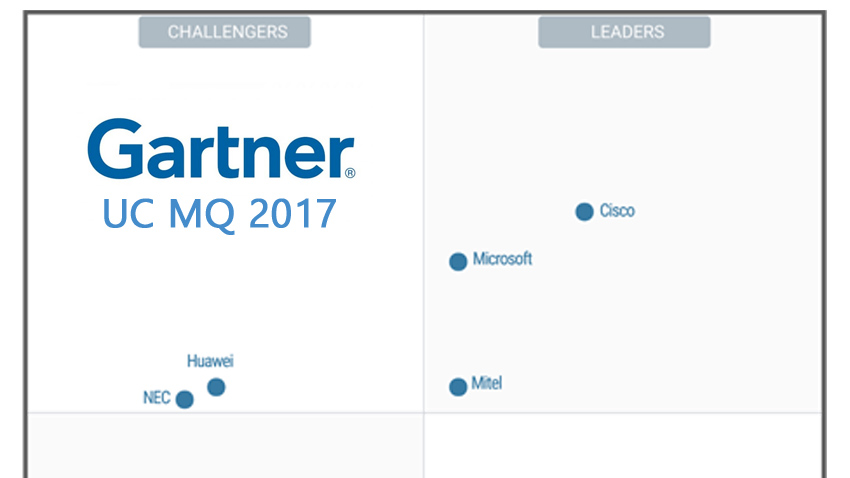
The Gartner Magic Quadrant for Unified Communications was officially unveiled this month for 2017, leaving many of the leading companies in the sector wondering whether they'd managed to make the cut. If you're new to the Magic Quadrant, it's simply an assessment by an analysis company, Gartner, based on evaluating UC companies according to their "completeness of vision", and "ability to execute" new ideas.
Though the Gartner Magic Quadrant is often considered to be a key indicator of the potential of companies in the UC space, it's also worth noting that it's a highly restrictive evaluation, that distils a huge industry into a consideration of 9 key vendors. Here, we'll be looking at the players in Gartner's UC magic quadrant, and asking whether the MQ really offers a complete view of the unified Comms market.
The Gartner UC Magic Quadrant
The Gartner Magic Quadrant works to separate 9 industry vendors from the Unified Communications sector, into four distinct categories. These are:
- Leaders: Vendors that provide a full UC offering and powerful market presence. Leaders can show their success in the UC field, and deliver exceptional services to a broad range of enterprises
- Challengers: Vendors that provide solutions that represent the ability to move into a leadership position, but may be lacking in various critical areas. Most challengers have strong solutions to offer but are lacking in market presence
- Visionaries: Vendors that offer a different and strong approach to one or multiple core areas in unified communications. These vendors might have a limited ability to execute new ideas across all markets, which make it hard for them to enter the "leader" segment
- Niche Players: Vendors that offer solutions particularly powerful in some UC areas, or have solutions with limited market reach
UC Leaders
The leaders for this year's UC Magic Quadrant were:
- Cisco: Based in California, Cisco is known for offering a comprehensive range of UC solutions designed to span across cloud, on-premise, and hybrid options. Cisco also offers UCM for large enterprises with up to 80,000 users, helping to organise, simplify, and manage large, distributed workforces. Cisco also provides UCM as part of its cloud-based service portfolio, complemented by WebEx. For collaboration, Cisco offers its /unified-communications/ucaas creation, "Cisco Spark"
- Microsoft: A global company based in Washington, Microsoft offers a holistic view into UC under the Skype for Business The on-premise solution is the Skype for Business Server, while the cloud UC solution comes in the form of Skype for Business (SfB) online. The Skype for Business offering has proven itself to be an IP PBX replacement for a range of organisations. Microsoft continues to enhance the SfB portfolio today, forging new partnerships with companies like Creston, Logitech, and Polycom
- Mitel: A publicly-traded global company based in Ottawa, Canada, Mitel offers UC through its "MiCollab" UC Suite, which aligns with a range of unique meeting solutions through its MiVoice telephony platforms. MiTeam features collaboration services for chat, document sharing, and group meetings. Mitel has a powerful presence within the virtualisation space and offers a range of unique delivery approaches for UC, combined with a significant base of new solutions deployed across virtual systems
UC Challengers
The challengers in the UC Magic Quadrant for 2017 are:
- Huawei: A privately-owned company based in China, Huawei provides its customers with a wide range of communication services and products. For instance, the Huawei "eSpace" solution for Unified Communications supports presence, telephony, messaging, video collaboration, and more. The Huawei UC architecture is based on a virtualised platform called the "Unified Session Manager", which allows the eSpace solution to run on a range of servers. Over the last year, Huawei has introduced public and private cloud deployment to the market, using the Unified Session Manager platform. The brand has also introduced a soft multipoint control unit to serve enterprises in search of scalable and flexible services
- NEC: Based in Tokyo, Japan, NEC is a worldwide provider of communication and IT services. Its aim is to "empower the smart enterprise" with a versatile range of services and products. Today, NEC offers two UC options: Univerge SV9500, and Univerge 3C (U3C). The U3C solution provides a fully-integrated UC suite, based on service-oriented and web-oriented architecture and open standards, along with enterprise scalability, centralised administration, and security. The Univerge SV9500 has similar capabilities, with strengths in the world of hybrid time division multiplexing and IP
UC Visionaries
The visionaries for the UC Magic Quadrant in 2017 are:


