The age of extended reality for the enterprise is here, and this time, we mean it. Over the last year, fun demos have given way to genuine, concrete case studies of VR, AR, and MR tools all making a real difference across industries. Extended reality automotive use cases, in particular, are starting to gain a lot more attention.
Analysts estimate the extended reality in automotive market was worth about $43 billion in 2024, with forecasts putting it near $69 billion by 2034. The wider XR space is expanding even faster, expected to grow from roughly $253 billion in 2025 to more than $1.6 trillion by 2032 as new business applications emerge.
Why the acceleration? Electric vehicle programs, distributed design teams, supplier networks that span time zones, and a skills crunch on the factory floor. That mix demands shared 3D context, remote co-creation, and hands-free guidance that fits inside the collaboration stack you already run. In other words, XR in automotive spaces is evolving into part of unified communications and workplace management, not a side project in a lab.
Extended Reality Automotive Market Momentum
If 2024 was the warm-up, 2025 is when extended reality automotive strategies hit their stride. The technology has moved past experimental labs into the boardroom, factory, and dealership. Analysts now see XR as an enterprise utility, not a novelty.
Plenty of companies are already digging in.
BMW’s “Virtual Factory,” built with NVIDIA’s Omniverse and OpenUSD, is a headline example scaling in 2025. The company simulates layouts for more than 30 global plants, trimming weeks from physical planning cycles.
Other OEMs like Hyundai, Mercedes-Benz, and Stellantis, are building similar “digital twin” environments to test logistics and workforce planning before steel is ever cut.
The market’s becoming more flexible too. The OpenXR and OpenUSD frameworks are emerging as the common language connecting CAD, real-time 3D engines, and collaboration apps. Hardware options are opening up, with emerging ecosystems from Samsung, Meta, and Apple.
Samsung’s new Galaxy XR platform integrates Android XR and Google’s Gemini AI; Meta continues to push business-grade collaboration through Horizon OS and Ray-Ban Display glasses; and Apple is driving high-end enterprise adoption with Vision Pro and its refined spatial-computing SDKs. Each is vying to own the interface for industrial metaverse collaboration.
For leaders evaluating adoption timing, this is what we call the XR inflection point, the moment when capability, cost, and business readiness finally align.
So, what are the use cases?
Design, Prototyping & Decision-Making
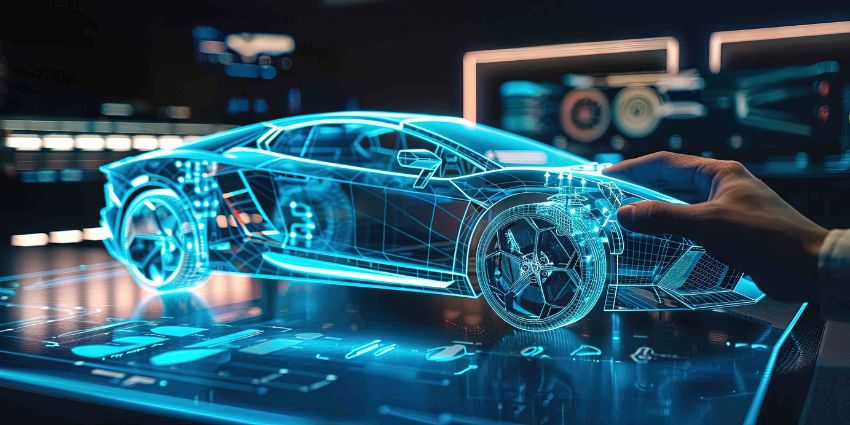
If there’s one area where extended reality automotive ideas have gone from cool to critical, it’s design. What used to live on screens or clay models now unfolds in life-sized, shared virtual spaces where teams can literally walk around an idea before it becomes metal.
At BMW, the Virtual Factory is a masterpiece of digital collaboration. Using NVIDIA’s Omniverse and OpenUSD, engineers can map out entire production plants and tweak layouts in real time. They’ve modeled over dozens of factories, slicing planning time from weeks to days, and avoiding millions in rework.
Ford’s design crews are doing something similar with Gravity Sketch. Picture designers across Detroit, Cologne, and Shanghai sketching a car together in 3D space, debating curves, and swapping ideas midair.
Startups like Rivian and long-time innovators like Volvo are seeing the same benefits. Using Varjo and Unity, they run high-fidelity design reviews where light, materials, and ergonomics behave just as they would on the real road.
Even the decision-making process feels transformed. Autodesk’s XR-based reviews let managers, designers, and safety engineers stand inside a digital model together, test visibility, and sign off on changes on the spot. Meanwhile, BMW and Meta Reality Labs are pushing “car-locked” XR that syncs headset tracking with vehicle sensors, meaning the virtual car actually drives like the real one.
Manufacturing, Training & Workforce Enablement
On the factory floor, extended reality automotive use cases are changing everything. Walk into a next-gen assembly plant today and you’ll find operators learning through holograms, not handbooks. The days of crowding around a static demo are almost gone.
At Stellantis, immersive training has replaced traditional onboarding. Thousands of workers now practice intricate assembly steps in virtual environments before ever touching a vehicle. The results are hard to ignore: training times down around 40%, safety incidents dropping, and new recruits walking onto the line ready to perform from day one.
Schnellecke Logistics took a similar leap. Using TeamViewer Frontline and AR “vision-picking,” warehouse teams see digital instructions projected right into their field of view. The payoff? Zero picking errors, 20% faster throughput, and a workforce that can flex between tasks without constant supervision.
What makes this wave different is how connected it is. XR training modules now tie directly into the same platforms used for calls and meetings, so supervisors can monitor, annotate, or coach in real time. It’s workforce enablement and unified communication rolled into one.
Sales, Marketing & Customer Experience
Buying a car has never been only about specs or performance. There’s that gut moment when a model feels right, when you picture it sitting in your driveway. What’s changing in 2025 is how that feeling begins. With extended reality automotive tools, shoppers can wander through digital showrooms, look around the cabin, and try out colors or features from their couch. It’s surprisingly intimate, closer to the real thing than a brochure or website could ever get.
At Mercedes-Benz and BMW, global launches now unfold in hybrid showrooms powered by XR. Instead of flying journalists and dealers halfway around the world, brands host walk-throughs in shared virtual environments where participants can explore interiors, toggle specs, and even “sit” behind the wheel. It’s greener, cheaper, and more consistent across markets.
When customers can explore a car in XR, something changes. Capgemini found that immersive retail spaces boost buyer confidence and strengthen long-term loyalty by giving people a genuine sense of what they’re investing in. Shopify reports that interactive 3D configurators can push online conversion rates up by nearly 94 percent. Once someone can step inside a vehicle virtually, seeing the stitching, the lighting, the space, the decision feels natural instead of uncertain.