
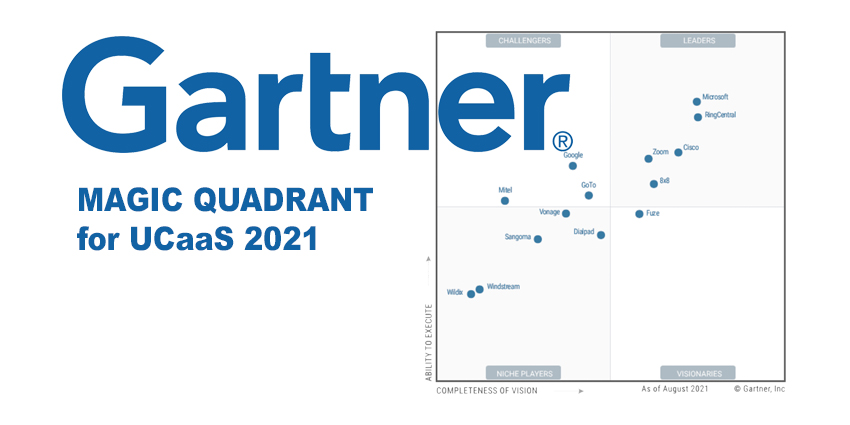
Gartner has released its UCaaS Magic Quadrant for 2021, revealing the market leaders and ones-to-watch in the unified communications space for the coming year.
The latest report comes at a time when businesses are wrestling with the concept of hybrid work and what it means for their culture and employees over the long term.
The pace of change is clear to see, with Gartner forecasting that 75 percent of enterprise users globally will not use a deskphone by 2024 – up from just 30 percent in 2020.
Meanwhile, the analyst predicts that 15 percent of businesses will rely solely on cloud office suites from Microsoft and Google for their business needs, including telephony, by 2022 – rocketing from just two percent in 2019.
Changes from MQ 2020
The vast majority of UCaaS providers from the Magic Quadrant from 2020 have remained in the report – even mostly in the same position.
But a notable change this time around is Alcatel-Lucent Enterprise (ALE), which has been removed altogether.
The removal is likely related to ALE’s agreement with RingCentral, which sees the latter’s tech power Rainbow Office. The partnership was mentioned in the last Magic Quadrant, with Gartner saying that it was announced too late in the year to be taken into consideration for the report. It is also worth noting that other providers that partner with RingCentral for UCaaS, such as Avaya and Atos, are not included either.
Gartner did not reveal the specifics of why ALE has been removed, only to say that it does not meet the Magic Quadrant’s inclusion criteria. The criteria states that providers must have self-developed, multitenant core UCaaS software which they operate themselves, along with various other user and geography requirements.
There are two other entity changes in the new Magic Quadrant. Sangoma features instead of Star2Star, following the acquisition in January 2021, while Wildix joins as the smallest provider in the pack by some way.
UCaaS Leaders
- 8x8
- Cisco
- Microsoft
- RingCentral
- Zoom
8x8
8x8 goes to market with its Experience Communications as a Service (XCaaS) offering which encompasses 8x8 Contact Center, 8x8 Meet, 8x8 Team Messaging and CPaaS.
Gartner noted that 8x8 is geographically diversified, noting its recent increased focus in the UK market.
It was also praised for its integration with Microsoft Teams for UCaaS, CCaaS, and voice.
However, Gartner noted that clients had reported customer service and support inconsistencies during the study period for the Magic Quadrant, resulting in mixed customer satisfaction.
It pointed out that 8x8’s user base growth of 20 percent last year is behind competitors such as RingCentral, Microsoft, and Zoom.
Cisco
Cisco’s Webex has been revamped this year and now includes functionality for telephony, messaging, collaboration, meetings, and events – as well as a new contact centre offering.
Gartner noted that the last year has seen “unprecedented R&D” and marketing investment pumped into the platform by Cisco, calling Webex’s pace of innovation “among the fastest in the market”.
The analyst declared that Cisco has the most complete self-developed unified comms portfolio in the market when you take into consideration other elements such as devices, SBCs, and networking.
It also highlighted Cisco’s strong channel ecosystem as a positive.
But Gartner also noted Cisco’s relatively late arrival in the UCaaS market, having taken time to rationalise three UCaaS platforms down into the Webex offering it now has. It claimed this led to uncertainty in the market when customers were moving to the cloud, at a time when Microsoft Teams was building momentum.
Gartner said that many Cisco customers with on-prem solutions are now adopting several Microsoft capabilities when moving to the cloud, while channel partners have built out UC practices with competitors such as Microsoft, RingCentral, and Zoom.
Microsoft
Microsoft Teams has been a big winner during the move to remote and hybrid working, with the most recent data showing 250 million MAUs on Teams and 80 million MAUs on Teams Phone.
Gartner said that adoption of Teams for UC over the past year has “surpassed that of every other provider in this research by more than an order of magnitude”.
Microsoft Calling Plans are proving particularly popular among SMBs, the analyst added, particularly when compared to the more complex Direct Routing option.
In terms of weaknesses, Gartner said that Teams is not “as unified” as options from Cisco and RingCentral – with some customers bemoaning the fact that much of the administrating and provisioning is reliant on PowerShell.
There is also a lack of advanced telephony features such as advanced multiline hunt group capabilities, and advanced queuing and interactive voice response capabilities.
Gartner however said that it has seen no evidence to support the perception that Microsoft’s telephony is unreliable and lacks quality, as many enterprises believe.
RingCentral
RingCentral goes to market with its Message, Video, Phone (MVP) platform, and powers the UCaaS offerings of other providers such as Avaya, ALE, and Unify.
Gartner said that RingCentral has invested heavily in video meetings over the last year and has narrowed the gap between RingCentral Video and competitors such as Cisco, Microsoft, and Zoom.
RingCentral is also in the process of migrating customers from the Zoom-powered RingCentral Meetings platform to its own RingCentral Video, which Gartner said is being well executed.
However, the analyst said that its video platform is still trailing the likes of Zoom and is expected to come under more pressure from bigger brands over the coming year.
Zoom
Zoom’s UC offering was completed by the launch of Zoom Phone in 2019, which rocketed to two million seats earlier this year.
Gartner said that no provider grew quicker than Zoom over the past 12 months, with the exception of Microsoft. It praised Zoom for effectively using the strength of its meeting brand to upsell to telephony.
The firm’s full functionality can be procured easily through Zoom United, which bundles telephony, meetings, and chat in a simple fashion. It also launched Zoom Appliances earlier this year.
Gartner said that Zoom is often overlooked in specialised environments such as healthcare and manufacturing in favour of more tried-and-tested providers, but expects new features to boost its appeal in these areas.
The analyst also noted that, while 80 percent of Zoom Phone deals are transacted direct, Zoom is building out its global channel base to give customers better support.
UCaaS Challengers
- GoTo
- Mitel
Google’s UCaaS offering is made up of Google Chat, Google Meet, and Google Voice, housed in its Workspace collaboration platform (formerly known as G Suite).
Gartner praised Google’s offering for its ease of use, access to its Jamboard for virtual whiteboarding, as well as the quality of its video and calling. It also anticipates huge investment in its platform over the coming years.


