

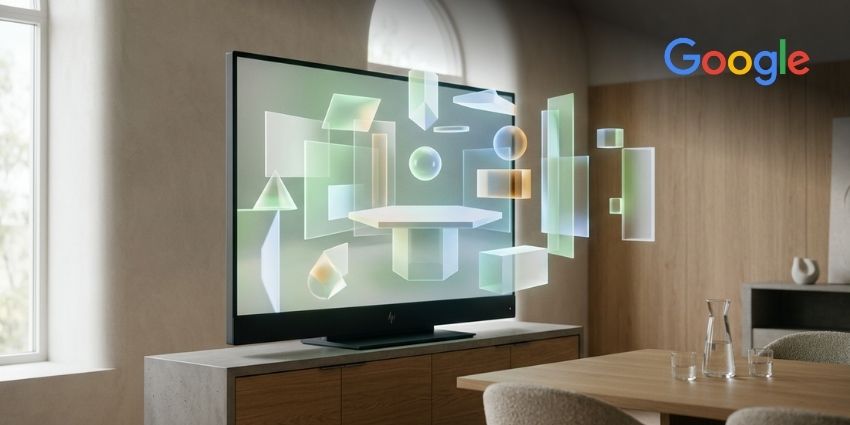
Google Beam makes remote participants appear life-size, seated as if in the same room, without a headset or glasses. A large light field display, six cameras, and an AI model do the work. It is the most convincing headset-free immersive video technology on the market, and until last week it only worked between two people.
On 20 May, as part of Google I/O 2026, Google announced an experiment that extends Beam's 3D rendering to group calls on Google Meet and Zoom. Remote participants joining from ordinary laptops or phones are rendered at their actual size, arranged around a virtual table. Spatial audio places each voice at the position of the person speaking. The optimisation happens automatically, with no configuration required.
Mohamed Abdelgany, Group Product Manager for Google Beam, says in the Google Research blog:
"Trying to read subtle emotions in a sea of tiny boxes may leave remote participants feeling like observers rather than engaged participants."
Why Google Beam's 1:1 Limit Was Always a Problem
Google Beam, formerly Project Starline, is still in limited early access. The first commercial device, HP Dimension, is a 65-inch light field display fed by six cameras, priced at $24,999 per installation. The Google Beam software licence is sold separately, at an undisclosed price. UC Today's hands-on review last October described the effect as convincing in a way that prior holographic-style technology had not managed.
The experience it delivered was bilateral. Two Beam devices, one person each end. Enterprise meetings rarely work that way. Cross-functional calls, client reviews, leadership stand-ups: these involve multiple people on multiple platforms from multiple locations. A technology that only worked properly for a single person with dedicated hardware was always going to have a narrow deployment case.
The group experiment changes that. Non-Beam participants on a standard Zoom or Google Meet call are now rendered on the HP Dimension screen in true-to-life proportions, arranged spatially around a table. The update is available for Google Meet and Zoom. Prior documentation indicates HP Dimension supports 2D interoperability with Microsoft Teams and Cisco Webex, but the 3D group rendering does not yet extend to those platforms.
Google Beam's Hybrid Meeting Research: What the Data Shows
Google claims the approach delivers a 50% stronger sense of social connection and a 21% increase in participants' reported ability to contribute to conversations, compared to standard grid-based video calls. These figures come from Google's own research programme, not an independent study. Abdelgany says:


