powering productive workplaces
Front page
NewsUC&C23 Apr 2026 · 4 min read

Google Cloud Next 2026: Meet Brings AI Notetaker Into In-Person Meetings

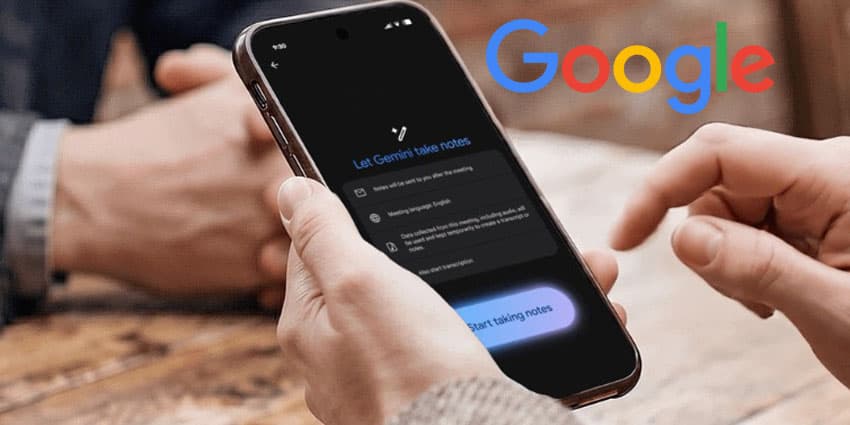
The Google Meet Gemini AI transcription assistant can now take notes in in-person meetings, not just video calls.

Google Cloud Next 2026 Meet AI notetaker

Google used its Cloud Next 2026 conference in Las Vegas to confirm that the "Take notes for me" AI feature in Google Meet, available in video calls since 2024, is now extending to in-person meetings. Triggered from the Meet mobile app or desktop browser, the feature uses Gemini to listen, transcribe, and generate structured notes that are delivered directly into a Google Doc.

The framing Google chose for the announcement is worth noting. The company stated that the feature works "regardless of whether your meeting is in-person, or hosted on another provider like Zoom or Teams," positioning Gemini not as a feature of Meet specifically, but as a capture layer for conversations wherever they happen. That is a broader ambition than the headline feature alone suggests.

Two supporting Workspace updates arrived alongside it. Google Drive is gaining a Projects feature, a curated space combining files and emails that narrows the context of Gemini searches when answering queries, rather than trawling an entire Drive instance.

Additionally, Smart Canvas, previously available in Docs, is expanding into Sheets, enabling Gemini to convert spreadsheet data into interactive dashboards, heat maps, Kanban boards, and calendar views. Both updates point in the same direction of tighter integration between what gets said in meetings, what gets documented, and what gets tracked.

The Market Context of Google Meet AI Arriving in Real Life

The timing is commercially interesting. The AI meeting assistant market, built on standalone tools such as Otter.ai and Fireflies.ai that filled a gap core productivity suites couldn't address, is projected to grow by $3.46 billion by 2029. But that gap is narrowing, and Google's move applies direct pressure to the category's pricing logic.

There is also an elephant in the room. This seemingly small upgrade to Google Meet teases that the tech giant is becoming a more direct competitor to the likes of Otter and Fireflies.ai.

Otter's Pro plan runs to $16.99 per month; Fireflies starts at $10 per seat. Google is bundling comparable functionality into existing Workspace Business and Enterprise tiers, meaning the incremental cost for many organizations could be negligible. For IT procurement teams reviewing their AI tool portfolios, that arithmetic is hard to ignore, even if the feature-for-feature comparison is not yet straightforward.
Microsoft's Copilot in Teams occupies similar ground within the Microsoft 365 ecosystem, and for enterprises running a predominantly Microsoft environment, the dynamic is comparable. What Google's announcement does, regardless of platform preference, is raise the baseline expectation for what any enterprise productivity suite should now be capable of delivering.

What End Users and IT Leaders Should Consider

For organizations already embedded in Google Workspace, the practical upside is obvious. Hybrid meetings have always been a reliable source of information loss. The late joiner, the verbal action item that never made it to email, the decision that only three people in the room actually heard: Google's feature addresses all of these, with a real-time "Summary so far" for latecomers and an automatic recap emailed to the organizer when the meeting ends.

The governance questions, however, deserve equal attention. Consent requirements for recording vary across US states; around a dozen require all-party consent. GDPR adds further complexity for European operations. AI systems that attribute speech to named individuals may also trigger biometric data obligations under frameworks such as Illinois' BIPA. These are not hypothetical concerns, but the first questions a legal or compliance team will raise, and they should be answered before deployment, not after.

There are also functional constraints worth acknowledging. Google states that the feature currently supports one language at a time, with no support for multilingual meetings, a limitation that will matter to global enterprises. Accuracy in noisy physical environments, as opposed to a controlled video call, is also an open question that Google has not addressed with published benchmarks.

None of this diminishes the direction of travel. Ambient meeting intelligence, which is always available and requires no third-party tool, is clearly where the market is heading. Google has made a credible move in that direction.

rate this story
helps rank stories across uc today
The discussion0 takes · attributed & checked

Does this reflect your experience?

opening the room…
Read nextordered by techtelligence · every pick explained
same beat · UC&C

GoTo CX Complete: Is GoTo Building the SMB AI-Powered UC+CC Layer Before Rivals Catch Up?

13 Aug 2026
matches this topicHow to Simplify Contact Center AI Operations So You Can Focus on Service Delivery23 Jul 2026matches this topicFive Signs Your Communications Stack Is Costing You More Than You Think21 Jul 2026