
powering productive workplaces
Front page
NewsUC&C21 Mar 2023 · 3 min read

Google Opens Access to Bard, its Answer to ChatGPT

Google opens Bard to select US and UK users, giving workplace tech buyers early access to generative AI, Google Search and LLM-powered productivity.

Google Bard access opens

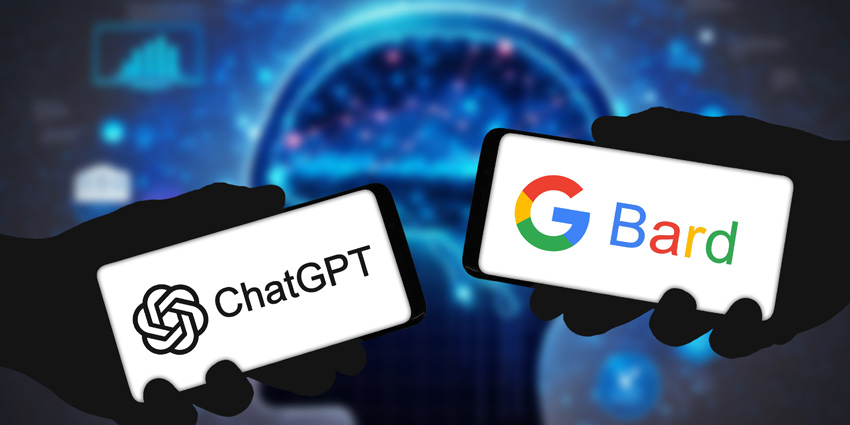
ChatGPT isn’t the only generative AI in town. Google has been working on its own AI, titled Bard, and recently announced it’s ready for the next step in its rollout.

Google’s AI chatbot will be made available to select users in the U.S. and U.K., and you can sign up for the waitlist today.

What is Bard?

Bard is Google’s generative AI, similar to ChatGPT. It’s powered by a research large language model (LLM) akin to LaMDA (which was not publicly released, but gained publicity when a researcher claimed it had reached the point of sentience), and will continue to update over time as it’s tested and fine-tuned.

Google’s announcement describes Bard’s large language model as a predictive engine that generates responses to prompts by selecting the words most likely to be used in conversation. Think of it as a more advanced version of Gmail suggesting email replies, or Google Docs suggesting ways to finish a sentence.

Users can ask Bard for things like suggestions, help making lists, an outline for a blog post, or a question about a topic. Bard will then provide a few drafts of answers, which users can select to continue the conversation. Like ChatGPT, Bard maintains the context of the conversation, so users can ask follow-up questions.

Google positions Bard as a way to “boost your productivity, accelerate your ideas, and fuel your curiosity,” which can be used to complement Google Search. Bard also includes a “Google it” button, so users can search for more answers through Google’s search engine. Additionally, Bard uses the internet to keep its information up to date and can cite the sources it uses.

Google’s positioning of Bard makes it clear that it’s intended to assist with creative processes, provide information, and make suggestions, rather than to write entire essays (a major concern among educational institutions).

As Bard develops, Google intends to add new capabilities, including additional languages, coding, and multimodal experiences. Google will be listening to user feedback from this early rollout to guide Bard’s development. The company also has plans to further integrate LLMs into Search in the future. 

Google assures users that “our work on Bard is guided by our AI Principles.” While the AI is still learning based on feedback and evaluation, Google built in several guardrails to keep interactions helpful, including filters to prevent it from sharing harmful, illegal, or sexually explicit information.

Not Always Right

At this point in the process, Google has made it clear that Bard is not all-knowing, and is still learning. As such, it may be prone to error. (Considering Bard made a widely publicized and criticized error during its first demo, this may not come as a surprise.)

From the moment users open Bard, Google notifies them that “Bard is an experiment,” it “will not always get it right” and “Bard will get better with feedback.” This appears to be a necessary disclaimer, given other AI platforms also have a tendency to get facts wrong on occasion, not to mention widespread tales of AI like Bing insisting that it’s right and the users are wrong.

It’s the company’s hope that, as more users chat with Bard and the AI develops, it will become more accurate in its responses. 

Who Can Try Bard (And How) 

Google is taking a slow and steady approach to Bard’s rollout, but you can sign up for the waitlist at https://bard.google.com/. Users must be 18 or older and located in the United States or the United Kingdom.

According to Google, Bard will expand to more countries and more languages in due time as the testing continues.

rate this story
helps rank stories across uc today
The discussion0 takes · attributed & checked

Does this reflect your experience?

opening the room…
Read nextordered by techtelligence · every pick explained
same beat · UC&C

GoTo CX Complete: Is GoTo Building the SMB AI-Powered UC+CC Layer Before Rivals Catch Up?

13 Aug 2026
matches this topicAI Is Reshaping Business Communications. Here's How to Keep Up Without Getting Burned30 Jul 2026matches this topicThe Contact Center AI Gap: Why Ambition Isn't Translating into Results9 Jul 2026

