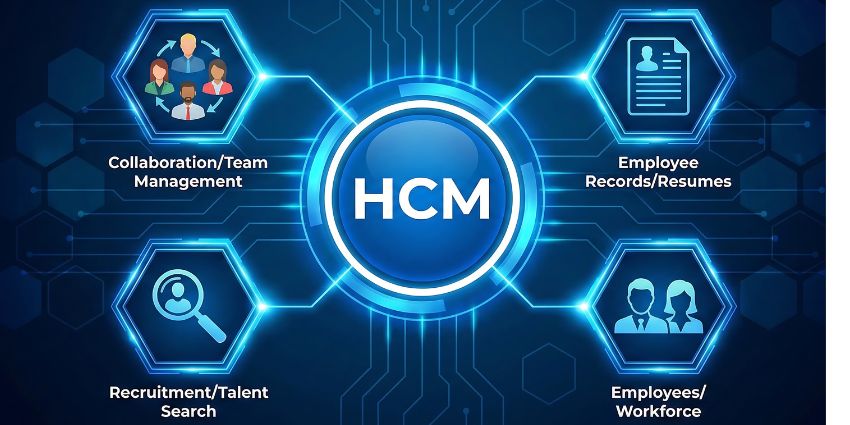
In 2026, HCM trends show that human capital management (HCM) has stopped being a HR software and started acting like workforce infrastructure. Skills data, learning systems, performance analytics, onboarding workflows, and AI governance now link directly to business outcomes: delivery speed, productivity, retention, compliance exposure, and operational resilience.
As a result, IT, security, legal, and workplace technology teams are moving deeper into workforce strategy. That’s also why unified communications is no longer adjacent to HCM. If onboarding, learning, collaboration, and manager coaching happen inside your collaboration stack, then your UC layer is already part of the employee lifecycle.
If you’re in discovery, the real question isn’t “Which HCM platform is best?” Instead, it’s this:
“What workforce architecture are we building; and which human capital management platform can support it without adding fragmentation, risk, or adoption failure?”
Below are the defining HCM trends shaping 2026, grounded in real vendor moves and regulatory change.
Related Stories
- Human Capital Management Events 2026: The Most Influential HCM Conferences for Talent Platform Buyers
- HCM Platform Reviews: Shortlisting the Best HCM Provider
HCM Trends 2026: Skills Intelligence Becomes the Core of Workforce Planning
The defining HCM trends story in 2026 is skills. However, this isn’t marketing language. Instead, skills are becoming the core model for workforce planning.
Rather than relying on job-based models, enterprises are moving to skills-based systems. They map capabilities, validate proficiency, spot adjacency, and drive internal mobility before external hiring becomes the default.
This isn’t theoretical. Major vendors are building around it:
- Workday Skills Cloud aggregates and infers skills from worker profiles, learning records, roles, and career data to support talent decisions and internal mobility.
- Oracle Dynamic Skills within Oracle Cloud HCM uses AI to match employees to roles, projects, and development paths using skills data.
So what’s the implication for buyers in 2026? Skills intelligence must be operational, not cosmetic.
To pressure-test this HCM trends shift, serious buyers ask:
- Is skills data inferred, validated, or both?
- Can internal mobility, talent marketplaces, and workforce planning run on skills, not just job titles?
- Who owns and maintains the skills taxonomy over time?
Meanwhile, UC enters the picture for a practical reason. Capability isn’t only expressed in HR systems. It also shows up in project collaboration, onboarding behaviour, knowledge-sharing, and learning engagement. That’s why collaboration data (when properly governed) is now part of the workforce intelligence conversation.
HCM Trends 2026: AI Shifts from Automation to Decision Support, and Explainability Gets Tested
Another major HCM trends signal: AI in HCM is no longer about automating payroll or digitising forms. Instead, in 2026, the focus is decision support:
- Early attrition risk detection
- Career path recommendations
- Skill adjacency modelling
- Manager coaching prompts
- Personalised learning pathways
- Draft performance feedback support
However, buyers are no longer impressed by “AI-powered” banners. Instead, they’re asking defensive questions:
- How is bias reduced?
- How are recommendations explained?
- What oversight exists?
For example, Workday has positioned Explainable AI inside its HCM stack to address transparency and trust concerns.
As a result, if a platform can’t show why it generated a promotion suggestion, pay insight, or internal mobility match, many enterprise buyers now treat that as risk exposure.
In short, AI in 2026 is less about wow-factor and more about defensibility.
[button_cta link="https://www.uctoday.com/talent-hcm-platforms/how-do-hcm-platforms-work/"]How do HCM platforms work?[/button_cta]
HCM Trends 2026: Governance and Responsible AI Become Deal-Breaking Criteria
Regulation is no longer abstract. Therefore, governance is moving to the front of HCM trends buying decisions.
The EU AI Act classifies AI systems used in employment contexts, including recruitment and workforce management, as high-risk. This pushes stricter duties around oversight, transparency, and risk management.
Because of that, enterprise buyers now expect:
- Clear audit trails
- Data lineage transparency
- Human oversight models
- Bias testing and drift monitoring
- Clear data minimisation and retention policies
Governance becomes even more sensitive when HCM connects to collaboration platforms. Once someone suggests using collaboration metadata as a workforce signal, teams need clear consent models, boundaries, and role-based access.
So trust is no longer branding. It’s architecture.
HCM Trends 2026: People Analytics Moves from Reporting to Predictive Intervention
The analytics shift in HCM trends for 2026 is predictive modelling tied to action.
One frequently cited case study is IBM’s attrition prediction work, which reportedly saved major costs by spotting flight risk early and enabling retention conversations.
That said, prediction without intervention is noise. So the real differentiator in 2026 is discipline: