
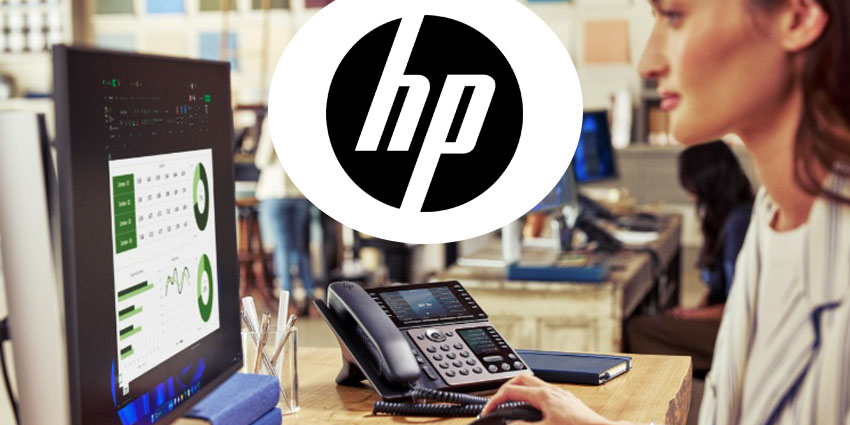
HP has announced its Poly Edge V Series Open SIP desk phones, a comprehensive hardware portfolio designed to bring professional-grade audio, advanced connectivity, and robust security to hybrid and frontline workspaces.
Slated for release in September with a starting price of $159, the new lineup intends to represent a calculated refinement of a product category that continues to hold its ground in the enterprise tech stack. Built with modern sustainability mandates in mind, the devices are Energy Star compliant, TCO Certified, and incorporate at least 35 percent recycled plastics and packaging.
The portfolio spans a wide range of operational requirements, scaling to meet the needs of diverse organizational environments without relying on bulleted feature lists to make its case. The entry-level tier comprises the V200, V250, and V250 Plus models, which support up to 16 lines and introduce color screens on the higher-end units.
Moving up the hierarchy, the mid-tier V400 and V450 devices handle up to 32 lines and offer expansion module support. In high-volume environments, the V650 supports up to 44 lines with a dual-display configuration, while the premium V800 and V850 executive models feature expansive five-inch displays and support up to 60 lines.
Crucially, models from the V450 upwards include integrated Wi-Fi and Bluetooth capabilities. All models feature at least one USB-C port for PC and headset connectivity, with seamless fast-pairing enabled for HP Poly Voyager Series headsets and straightforward USB connections for the HP Poly Mission Series. Beyond standard telephony, the entire series integrates next-generation NoiseBlockAI technology to filter out background chaos, alongside a Trusted Security Module to protect data and device integrity at the hardware level.
- HP Pushes AI Into the Enterprise PC Layer as Competition Intensifies
- HP Names Interim CEO as Incumbent Enrique Lores Departs for PayPal Position
Recalibrating the Unified Communications Market
We're in a peculiar transition phase in the UC and collaboration space, approaching the end of an epoch characterized by a rush toward mobile-first UC and pure cloud deployments. In that context, the introduction of new HP desk phones is obviously not a revolutionary pivot, but rather an incisive reflection of market maturation.
Tech buyers are increasingly recognizing that a one-size-fits-all software approach often fails at the edges of the network. The persistence of the desk phone aligns with a broader industry recalibration that sees organizations right-sizing their technology, balancing the agility of UCaaS with a renewed interest in robust on-premises and hybrid telephony for specific, mission-critical environments.


