Immersive collaboration is having a moment. Between spatial computing headlines, “VR meetings enterprise” demos, and a growing list of XR workplace tools, it’s easy to assume the endgame is obvious: the meeting gets replaced.
That’s not what’s happening.
The more useful question for CIOs and CTOs isn’t “Will XR replace meetings?” It’s: Where does immersive collaboration remove friction that video meetings can’t? Because in most organisations, the meeting isn’t a product problem, it’s a coordination problem. And most coordination still works best when it’s low-friction, reliable, and accessible for everyone.
This article breaks down what immersive collaboration technology actually is, how XR collaboration compares to video meetings, where it delivers measurable productivity gains, and what infrastructure you need before it becomes a serious enterprise video conferencing alternative.
[button_cta link="https://www.uctoday.com/immersive-workplace-xr-tech/extended-reality-for-business/"]Explore the pillar: Extended Reality for Business[/button_cta]
What Is Immersive Collaboration Technology?
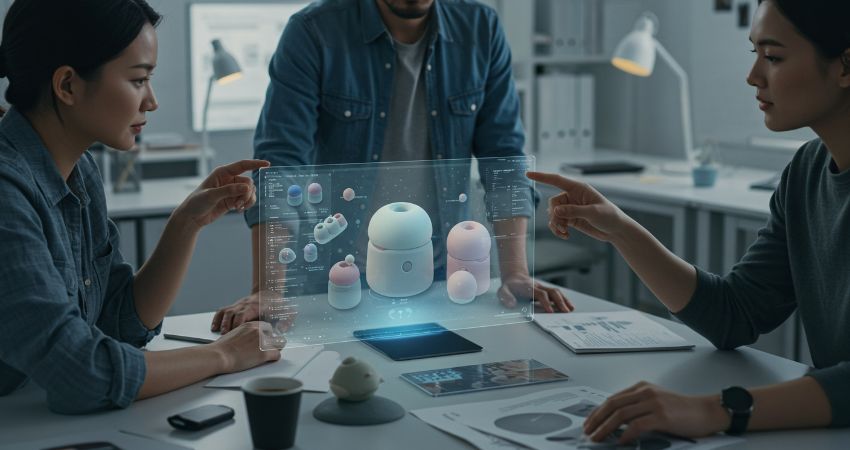
Immersive collaboration is the use of virtual, augmented, or mixed reality to help people work together inside a shared digital space. That can mean meeting in a 3D environment. More importantly, it can mean working together on 3D information such as models, layouts, scenarios, and simulations where a flat screen creates misunderstandings.
In practice, immersive collaboration sits on a spectrum:
At one end, you have meeting-like experiences like avatars, spatial audio, shared rooms, and virtual whiteboards. These are the experiences that drive the 'VR meetings enterprise' narrative.
At the other end, you have workflow-like collaboration such as teams reviewing a digital twin, validating a design, rehearsing a process, or walking through a facility layout together. This is where XR workplace tools start behaving like serious workplace technology, because the goal isn’t novelty. It’s fewer errors, faster alignment, and better decisions.
If you’re trying to make an enterprise decision, treat immersive collaboration as a work-type tool, not a meeting replacement. The winning deployments focus on high-value moments where shared spatial context changes outcomes.
How Does XR Collaboration Compare to Video Meetings?
Video conferencing is dominant for a reason: it’s low effort. People already know how to use it, networks already support it, and it works across devices. For most meetings, XR adds friction without adding enough value.
Immersive collaboration earns its keep when video calls hit a ceiling. That usually happens in three situations:
1) When the work is spatial. If you’re discussing a 3D space, a physical workflow, or a complex object, video calls flatten the problem. Teams end up talking around the thing instead of working with it.
2) When the cost of misalignment is high. If a wrong decision leads to rework, safety exposure, wasted materials, or delays, then 'better shared understanding' becomes a measurable outcome.
3) When attention and engagement matter. Immersive environments can reduce side-channel multitasking and make collaboration feel more present. That doesn’t matter for every meeting. It matters for the meetings that decide expensive things.
So the honest takeaway is simple: immersive collaboration won’t replace meetings. It will specialise them, turning some meetings into shared workspaces where teams manipulate the same object, scenario, or environment together.
What Productivity Benefits Can Immersive Workspaces Deliver?
Productivity is where immersive collaboration gets real and where buyer expectations should tighten. You’re not buying a vibe. You’re buying a faster path to correct decisions and consistent execution.
In the immersive workplace, the strongest productivity benefits show up in:
Design and decision-making with shared 3D context. This is where spatial computing collaboration shines: design reviews, planning sessions, layout validation, and complex technical walkthroughs. The measurable benefit isn’t more immersive. It’s fewer misunderstandings and fewer iterations.
Hands-on alignment for distributed teams. Distributed work is about shared context. Immersive collaboration can compress alignment time when teams need to see the same thing and act on it.
Training and rehearsal in collaborative scenarios. While this article isn’t a training deep-dive, it’s worth saying: group rehearsal and scenario-based learning can be a high-leverage collaboration use case, especially when knowledge transfer is the bottleneck.
None of these benefits require replacing video meetings. They require picking scenarios where immersive environments change the quality of decisions.
Where Do Enterprise Buyers Get This Wrong?
The most common mistake is deploying immersive collaboration as a new meeting room. That’s backwards. If you start there, adoption usually stalls because you’re competing with the easiest tool in the enterprise: a link to a video call.
A better approach is to treat immersive collaboration as an alternative to misalignment. Where does your organisation repeatedly misunderstand the same thing? Where do approvals take too long because stakeholders can’t visualise impact? Where do teams rely on screenshots, PDFs, and long explanations because the work doesn’t fit in 2D?
That’s where immersive collaboration platforms win, because they turn 'explaining' into 'showing,' and 'showing' into 'working together.'
What Infrastructure Supports XR Collaboration?
Even in consideration stage, infrastructure matters because XR collaboration fails fast when the basics aren’t in place. Immersive workplace adoption strategy lives or dies on deployment readiness, not demo quality.
At minimum, assume you will need:
Enterprise identity and access. If users can’t authenticate cleanly or access control is unclear, XR becomes a shadow IT risk.