The Trump administration is escalating its effort to keep Chinese technology out of sensitive US environments, moving to block new foreign-produced humanoid robots and connected mobile machines from entering the country.
The policy formally applies to overseas-made equipment rather than China alone – but its political and commercial target is clear: China’s fast-growing robotics industry.
The US communications regulator has added new foreign-produced advanced robots and connected power inverters to a government list of equipment considered an unacceptable national-security risk.
In practice, affected products will generally be unable to gain the approval needed to be imported, marketed or sold in the US.
The move applies to future models, rather than equipment already authorised for sale.
Posting on LinkedIn, US-based trade association and advocacy group the Association for Uncrewed Vehicle Systems International (AUVSI) welcomed the decision.
"The AUVSI welcomes strong, risk-based action against the national security risks of [China's] robotics playbook.
"The threat is real and documented. While these restrictions are necessary, alone they are not sufficient. AUVSI calls on Congress to codify today's action through the GUARD Act and to pair it with real investment in American robotics capacity."
Why Connected Robots Have Become A Security Issue
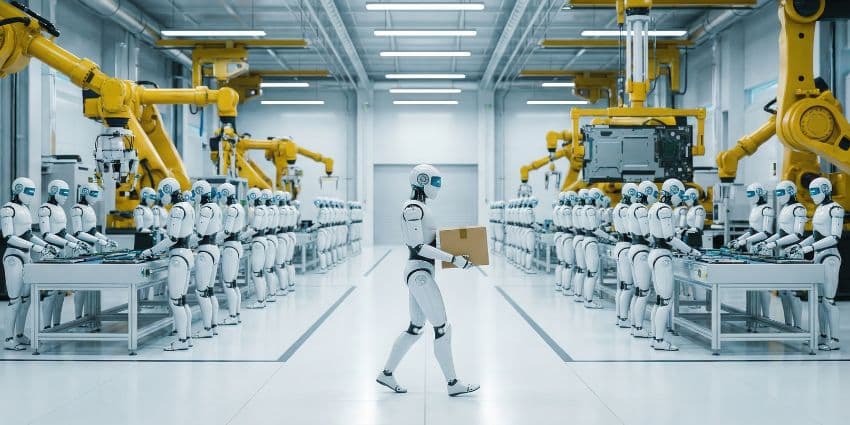
Humanoid robots are frequently presented as the physical face of AI: machines able to move through warehouses, factories, retail sites and public spaces while carrying out tasks designed for people.
However, the same features that make them attractive to employers raise difficult security questions.
The US government’s definition of the affected devices is broad. It covers mobile robots, including humanoids and animal-like quadrupeds, capable of navigating autonomously or responding to sensor data. The machines operate away from a human operator and use sensors, network connections and software enabling autonomous movement, data collection or remote command and control.
That moves the debate beyond whether a robot looks human. A connected machine can carry cameras, microphones, environmental sensors, mapping tools and cloud links through an organisation’s operational environment. It may also receive remote support and software updates.
US authorities say these devices could be exploited to surveil Americans, support foreign intelligence services or remotely commandeer machines.
In a workplace, the concern is not merely one faulty robot. It is the possibility that a compromised connected fleet could collect sensitive information, map a secure facility, interrupt physical operations or provide a route into the wider corporate network.
This sits within a larger US security concern around Chinese technology in critical infrastructure.
The Volt Typhoon campaign, disclosed in 2023, involved alleged Chinese state-linked efforts to gain persistent access to networks supporting US critical infrastructure through compromised internet-connected devices.
The Rules Are Broader Than China
The restriction applies to new foreign-produced advanced robotic devices and power inverters. A manufacturer’s nationality is not, by itself, the deciding factor. The regulator says it will assess whether a product is foreign-produced under US procurement definitions.
That means a robot offered by a US-headquartered business could potentially be caught if its production arrangements do not meet the domestic threshold.
At the same time, a conditional approval route is available where authorities determine that a specific device, or class of devices, does not present an unacceptable risk.