Since purchasing Oculus, Meta has made significant strides in the extended reality (XR) world.
In recent years, the company has been investing heavily in its vision of the “metaverse”, exploring new ways to bring people together in a digital landscape through virtual, mixed, and augmented reality (VR/MR/AR). The Meta Quest 2 and Meta Quest Pro are just two examples of the latest immersive technologies offered by Meta. Both are designed to enable powerful MR experiences, though their focus is slightly different.
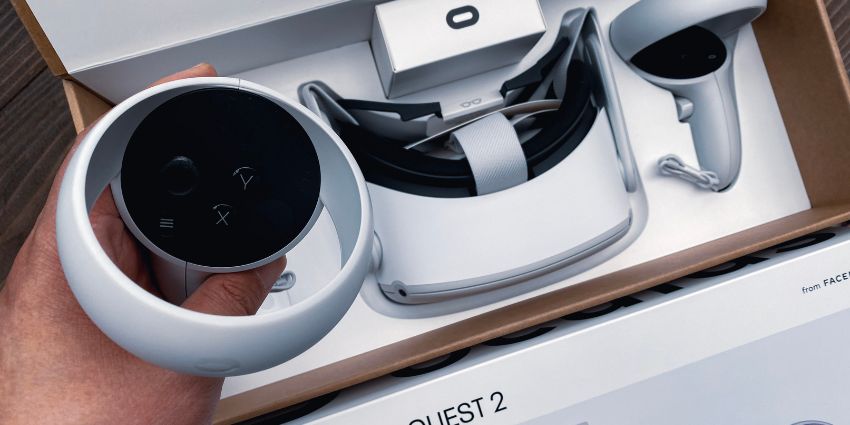
The Meta Quest 2 is the latest consumer-focused device created by Meta, built mainly for the entertainment and gaming landscape, though it has been leveraged by a number of companies for training and collaborative purposes. The Meta Quest Pro, on the other hand, was custom-made for the enterprise landscape, empowering companies to leverage the new age of “Meta work”.
Here are the major differences between the two systems.
Meta Quest Pro vs Meta Quest 2: Features
Both the Meta Quest 2 and Meta Quest Pro are VR headsets, built by Meta. The Quest 2 is a cutting-edge consumer-grade VR headset, with black-and-white passthrough, gesture controls, powerful processing, and exceptional visual clarity.
The Quest Pro is essentially everything the Quest 2 is, and then some. It has clearer front cameras, stronger color passthrough, and an intuitive next-level processor. The Quest Pro has several features exclusive to the professional market, which helps to justify its much higher price tag.
Let’s look at some of the key features head-to-head:
| Meta Quest 2 | Meta Quest Pro | |
| Display | LCD | QLED (pancake-style lenses) |
| Resolution | 1832x1920 per eye | 1832x1920 per eye |
| IPD Adjustment | 3 pre-sets (58, 64, and 66 mm) | 55-75mm increments |
| Refresh rate | 72-90 Hz | 72-90 Hz |
| Processor | Qualcomm Snapdragon XR2 Gen 1 | Qualcomm Snapdragon XR2+ Gen 1 |
| Memory and storage | 6GB RAM and 128-256GB | 12GB RAM and up to 256GB storage |
| Sensors | Gyroscope, accelerometer, proximity sensor | Ambient light sensor, accelerometer, proximity sensor, gyrometer, barometer, and magnetometer |
| Cameras | Four cameras for controller and headset tracking | 5 cameras for room-scale, 2 cameras for face tracking, 3 cameras per controller for self-tracking, 3 cameras for eye tracking |
| Audio | 3.5mm jack, integrated stereo speakers, microphone, and spatial audio | Spatial audio, dual 3.5mm jacks, integrated stereo speakers, and a microphone |
| Connectivity | Wi-Fi, Bluetooth 5, and USB Type C Gen 1 | Wi-Fi 6E, Bluetooth 5.2, and USB Type C gen 2 |
| Face/eye/hand tracking | Hand tracking | Face, eye, and hand tracking |
Quest Pro vs Quest 2: Display and Performance
While both the Quest Pro and Meta Quest 2 have the same resolution, the Quest Pro has a 10 º higher field of view, and better optic technology. The Quest Pro supports QLED lenses, with more than 500 individual zones for local dimming. It also has its own dedicated pancake lenses, which provide higher visual quality without compromising on ergonomics.
The Quest Pro also has a higher color gamut and supports 37% more pixels per inch than the Quest 2. Developers on the Quest Pro can implement foveated rendering for a performance boost and increase in resolution by focusing on where the user’s eyes are looking.
In terms of performance, the Quest Pro is up to 50% faster at generating and streaming content than the Quest 2, due to a specially enhanced Snapdragon chip. While the Quest 2 is still extremely fast and effective at maintaining high frame rates, it’s not nearly as advanced as the Quest Pro.
The Quest Pro is designed in large part to provide users with a way of creating a portable office space. It can therefore deliver more streamlined experiences in VR, and also offers an enhanced pass-through experience with color visuals, excellent for mixed reality purposes.
Quest Pro vs Quest 2: Comfort and Ergonomics
It’s difficult to know for certain whether the Quest Pro will be comfortable enough for long-term wear. However, it is designed to be more balanced than the Quest 2, with the battery placed on the back to offset the visor weight.