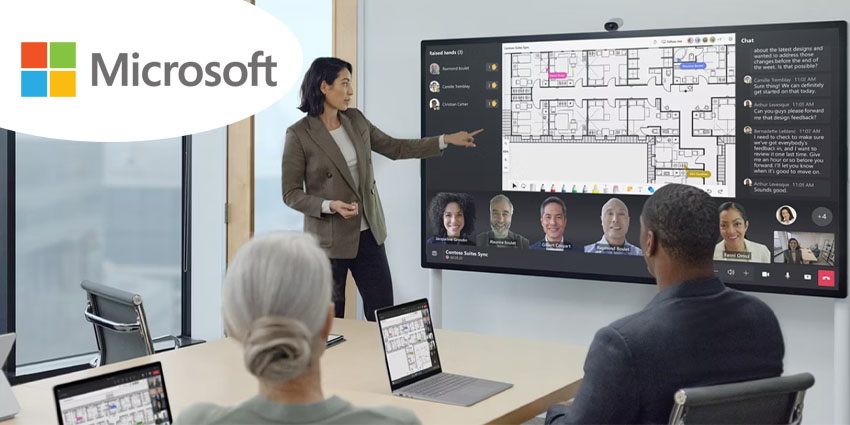
Microsoft has officially ended production of its landmark collaborative display line, ceasing manufacturing of the Surface Hub 3 and abandoning plans for any future iterations. The era of Microsoft’s first-party, large-format interactive screens has quietly but definitively come to a close.
Originally engineered exclusively for the commercial sector, these devices were designed to serve as the digital nucleus for hybrid workspaces. They represented a substantial capital expenditure for organizations aiming to seamlessly connect in-office and remote personnel through high-end digital whiteboarding and video conferencing.
The Surface Hub 3 was available in both 50- and 85-inch sizes, priced at $8,000 for the smaller version and $20,000 for the larger.
Despite the formidable price point, the product line introduced distinct architectural innovations aimed at long-term enterprise utility. The structural separation of the display panel from the internal computing components was a deliberate design choice. This modularity allowed organizations to upgrade the underlying processing power via a swappable compute cartridge, theoretically preserving the lifespan of the expensive glass.
Furthermore, the most recent iteration featured a dynamic rotating chassis that seamlessly transitioned between portrait and landscape orientations to accommodate diverse content layouts.
However, these sophisticated engineering feats proved insufficient to sustain the hardware's viability. While Microsoft and its authorized distribution partners will continue to fulfill orders using existing inventory, the manufacturing lines have been permanently shut down. Once the current warehouse stockpiles are exhausted, the product line will officially exit the primary market.
- Microsoft Teams Finally Adds Pre-Join Microphone Testing: The End of the Audio Guessing Game
- Microsoft Warns on AI Jobs Impact as SAP Backs Early-Talent Shift
The Hardware Strategy Pivot With Microsoft Sunsetting the Surface Hub Series
Arguably, this discontinuation is less of a sudden shock and more of a logical progression within Microsoft's broader enterprise strategy. Over the preceding two years, the tech giant has systematically divested from low-volume, experimental form factors. The cancellation of these large-format displays follows the recent retirements of the dual-screen Surface Duo smartphone, the 32-inch Surface Studio desktop, and the 14-inch Surface Laptop Studio.