
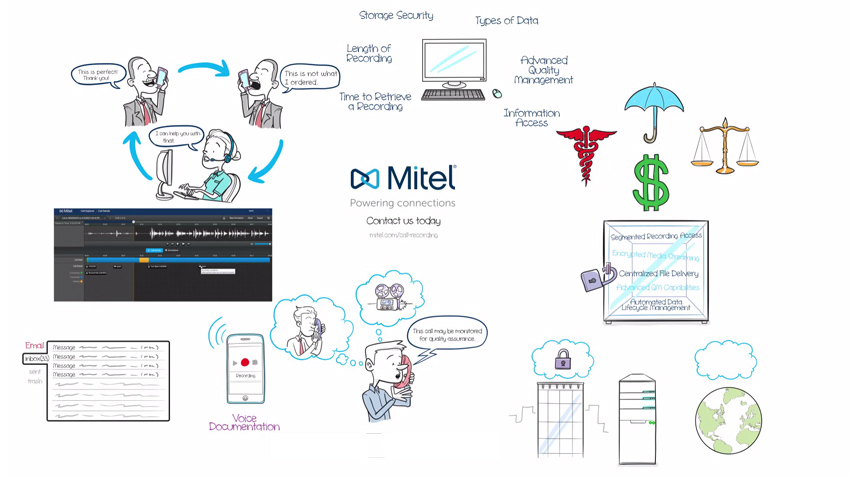
On the face of it, call recording sounds one of the more straightforward processes in the UC technology constellation. Beyond clicking the record button during a telephone call, what is there to it, really?
Being the stalwarts of the business communications industry that they are, Mitel knows that things are not that simple. When businesses do anything, there is always a bigger picture involved - namely, what value it has in terms of business performance.
So in explaining the development of what it calls “voice documentation”, Mitel argues that the actual process of recording telephone conversations is not what is important to businesses at all. The real value lies in how the recordings can then be used, who uses them, how easy it is to share and distribute them.
Based on its own patented Portable Voice Documentation (PVD) technology, Mitel’s MiVoice Call Recording platform is designed to make the capture, organisation, distribution, playback and evaluation of recorded calls as seamless as possible. With the central aim of enabling real time review by anyone who needs to listen in, MiVoice Call Recording is designed to meet the needs of the modern enterprise with in-built tools for supporting data protection compliance, quality assurance and even e-learning.
In this review, we will cast our eyes over all of these and more to give you the lowdown on who MiVoice Call Recording is for, what it can do, and what value it adds to your company. Please remember, all the opinions contained in this review are those of the author only, and UC Today plays no role in selling any product.
What Can It Do?
MiVoice Call Recording is a call recorder extension built for Mitel’s MiVoice Business telephone system and MiVoice MX-One multimedia communications server. Plugged into these systems, MiVoice Call Recording offers end-to-end capture of any and all calls, whether outbound, inbound, one-to-one or conference.
MiVoice Call Recording supports a flexible range of deployment options, including on-premises, in a virtualised private cloud environment, or in the public cloud. This flexibility also makes it highly scalable, with straightforward configuration in both single small offices and large distributed contact centres. It can be operated on all Windows OS, and supports all Microsoft SQL databases.
One of the key USPs of MiVoice Call Recording is that it aims to break recording out of the contact centre and call centre silo. As it is plugged into business-wide communication systems, so it allows all recordings to be easily and instantly distributed wherever it is needed via a single web-based interface.
The idea behind this is to give businesses, particularly larger, multi-site enterprises, every advantage they can take from call recording. Whereas recordings may traditionally be used just in the contact centre to monitor service levels, agent performance, compliance and dispute resolution, Mitel imagines a high purpose.
Improved access to recorded calls across a business is intended to improve collaboration - it might be a case of something on a recorded call being of interest to the marketing or legal or finance teams. Instead of having to go through the lengthy process of downloading, compressing and emailing, the Call Recording interface makes everything available instantly at the click of a button.
On the flipside of this, Mitel has been very careful to balance better access and information sharing with strict security and privacy protocols. Even for businesses in the most highly scrutinised sectors, such as finance, Mitel Call Recording is designed to offer the highest levels of compliance with regulations such as PCI-DSS, FCA, HIPAA and the Telemarketing Sales Rule. It achieves this through a combination of media streaming encryption, centralised file management and automated data lifecycle management.


