

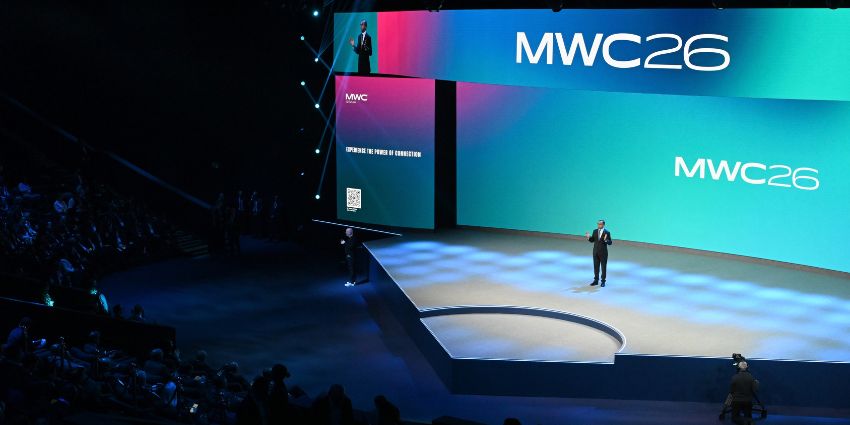
Every year, a version of the same question surfaces in our inbox: should UC and collaboration professionals actually be paying attention to MWC?
It's a fair question. Mobile World Congress is, at its core, a telco and mobile infrastructure event. This year, the headline themes in Barcelona were AI-native networks, 6G roadmaps, edge computing, and consumer devices. No major announcements came from the platforms your teams use every day: no Teams, no Webex, no Zoom, no RingCentral. If you were waiting for that, MWC 2026 wasn't the show.
But the answer to the question is still yes. Just not for the obvious reasons.
MWC 2026 didn't offer UC professionals product news. Instead, it offered something more useful: a clear view of where the infrastructure layer underneath every communications platform is heading.
The Demo Phase for Agentic AI Is Over
The most significant UC-relevant moment from MWC 2026 didn't come from a collaboration vendor. It came from Colt Technology Services.
At the show, Colt unveiled a proof of concept built with Microsoft that uses agentic AI to automate complex enterprise pricing workflows. Specifically, it cuts quote generation for large, multi-region infrastructure deals from several days to approximately ten minutes. CCS Insight framed the significance well: agentic AI earns its credibility in "bounded, repeatable, high-value processes with clear playbooks and measurable outcomes." The Colt deployment fits that description precisely. So do a significant number of enterprise communications workflows. Consider IT service desk triage, meeting-to-CRM handoffs, and new starter provisioning. None of these are glamorous. All of them are strong candidates for the kind of agentic automation that MWC 2026 showed crossing into production.
Crucially, the credibility question for agentic AI is now largely settled. The conversation has moved on to governance: how you monitor it, audit it, and keep it trustworthy at scale. For UC buyers and IT leaders, that's where the focus needs to be.
The Network Is Getting Smarter, and That Changes the Quality Conversation
One of the most consistent threads across MWC 2026 was AI framed not as something layered onto networks, but as something built into how they operate. Qualcomm outlined an AI-native 6G vision in which AI handles spectrum efficiency and network orchestration as core functions. Meanwhile, SoftBank introduced its Telco AI Cloud platform to push AI directly into network infrastructure. Ericsson, similarly, detailed AI accelerators it plans to embed in next-generation hardware for automatic signal optimisation and anomaly detection.
So what does this mean for UC professionals? Historically, teams have managed call quality, latency, and reliability at the platform level — through codec choices, QoS policies, and split tunnelling workarounds. As networks grow self-optimising, however, that complexity shifts back towards the carrier layer.
The GSMA's Open Gateway initiative shows most clearly where this leads. Open Gateway builds standardised network APIs that let applications request specific capabilities directly: QoS guarantees for a video session, network slicing for priority traffic, and secure identity verification in the communications layer.
The initiative gained clear momentum at MWC 2026. The timeline is not 2026, but this is an architectural direction that vendors, operators, and enterprise IT teams are actively building toward right now.
XR for Enterprise Collaboration: Still a Long Road, But the Use Cases Are Sharpening
Extended reality didn't dominate MWC 2026 headlines, yet enterprise AR maintained a consistent presence across the show floor. Notably, the scenarios on display weren't about reimagining the office meeting. They were operational: field technicians following AR-guided maintenance instructions, remote specialists working alongside on-site engineers, and training environments replacing paper documentation with guided workflows.
That said, the honest context matters. Enterprise XR adoption has moved more slowly, and proved more complicated, than early projections suggested. Hardware remains cumbersome for sustained use. Deployment at scale carries real IT complexity. Moreover, the business cases that justify genuine investment, rather than just a pilot, still apply to a limited set of verticals.
What did shift at MWC 2026, however, is the specificity of those use cases. The industrial and field service applications on the floor were more operationally grounded than the broad "spatial computing" narratives of recent years. For UC professionals managing estates that extend into manufacturing, utilities, healthcare, or field services, these use cases are therefore becoming harder to dismiss, even if broad deployment is still some way off.


