
While most of the attention of the telecoms industry seems to be focused on developing the most feature rich, scalable, all singing, all dancing integrated communications solutions possible, sometimes don't we need to sit back and ask - what about the little guy?
Here are some interesting statistics for you - at the start of 2016, small businesses accounted for a staggering 99.3 per cent of UK registered private businesses, employing 60 per cent of the private sector workforce.
Some of these small businesses are no doubt ambitious, entrepreneurial set ups with aspirations to grow one day into the mid-market and beyond, and want IT and comms systems which will grow with them.
But a majority are not. Small retailers, local hospitality outfits, sole traders and micro-businesses make up a huge chunk of the UK economy. They may never need more than 10 telephone endpoints, they do not have multiple branches to link, they have no need for sophisticated contact centre management and analytics software as their call traffic is just not high enough.
This is a huge market for UC vendors. A market which seeks straightforward deployment, ease of use, reliability and cost effectiveness from its communications solutions.
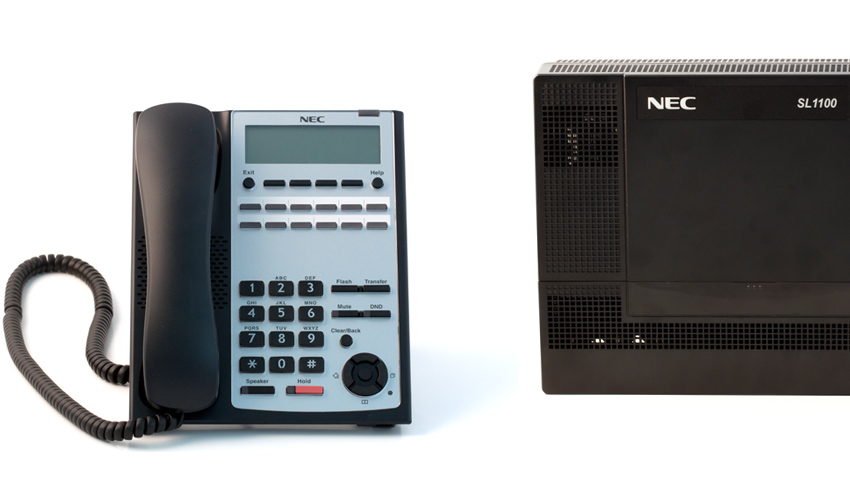
Enter the NEC SL1100 platform. An on premises PBX and UC server aimed squarely at the end of the SME market, its Japanese manufacturer positions the SL1100 as a straightforward IP telephony solution that offers enterprise quality for small business needs. With a pay-for-what-you-need licensing system, it also promises better value by allowing customers to budget smartly for their core communications requirements.
In this review, we will ask whether a small business solution means cutting corners on features and quality, or whether the SL1100 delivers on its promise to meet small business needs with a high quality offering.
As always, please remember that UC Today is entirely independent and plays no role in endorsing or promoting and particular product or brand. Our reviews are intended only to provide our readers with useful information when making their purchasing decisions.
How Does It Look?
The main SL1100 server unit comes in a 15” mountable chassis with a total of 56 inbuilt ports and two expansion card slots, plus a LAN Ethernet Port (10/100 Mbit interface), 1 external backup battery connector and a total of 3 audio mini jack outputs for connecting paging systems or external music sources.
The main server can be linked with up to two stackable expansion units. These are similar in appearance to the main unit, but they do not include the CPU or software installations.
What Can It Do?
As a PBX server, the SL1100 is a highly flexible hybrid solution offering IP, analogue and digital telephone extensions. It provides access to SIP trunking but also supports legacy connections such as PSTN and Basic and Primary ISDN. This gives customers the freedom to keep using existing systems for as long as they want, and start updating systems as and when they choose.
There are a maximum of 40 extensions supported on a single server, rising up to 100 with the maximum of two additional expansion units. There are a total of 16 SIP trunk ports available, and 12 analogue and ISDN trunks per unit.
There are three telephone handsets available in the SL1100 range as standard, a 12 and 24 key digital option plus a 24 key IP telephone. There is also the option to bundle in one of two wireless DECT telephones and a DSS desktop unit with 60 programmable keys.
Voicemail and auto attendant are included in the purchase price. The InMail voicemail system includes notifications to your desktop phone, mobile and email, plus a call record feature for tracking important conversations. The auto attendant is a great feature for small businesses which may have to leave business premises un-staffed for periods of time, with up to eight programmable modes for setting call responses.
Other features and applications are offered on a flexible licensing basis so customers only have to pay for what they need. All apps are managed via NEC’s SL Desktop Suite, an integrated UC software platform with an easy to use GUI interface. Key features of the desktop suite include the option to manage calls from a PC screen via the SL Desktop Softphone and straightforward system configuration and management without having to get an engineer out.



