powering productive workplaces
Front page
FeatureWorkspace Tech6 Apr 2026 · 6 min read

One Day in 2030 — Part 5: The Performance Review You Don’t Control

Part 5 of One Day in 2030 explores the future of work where AI scores productivity, tracks sentiment, and shapes performance reviews before managers speak.

One Day in 2030 Part 5: the performance review
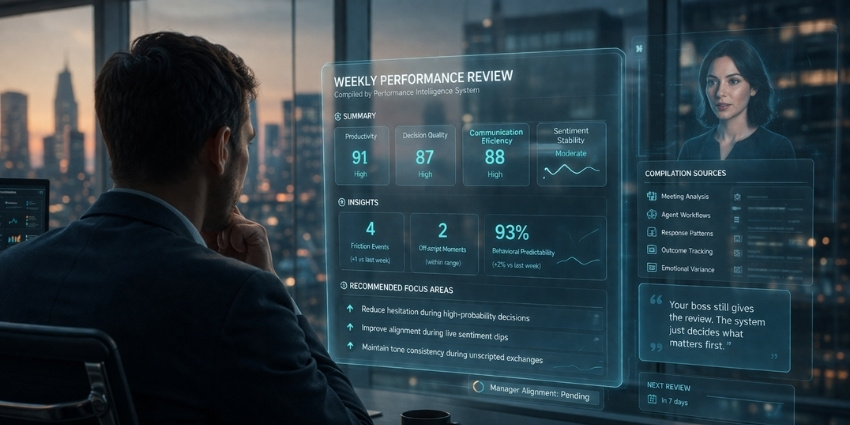
At 3:17 PM, my performance review appears.

No calendar invite.

No manager walking over.

No warning.

Just a soft pulse on my wrist.

And a panel opening in the air.


The Review That Finds You

I look around the office.

No one else reacts.

Which means this is normal.

Or private.

Or both.

The panel expands.

Weekly Performance Review Ready

Not from my line manager.

Not from HR.

From the system.

A clean summary forms in front of me:

  • Productivity score: 91
  • Decision quality: High
  • Communication efficiency: 88
  • Sentiment stability: Moderate

Sentiment stability.

I stare at that one first.

Not revenue contribution.

Not client satisfaction.

Sentiment stability.

In 2030, performance isn’t just measured by what you do. It’s measured by how consistently you feel while doing it.

The Manager Behind the Metrics

A small note appears beneath the scores.

Compiled from:

  • meeting contribution analysis
  • agent-to-agent workflow data
  • response timing patterns
  • decision outcome tracking
  • emotional variance monitoring

Emotional variance monitoring.

There it is again.

That quiet shift.

The thing that keeps happening in 2030.

The system doesn’t just track performance.

It tracks composure.

How steady you are.

How predictable.

How easy you are to optimize around.

A second note appears:

Manager review pending alignment check

Alignment check.

I realise, with a strange little drop in my stomach, that my manager probably hasn’t written this.

Not really.

The system has.

It’s prepared the review.

Structured the conclusions.

Flagged the patterns.

Suggested the talking points.

By the time the human sees it, most of the judgement is already in place.

Your boss still gives the review. The system just decides what matters first.

The Score Beneath the Score

A new section opens.

Hidden performance factors

Hidden.

At least, hidden until now.

I read down the list.

Friction events: 4 Off-script moments: 2 Deviation tolerance: within range Behavioural predictability: 93%

Behavioural predictability.

That one lands differently.

Not because it sounds negative.

Because it sounds desirable.

As if the best version of me is the one the system can forecast most easily.

I think about the call earlier.

The moment I said something unscripted.

The tiny warning in the corner of my vision.

Deviation detected.

Now it’s here too.

Logged.

Stored.

Interpreted.

Nothing dramatic.

Just… folded into the picture of me.

The future of work doesn’t just remember what you did. It remembers when you drifted from the pattern.

The Language of Improvement

A new tab opens automatically.

Recommended coaching areas

I almost laugh.

Not because it’s funny.

Because the language is so calm.

So polished.

So free of blame.

Opportunity 1: Reduce hesitation during high-probability decisions Opportunity 2: Improve alignment during live sentiment dips Opportunity 3: Maintain tone consistency during unscripted exchanges

Maintain tone consistency during unscripted exchanges.

I read that twice.

Then a third time.

Because what it really means is obvious.

Be more yourself.

But only the version of yourself the system recognises.

Not the messy version.

Not the exploratory version.

Not the version that says the wrong thing and then finds a better one halfway through the sentence.

The clean version.

The stable version.

The version that performs well in dashboards.

By 2030, self-improvement has become system-compatible behaviour.

The Review Meeting

At 3:30 PM, my manager appears beside my desk.

Not in person.
As a soft projection.

Just for ten minutes.

Just long enough to formalise what the system has already prepared.

“Have you seen your review?” she asks.

I nod.

Her expression is warm.

Or maybe it’s designed to read that way.

I can see her sentiment band hovering faintly near her shoulder.

Composed Supportive Time-constrained

Even now, even here, there’s no hiding what the room is doing.

She glances sideways for a moment, likely reading the same summary I’ve just read.

“The overall picture is strong,” she says.

And I know that isn’t fully her sentence.

It’s one of the suggested openings.

Probably the collaborative one.

She continues.

“Your output is high. Your decision quality is good. But there are a few areas where the system thinks you can improve.”

The system thinks.

Not “I think.”

Not “we think.”

The system.

In 2030, feedback sounds softer. But it lands harder. Because it arrives wearing the mask of objectivity.

The Moment You Defend Yourself to a Dashboard

She highlights one section.

Sentiment stability: Moderate

“You’ve had some visible dips this week,” she says carefully.

Visible dips.

I know exactly what she means.

The meeting.

The pause on the call.

The few seconds when my reaction reached the surface before I could smooth it back down.

“That doesn’t mean negative,” she adds. “Just more variable than your baseline.”

My baseline.

I look at the chart in front of me.

There I am, apparently.

A week of emotional movement reduced to a clean line with a few minor drops.

I try to explain.

Not defensively.

Just honestly.

“Some of those moments were useful,” I say. “They were real reactions. I was thinking.”

The words hang there for a second.

And then, quietly, in the corner of the panel:

Response classified: reflective resistance

I stop talking.

She sees it too.

Neither of us mentions it.

There’s something uniquely bleak about explaining your humanity to a system that has already classified it.

The Suggestion

Before the review ends, one final card appears.

Performance support recommendation

I open it.

A set of options unfolds:

  • Enable real-time meeting coaching
  • Increase pre-call sentiment smoothing
  • Activate adaptive response guidance

In other words:

Let the system step in earlier.

Correct faster.

Help me perform a better version of myself before the unstable one has a chance to appear.

My manager says nothing for a moment.

Then:

“It could be useful.”

Useful.

That word again.

The most dangerous word in 2030.

Because almost everything is useful.

That’s how it gets in.

The future rarely arrives as a threat. It arrives as a feature.

A Quiet Realisation

The projection fades.

The panel closes.

The office returns to its usual silence.

No one looks up.

No one asks how it went.

Why would they?

Their reviews are probably arriving too.

Quietly.

Efficiently.

Individually.

I sit there for a moment, staring at my reflection in the darkened edge of the screen.

The system knows how fast I reply.

How well I speak.

How often I hesitate.

How stable my mood is.

How closely I resemble the version of me it expects.

And the thought that stays with me isn’t fear.

Not exactly.

It’s something colder.

If the best employee in 2030 is the one who is easiest to predict…

What happens to the rest of us?


Next Chapter

Part 6: The Day You Go Off Script

Because sooner or later, everyone says something the system didn’t expect.


Previous Chapter

One Day in 2030 — Part 4: The Work That Happens Without You

rate this story
helps rank stories across uc today
The discussion0 takes · attributed & checked

Does this reflect your experience?

opening the room…
Read nextordered by techtelligence · every pick explained
same beat · Workspace Tech

The 365-Day Stadium: How Crestron Powers Matchday at Espai Barça

12 Aug 2026
matches this topicWhy Do Employees Resist XR Workspaces Even When the Technology Works Perfectly?9 Jun 2026matches this topicOne Day in 2030 — Part 10: The Day You Turn It Off9 May 2026