Because nothing obvious happens.
No alert.
No message.
No interruption.
Just… a slight change in how the day responds to me.
The Pattern Break Registers
It starts small.
A delay.
I ask for a summary.
It takes a second longer than usual.
Barely noticeable.
But enough to feel different.
I request a recommendation.
Three options appear.
But this time, none are marked recommended.
Just probabilities.
No guidance.
No nudge.
The system hasn’t stopped helping. It’s just… less certain about how to help me.
I sit back.
Something has shifted.
The Flag You Don’t See
I open my activity stream.
Everything looks normal.
Tasks moving.
Messages flowing.
Work continuing.
But there’s a new layer underneath it all.
Invisible.
Quiet.
Persistent.
I can’t see it directly.
But I can feel it in the way the system responds.
Less confident.
Less immediate.
Less… aligned.
And then I notice it.
Not in my dashboard.
In someone else’s.
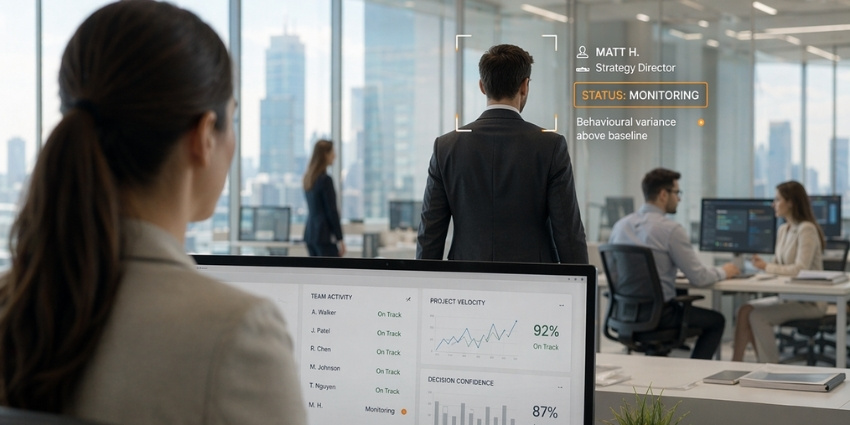
Across the office, a colleague’s screen reflects faintly in the glass.
For a split second, I catch it.
A label next to my name.
Status: Monitoring
It disappears before I can focus on it.
But I’ve seen enough.
In 2030, the system doesn’t tell you when you’ve been flagged. It just starts treating you differently.
The Subtle Restrictions
By mid-afternoon, the changes become clearer.
Not blocked.
Not restricted.
Just… adjusted.
A high-priority decision is routed away from me.
Assigned elsewhere.
A meeting I would normally lead appears in my calendar.
As an observer.
My assistant explains it calmly:
“Optimising for outcome confidence.”
Outcome confidence.
Not capability.
Not experience.
Confidence.
The system is reallocating work.
Based on how predictable I am.
Work doesn’t disappear in 2030. It gets redirected.
The Conversation That Doesn’t Happen
No one mentions it.
No manager pulls me aside.
No message appears explaining the shift.
Because technically…
Nothing is wrong.
I’m still performing.
Still delivering.
Still within acceptable range.
But something has changed.