
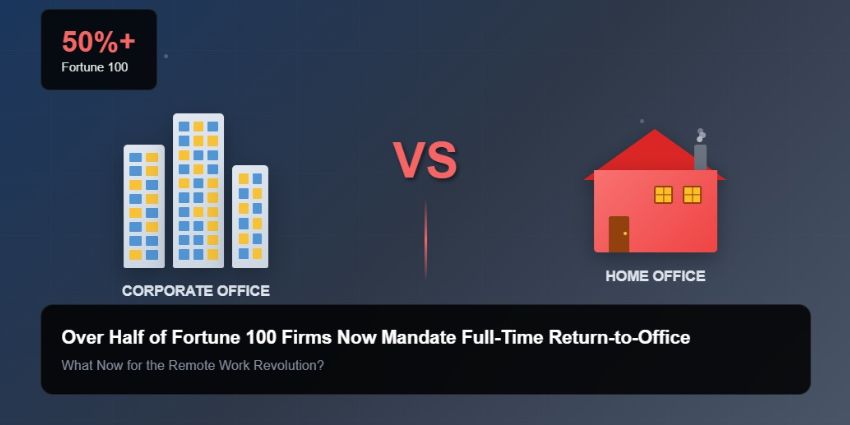
Over half of Fortune 100 businesses now mandate their employees return to the office full-time for the first time since the COVID-19 pandemic.
The flexible work era appears to be losing its shine, at least among the most prominent players in corporate America. According to fresh data from commercial real estate giant Jones Lang LaSalle (JLL), 54 percent of companies now require employees to be in the office full time, a colossal jump from just five percent two years ago.
This dramatic pivot is detailed in JLL’s latest 25 Office Market Insights report for Q2 2025, which reveals the average mandated office presence now stands at 3.8 days a week, up from 2.6 days in Q2 2023. The trend signposts a decisive retreat from the hybrid working arrangements that defined post-pandemic office culture. Just 41 percent of Fortune 100 firms now support hybrid work, a significant drop from 78 percent two years ago.
Of the ten largest employers in the Fortune 100, seven demand in-person attendance at least four days a week, and the top three—Amazon, Walmart, and UnitedHealth Group—have reinstated full-time, five-day office mandates.
Big-name companies are leading the charge. Google, Amazon, and Starbucks have not only tightened their RTO policies but are reportedly offering cash incentives to remote workers to either relocate closer to their offices or leave the company. Albeit, Amazon has been struggling to implement its full-time RTO mandate due to a lack of space in US cities.
JPMorgan Chase followed suit in January, mandating all staff return full time, while the new Trump administration has enforced a five-day in-office rule for federal workers.
What C-Suite and IT Leaders Need to Know Now
For CIOs, CTOs, COOs, and members of enterprise tech-buying committees, this sharp return to physical workspaces reshapes several strategic priorities, from IT infrastructure to real estate spending, security protocols, and employee experience.
First, network and workplace tech investments must evolve again. Over the past three years, many firms have optimised their environments for distributed work, investing heavily in collaboration tools, cloud-first infrastructure, and endpoint security. Now, leaders must recalibrate for hybrid parity and in-person productivity, ensuring seamless connectivity across both in-office and legacy remote tech stacks.
Second, there's a renewed pressure to rationalise office space and tech real estate spend. JLL’s report shows only marginal gains in actual attendance despite stricter mandates, suggesting empty-desk inefficiencies persist. Leaders may need to reimagine how physical space is used, investing in smart occupancy tools, desk-booking platforms, and modernised meeting spaces to reflect evolving patterns of presence.


