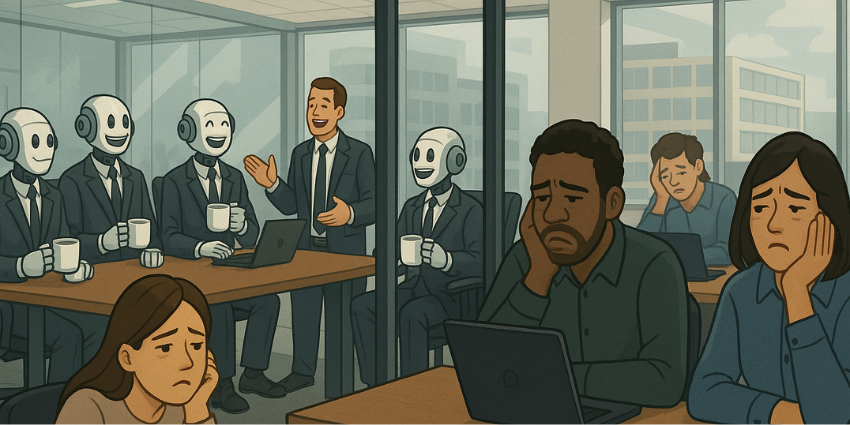
Work is supposed to be better than ever, right? We’ve got hybrid and remote jobs making long commutes obsolete. Wellness programs are growing up, and employers actually care about inclusion and diversity. We’ve even got AI bots that can attend annoying meetings for us.
So why are burnout levels at about 66%? Why is it still so hard for companies to attract and actually keep the right talent? Because companies still focus more on tech than people.
75% of companies now run multiple AI agents, which feels ambitious, considering most employees are still trying to figure out where the AI’s responsibilities end, and theirs begin.
We’ve decided AI/human hybrid teams are the future, but we haven’t even begun to figure out the balance. Work is accelerating past the humans doing it, and psychological safety at work is wobbling.
You can see the strain in the numbers. Quantum Workplace found that employees who use AI heavily experience 45% more burnout, which makes sense when you’re expected to collaborate with tools that never rest. S&P Global also reports AI-related initiative abandonment jumping from 17% to 42%, which says a lot about how overwhelming this all feels inside organizations.
This is why AI psychological safety has become the make-or-break factor in Agentic AI adoption. It’s not fear of job loss. It’s the fear of losing a say. If that isn’t addressed, even the smartest automation will struggle to earn trust.
Further reading:
- Cracking the ROI of Employee Engagement
- How to Prevent Burnout in the Age of AI
- Reducing Change Fatigue in the AI Workplace
What is Psychological Safety in The Workplace?
Psychological safety in the workplace sounds more complicated than it really is. It means that everyone on your team (regardless of their role), feels comfortable taking risks, sharing concerns, asking questions, and admitting mistakes.
It seems like a “company culture” thing; creating a place where employees feel equally heard, respected, and comfortable. But there’s more to it than that. Psychological safety has a direct impact on employee and company performance.
In the AI era, it also means team members know that they can say something if an AI tool does something wrong. That’s particularly important now that “AI workslop” is such a common problem. About 40% of employees say they’ve received low-quality AI output lately, and a good percentage of teams use AI content without actually double-checking it for accuracy first.
If your employees don’t feel comfortable speaking up or questioning an AI system, they’ll just copy and paste whatever it generates into your records. That’s how you end up in the same position as companies like Deloitte, which had to apologize for all the AI-generated errors in a crucial report.
What Agentic AI Really Means for the Workplace
The funny thing about agentic AI is that everyone talks about it like it’s still somewhere “on the horizon,” even though these systems are already making real decisions inside thousands of organizations. They re-route tasks, monitor signals, call APIs, and pull entire workflows together like a seasoned ops lead. It’s equally exciting and scary.
When they’re designed well, agents behave like hyper-capable coworkers who handle the multi-step jobs everyone else avoids. They escalate issues, reorganize work, and react to shifting conditions without waiting for instructions. It’s the closest thing modern workplaces have ever had to autonomous execution.
Look at the NHS Copilot rollout. One of the clearest examples is the NHS Copilot rollout. About 30,000 staff across 90 NHS organizations used the tool, saving roughly 43 minutes per day per person, around 400,000 hours a month at scale.
A global bank built an “agentic digital factory” to modernize nearly 400 legacy systems. The result? More than a 50% reduction in time and effort, and employees shifted from repetitive tasks into higher-judgement supervisory roles
Once you see the outcomes, the surge in adoption makes sense.
Numbers like that are impressive for business leaders, but open a whole new can of worms with employees. It’s not that people hate AI (most of us use it every day). It’s that we don’t understand what these new “coworkers” are really doing behind the scenes, and what’s left over for us.
So adoption falters, and all those plans you once had for the ultimate augmented workplace inevitably end up on the scrap heap.
How is AI Affecting Psychological Safety At Work?
With a little luck, if you’ve been investing in finding ways to actually improve the employee experience in the last few years, you know the basics of “psychological safety 101”.
Essentially, it comes down to this: the feeling that employees can speak up about concerns, bad ideas, broken workflows, even their own mistakes, without worrying that doing so will hurt them. That’s it.
Simple concept, but it’s always been fragile. It cracks around power dynamics, perfectionism, rushed deadlines, and leaders who talk about openness but don’t model it. Now layer on AI systems making decisions faster than most people can track, and you’ve got a brand-new set of fault lines.
Agentic AI doesn’t just change tasks; it changes the emotional contract between people and their workplace. If employees don’t understand what the AI is doing, or why it’s doing it, they stop speaking up. Once the voice dries up, everything else follows.
1. Silent Decision-Making
One of the sneakiest risks is how quietly AI agents work. They reroute priorities, trigger escalations, or handle a task end-to-end without announcing themselves half the time. Just look at tools like Zoom Tasks, do you really know why your companion is assigning you specific jobs, or do you just accept it? Eventually, questions like that spawn new ones.
People think: If work is happening without me… am I being phased out? Or worse: If the system makes a mistake, will it look like it was mine?
2. The “Surveillance Vibe”
Even when agents aren’t designed to monitor people, that’s how it often feels. When every click, field, or trend can become an input to an AI decision, workers start wondering how much is being tracked and how much is being interpreted.
A system doesn’t need to say, “I’m watching you” for people to assume it might be, particularly now that we know so many crucial workplace tools (like Microsoft Teams) are tracking more.
3. Loss of Voice & Autonomy
This might be the most emotionally loaded risk. It’s not job loss people fear most (although that’s a biggie); it’s losing influence.
In meetings, employees share that they’re hesitant to question AI recommendations because it makes them feel uninformed or technically behind. Others don’t want to raise concerns about mistakes, assuming leadership will “side with the system.” Some stay quiet simply because the AI’s outputs show up polished and confident, even when they’re wrong.
When humans assume their judgment matters less than the software, psychological safety at work collapses.
4. AI Fatigue & Role Ambiguity
The stats paint a pretty honest picture: 75% of employees feel forced to use AI at work, and 40% aren’t sure how it fits into their role
People can only fake confidence for so long. The nonstop pace of tool launches, “mandatory” AI training, and shifting responsibilities has created a low-grade exhaustion across entire teams.
That sense of I should know this by now eats away at morale. It also makes people far less likely to admit confusion, which is exactly what destroys psychological safety in the long run.
(Read more about solving digital fatigue here.)
Why Do Employees Feel Pressure When AI Tools Are Introduced?
When AI starts handling tasks faster than people can even understand them, there’s a strange pressure to “keep up with the machine.” It creates a type of workplace anxiety that leaders rarely see directly but feel indirectly through burnout, hesitation, and disengagement.
People aren’t machines. They’re not meant to run at that pace. Deep down, everyone knows it, but that doesn’t mean they don’t feel the pressure.
Why Addressing These Risks Matters
So, why do we need a fix? A few reasons.
- Silent Agents + Silent Employees = Invisible Risk: If agents make decisions quietly and employees stop questioning them, problems scale in the background. You don’t get small issues; you get systemic ones.
- Psychological Safety Builds Trust in AI: Teams with high psychological safety are more confident experimenting with AI, raising concerns, and learning out loud. Without that cultural base, adoption becomes compliance, not engagement.
- Innovation Depends on Voice, Not Automation: This is the part leaders regularly underestimate. AI might accelerate work, but innovation still comes from people taking risks, suggesting strange ideas, challenging polished outputs, and admitting when something doesn’t make sense.
- Ethics & Compliance Need Human Courage: Bias doesn’t catch itself. Neither do hallucinations, misrouted tasks, or misinterpreted data. Humans need to feel secure enough to spot issues and speak up.
How Can Leaders Protect Psychological Safety During AI Adoption?
Most of the tension around AI is emotional. People know the tech is coming. Most even want it. What they don’t want is to feel sidelined, second-guessed, or replaced by a system that moves faster than they can question it. If there’s one lesson emerging from early Agentic AI adoption, it’s this: the technology doesn’t break culture, but it exposes every weak joint you’ve been ignoring.