The public sector is often regarded as slow to adapt, while private companies are seen as the innovators that spark change.
But when it comes to XR technology, public sector organizations are breaking that stereotype. They’re willing to pioneer new use cases – and are seeing boosts to their productivity because of it.
Let’s explore 3 real-life use cases from the public and education sectors, and how private enterprises can adopt similar practices to boost their own productivity and ultimately increase profitability.
AR-Assisted Productivity & Cost Savings in Manufacturing
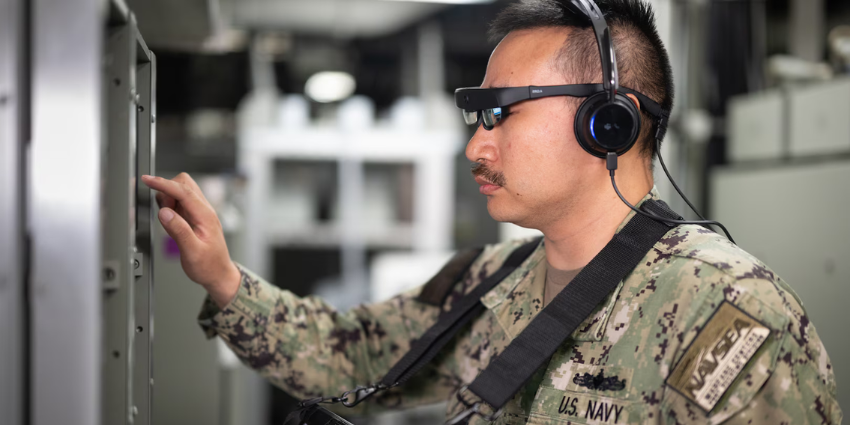
America’s naval vessels are seeing faster repairs with lower costs thanks to the rollout of smart glasses. The Augmented Reality Maintenance System (ARMS) allows on-board maintenance crews to transmit their point of view to subject matter experts [see featured image].
Rather than having to travel to the ship in question, these experts can now view maintenance issues remotely and advise the on-board teams with the repair process. Capt. Tony Holmes, Commanding Officer, Naval Surface Warfare Center, Port Hueneme Division, said:
“If outside help is required to resolve an issue, and that issue can be resolved by over-the-shoulder assistance via ARMS, that is a good thing”
Early metrics are showing a 92% reduction in the time subject matter experts are devoting to an issue. The ARMS systems also led to a 94% cost avoidance when compared with legacy processes.
Augmented reality glasses could deliver improved outcomes for private sector manufacturers that deal with highly specialized machinery. Say goodbye to the days of transporting experts across the world to help with repairs.
Reducing the travel demands on specialized teams can also avert legal and immigration issues – in a time of increasing geopolitical barriers.
For example, immigration issues led to Korean Hyundai employees being detained at a soon-to-be opened car factory in Georgia, USA earlier this month. They had travelled there to train local workers and oversee final touches with the machinery, The Diplomat reports.
Enhanced Training for Those Difficult Workplace Conversations
Being able to practice real-world encounters in a virtual setting can enhance workplace training.
The Criminal Justice and Social Work department of one U.S. university is helping students take on real-world situations in the safety of the virtual world.
In its new VR Lab, students will face scenarios such as responding to domestic violence calls or encounters with individuals experiencing substance abuse issues - in collaboration with training company WRAP. Dr Katy Hancock, department chair of criminal justice and social work, said:
“While classroom learning gives students a chance to build theoretical knowledge and critical thought, the WRAP system allows them to apply those concepts in practice”
This opportunity is particularly relevant for HR departments and client-facing staff looking to upskill in valuable ‘soft skills’.
For example, HR managers could practice difficult workplace encounters, such as informing someone they didn’t get the promotion they were hoping for. For client managers, they could practice how best to deal with a dissatisfied customer.