
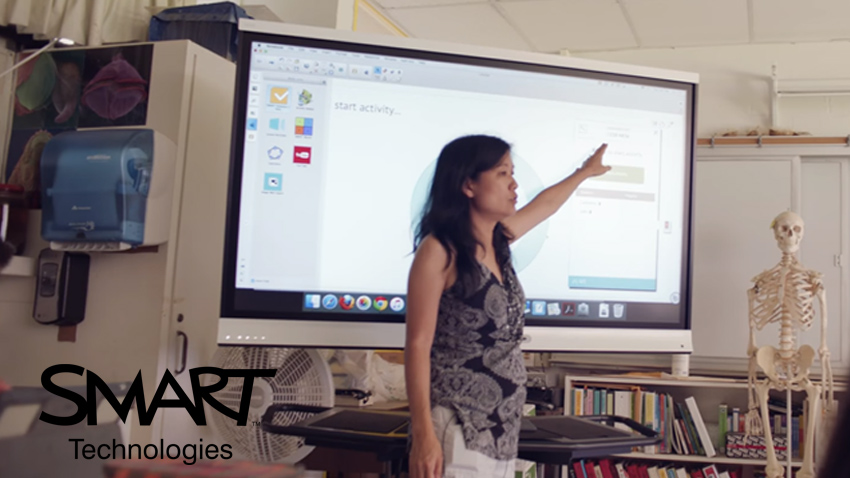
SMART Technologies Inc. a leading provider of education and collaboration solutions, today reveals the findings of an international research study of teachers, education administrators and IT professionals in education that shows that large interactive displays are critical to the modern classroom environment.
- SMART Technologies announces international study highlighting the importance of technology, group pedagogy, and software in learning
- Research reveals over 400 responses from 26 countries across the World(i)
- Attainment levels, especially in Maths and English, increase by up to 34%, with an average improvement of 16%
SMART Technologies, in collaboration and consultation with a number of IT and education thought leaders and researchers, assessed the best practices and impacts of technology on active learning programs. The resulting study, launched this week, represents more than 400 educators, technology specialists, administrators and IT professionals.
SMART researchers collected data from over 26 countries(ii) and the research findings demonstrate that the increased use of mobile and display technology is strongly related to software and pedagogy, specifically the frequency of group activity vs. individual activity.
Increased use of technology, group pedagogy, and software are strongly related to student success, with attainment, especially in Maths and English, increasing by up to 34%, with an average improvement of 16%.
Jane Ashworth, UK MD of SMART Technologies, says: “Our research clearly demonstrates that many elements are necessary for a classroom ecosystem’s health and effectiveness. These include technology elements such as mobile devices, education and management software, large interactive displays, sound, networking and cloud technologies.
“Large interactive displays are clearly vital to the classroom ecosystem, and remain pivotal in effective group and whole class pedagogy and student driven learning."
"As we continue to drive education towards usable lifetime skills and preparing students for viable futures in a technology based society, group learning, collaboration, and the more social aspects of education are gaining importance and are beginning to be measured in some geographies(iii)”

Along with the increase in group pedagogy, key software use increases with the frequency of mobile/display technology use. For example, frequent use of class collaborative software was reported in 24% of classrooms with low levels of use of both mobile and displays.
For classrooms with high levels of both, class collaboration software was frequently used 72% of the time. Use of student collaboration software, class collaboration software, game based software, and content creation software all positively and significantly relate to group activity.
[caption id="attachment_10573" align="alignright" width="300"] Jane Ashworth, Managing Director UK & Ireland at SMART Technologies[/caption]
Multiple observed measures of student success all relate positively to group activity. The above chart reveals the relationship between group activity and success measures. All are significant at the .100 level. The three strongest changes are in social and emotional learning (SEL) skills (an increase of 37%), participation (59%) and interdependence (55%). Group activity clearly matters in teaching the social oriented skills necessary in preparing students for the future. It is supported by a technology ecosystem with broad use of large scale interactive displays, mobile, software, and connectivity.
According to Dr. Kecia Ray, Executive Director of the Center for Digital Education, "Active Learning environments are critical to student success and the use of technology in these spaces amplifies the level of engagement we can expect to see."


