
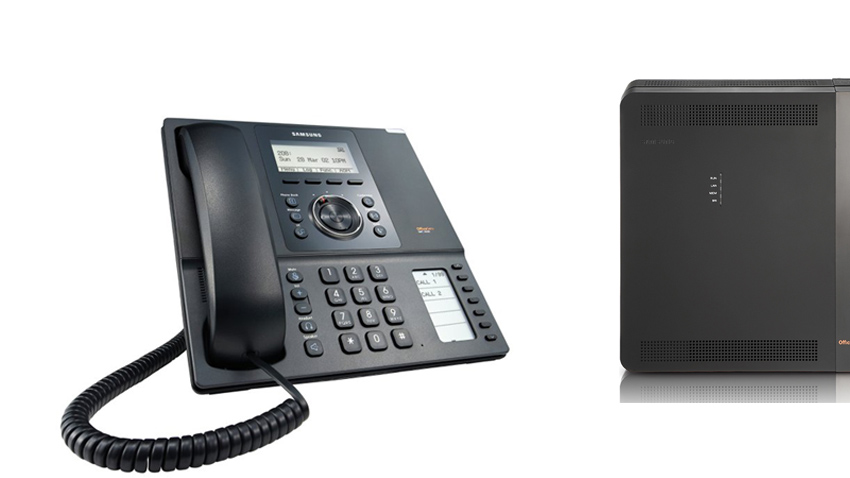
In developing the OfficeServ 7000 series of on-premises PBX solutions, global electronics giant Samsung set out to, in its own words, ‘level the playing field’ in business telecommunications.
The aim was to provide a series of products offering easy continuity from the smallest businesses up into the midmarket which all offered Enterprise-quality VoIP features in a readily scalable, easy to integrate system.
The result was five IP-PBX servers in the OfficeServ 7000 range, which offer advanced voice, data and wireless communication capabilities for four to 480 users from a single platform. All four units share interface modules, software applications and terminal support.
With multisite networking capabilities, the OfficeServ 7000 series can be deployed for up to 1000 users, extending the range from microbusinesses all the way up to those looking at breaking through to enterprise level operations.
The OfficeServ 7030 is the baby of the family. Samsung would no doubt resist the description ‘entry level’ because, it claims, the 7030 shares 99 per cent of the features and functionality of its more expansive cousins. The key difference is that the OfficeServ 7030 is intended for the smallest customers, and offers the smallest number of endpoints.
The concept is certainly appealing in its championing of communications equality. Here is a product aimed at the very smallest businesses, with a pricepoint and straightforward deployment options to match, intended to deliver the same level of sophistication as organisations many times their size would expect from an IP-PBX.
With a combination of legacy and advanced IP and SIP telephony support, Samsung claims that the 7030 offers an economically viable option for small businesses to embrace the latest technologies, while offering the cost and efficiency savings IP and SIP deliver. As well as protecting investment and reducing the total cost of ownership of a telephone system for a small business, the 7030 also provides a ready route to scale up to the other models in the series, from a single site to branching out to distributed operations.
In this review, we will ask whether the OfficeServ 7030 is able to deliver on these fine sentiments, whether it does indeed deliver enterprise level features and quality to microbusinesses, and, importantly, whether it delivers the communications solutions which matter most to the smallest businesses.
As always, the views contained in this review are the opinions of the author only. UC Today is a completely independent resource for the UC industry, and does not play any role in endorsing, marketing or promoting any particular products or brands.
What Can It Do?
The OfficeServ 7030 is a hybrid IP PBX server. It comes in a 12.5” enclosed chassis, with all ports and connection points neatly packed inside a closed black case with a removable front panel. It can be stacked with a maximum of two chassis in tandem.
In terms of endpoints, it can operate 16 IP phones or wireless handsets simultaneously, and also offers connections for up to eight digital phones and 10 analogue phones. In all, it can run 20 stations at once. It also supports up to eight SIP trunks or SPNet trunks, and four analogue trunks. With two voicemail ports available, the total number of stations, trunks and mail connections available at once is 30 - hence the name 7030.
A broad range of Samsung desk phones can be run from the server - it is compatible with the SMT-i5243, SMT-i5230, SMT-i5210 and SMT-i3105 IP phones, plus the DS-5021D, DS-5014D and DS-5007S digital phones and the SMT-W5120 wireless phone.
The modular architecture and shared software means the 7030 is fully interoperable with other units in the OfficeServ 7000 range, so there is no need for it to become redundant as a business grows. SPNet trunking allows the 7030 to be networked with other 7000 series servers at remote offices, meaning it can ultimately form part of a communication system of up to 1000 users.
Core features include auto attendant, Caller ID with name and number, Uniform Call Distribution (UCD), call sequencing and call recording, meaning even the smallest businesses can benefit from contact centre features delivering efficient and responsive call handling.
There is support for mobile and wireless integration which allows for greater flexibility in accessing the system both on- and off-premises. Wireless handsets and PDAs can link straight into the system through the 16 available wireless ports - if a business wanted to, it could run its whole VoIP network via wireless devices.
[caption id="attachment_5081" align="alignleft" width="300"] The OfficeServ 7030 provides wireless and mobile connections for small business telephone systems.[/caption]


