

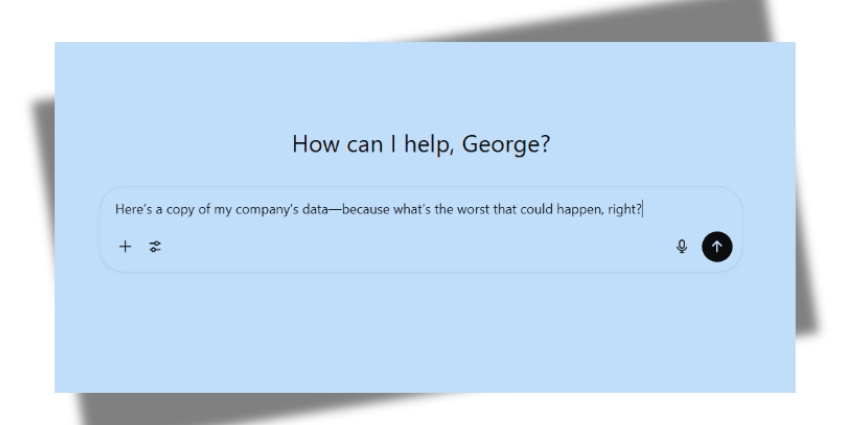
I've been watching the collaboration technology space evolve for years, but nothing has kept me awake at night quite like what I'm seeing right now. As someone passionate about how unified communications shapes the future of work, I'm witnessing a phenomenon that makes the early days of Shadow IT look like child's play. If you're an IT leader, compliance officer, or anyone responsible for enterprise risk management, this conversation is one you can't afford to ignore.
The statistics are staggering: 73% of knowledge workers are already using AI tools in their daily workflow, yet only 39% of enterprises have formal AI governance policies in place. We're living through the largest unsanctioned technology adoption wave in corporate history, and it's happening right under our noses—in our Microsoft Teams calls, Zoom meetings, and everyday collaboration workflows.
We're living through the largest unsanctioned technology adoption wave in corporate history, and it's happening right under our noses
The Silent Revolution in Your Conference Rooms
Here's the uncomfortable truth: while your IT team was busy securing traditional endpoints and network access, your employees started having a very different kind of conversation with artificial intelligence. They're not just asking ChatGPT about weekend plans anymore. They're copying entire meeting transcripts, pasting customer data, and uploading proprietary documents to AI platforms that exist completely outside your corporate firewall.
I recently spoke with a compliance director at a Fortune 500 financial services firm who discovered that over 60% of their sales team was routinely feeding client meeting recordings into various AI transcription and summary tools.
We had no visibility into it until we started monitoring UC traffic patterns," she told me. "The volume of data leaving our collaboration platforms was astronomical, and we had no idea where it was going.
This isn't isolated to one industry or company size. Shadow AI is proliferating across every sector, from healthcare organizations where nurses are using AI to summarize patient notes, to legal firms where paralegals are feeding case documents into AI research tools. The convenience is undeniable, but the compliance implications are terrifying.
When Productivity Meets Pandora's Box
The seductive power of AI productivity tools creates a perfect storm for risk. Consider these real-world scenarios I've encountered in just the past three months:
A pharmaceutical company discovered their R&D team was using AI to analyze clinical trial data by uploading raw datasets to public AI platforms. The efficiency gains were remarkable—research timelines compressed by 40%—but the HIPAA violations were catastrophic. Patient data that should have remained within secured systems was now scattered across cloud infrastructures they couldn't control or audit.
A manufacturing giant found their engineering teams were feeding technical specifications and design documents into AI tools to generate reports and proposals. The quality of output was impressive, but they'd inadvertently shared trade secrets with AI models that could potentially be accessed by competitors or foreign entities.
These aren't stories of rogue employees acting maliciously. These are dedicated professionals trying to do their jobs better, faster, and more efficiently. They're responding to productivity pressures in a world where AI has become the ultimate workplace assistant. The problem isn't their intent—it's the complete absence of guardrails around their actions.
Why Traditional IT Policies Are Failing
The playbook that worked for Shadow IT simply doesn't apply to Shadow AI. When employees started using Dropbox and Slack without permission, IT departments could block domains, monitor network traffic, and implement endpoint controls. AI presents a fundamentally different challenge because it's not about applications—it's about data patterns and human behavior.
Traditional data loss prevention tools are designed to catch files being uploaded or emails being sent. They're not sophisticated enough to recognize when someone is copying meeting transcript text and pasting it into a browser window. They can't detect when an employee is verbally dictating confidential information to an AI voice assistant. The attack surface has expanded beyond what conventional security tools can monitor.
Furthermore, the distributed nature of AI tools makes control nearly impossible. Employees aren't just using ChatGPT—they're experimenting with Claude, Gemini, Copilot, industry-specific AI tools, browser extensions, mobile apps, and platforms that launch weekly. Each tool has different data handling policies, retention periods, and security standards. Some store conversations permanently, others claim to delete them, and many exist in legal gray areas regarding data ownership and compliance.
The Compliance Time Bomb
For regulated industries, Shadow AI represents an existential threat to compliance frameworks that took decades to establish. GDPR's "right to be forgotten" becomes meaningless when customer data has been processed by AI models that can't selectively delete training inputs. HIPAA's data handling requirements crumble when patient information is processed by AI systems that weren't designed with healthcare compliance in mind.
Financial services firms face particularly acute challenges. When a wealth advisor feeds client portfolio information into an AI tool to generate investment summaries, they've potentially violated Sarbanes-Oxley requirements around data integrity and audit trails. When investment research is processed through unsanctioned AI platforms, it creates regulatory reporting gaps that could trigger massive fines and enforcement actions.
The timing couldn't be worse. As regulatory bodies worldwide are scrambling to understand AI's implications, enterprises are creating compliance violations faster than policies can be written. The EU's AI Act is setting global precedents for AI governance, while the SEC is demanding transparency around AI usage in financial operations. Companies that can't demonstrate control over their AI usage patterns are setting themselves up for regulatory disasters.


