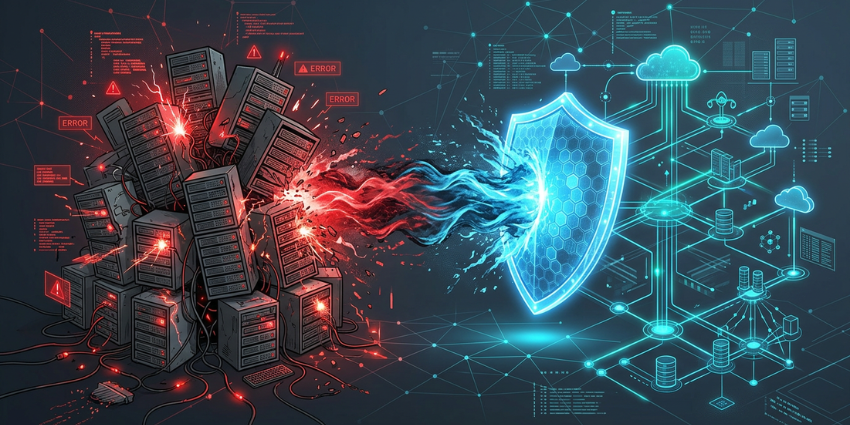
A strong system resilience strategy requires more than just buying backup servers. Many leaders confuse infrastructure reliability with simple duplication. They built a complex failover architecture, hoping it would prevent downtime.
However, this approach often creates massive enterprise redundancy risk. Adding more backup systems increases complexity without reducing real danger. To achieve true resilience, CIOs must rethink their IT resilience design. They must build systems that absorb disruption gracefully rather than simply duplicating fragile infrastructure.
Related Articles:
- What Is Negative Maintenance? The Principle Transforming IT
- How to Build True Observability Instead of Just Monitoring What Already Broke
- AWS Outage 2025: Lessons for IT and Business Leaders
Why does redundancy fail to ensure resilience?
Redundancy simply copies your existing problems. If a core database fails under heavy load, the backup will likely fail too.
True infrastructure reliability means designing systems that handle stress gracefully. A weak system resilience strategy assumes that having two of everything prevents outages. In reality, this mindset ignores the root cause of the failure. You cannot buy resilience by simply duplicating bad architecture.
What happens when failover systems break?
A complex failover architecture looks great on paper. However, these mechanisms rarely work perfectly during an actual crisis.
Automated failovers often trigger too late or fail to transfer data correctly. When the backup system breaks, IT teams face a catastrophic enterprise redundancy risk. They must troubleshoot two broken environments instead of one. Relying entirely on failover mechanisms creates a false sense of security.
How does complexity increase risk?
Every new backup system adds another layer of technical debt. More servers mean more connections, configurations, and potential breaking points.
This complexity actively threatens your infrastructure reliability. Engineers struggle to maintain these sprawling environments. When an outage occurs, finding the root cause takes much longer. A smart IT resilience design focuses on simplicity and graceful degradation, not endless duplication.
Where do resilience strategies fail?
Most strategies fail because they treat downtime as a hardware problem. Leaders throw money at servers instead of fixing software design.
A modern system resilience strategy treats failure as an inevitable design challenge. Systems should isolate failures so they do not cascade across the network. If your failover architecture requires perfect conditions to work, your strategy is already failing.
How should organizations design for failure?
Organizations must shift their focus from redundancy to failure management. You must design applications that continue working even when backend services crash.