
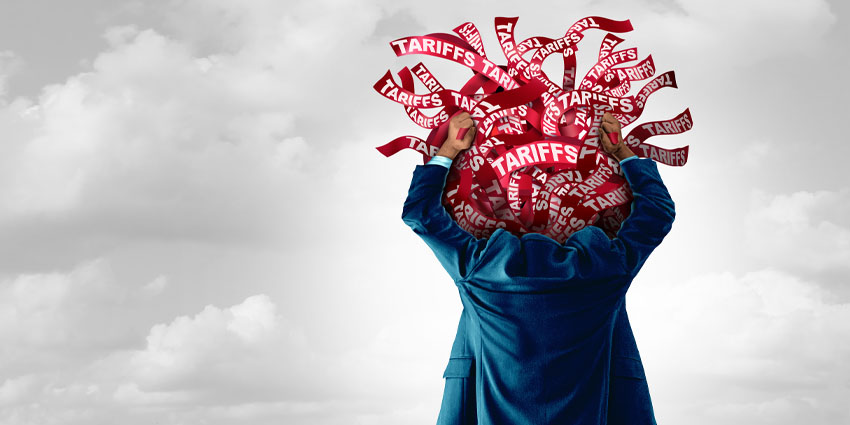
The earthquake of President Donald Trump's on-again/off-again tariffs continues to have repercussions for the tech world.
The Trump administration's recent 90-day reprieve for most affected nations might have stabilised the stock market after experiencing one of the most worryingly frantic periods of its history after the tariffs were first introduced. However, no innovative business can possibly think that's the end of volatility, and organisations are trying to adapt and future-proof as much as they can. For example, the chaos sparked by the current climate recently caused collaboration device vendor Logitech to take drastic action.
While the company stresses its confidence in delivering on its current fiscal year targets, the unpredictability has catalysed a strategic retreat from longer-term forecasting—it withdrew its outlook for the 2026 financial year entirely, citing the "continuing uncertainty" of Trump's tariffs.
Logitech's comment on the situation said:
Logitech withdrew its outlook for Fiscal Year 2026 given the continuing uncertainty of the tariff environment."
This comes as the Trump administration implements a significant expansion of import tariffs affecting a wide range of tech hardware components and finished products. The administration's ongoing aggressive trade stance toward China and other prominent manufacturing hubs has resulted in anarchy in supply chain economics for tech manufacturers, with a particular impact on companies heavily invested in physical collaboration tools and peripherals.
- Logitech To Enhance Modern Workspaces With Rally Camera Streamline
- What Comms Lessons Can High-Risk Sectors Learn From the White House Leak?
Why UC and Collaboration Vendors Suffer Disproportionate Tariff Impact
The UC and collaboration sector is particularly vulnerable to these trade policy shifts for several structural reasons. Unlike pure software providers, hardware-dependent UC vendors like Logitech operate in a space where their product ecosystem—cameras, headsets, conference room systems, and peripherals—hinges on complex global supply chains with significant exposure to tariff-affected regions.
This space arguably faces a trifecta of challenges under the new tariff regime. First, the hardware-intensive nature of collaboration technology creates high exposure to component tariffs. Many UC devices entail semiconductors, cameras, microphones, and specialised components sourced from or manufactured in tariff-affected regions, particularly China. With some components imposing duties up to 25 percent, the cost structure for these products becomes substantially less predictable.
Second, compared to pure software plays, the industry traditionally operates on relatively tight margins, meaning tariff-induced price increases cannot be smoothly absorbed without potentially derailing profitability. Most major players i the UC hardware space work within 15-30 percent gross margin ranges, according to Gartner's 2024 Market Guide for Unified Communications Hardware, making them particularly sensitive to input cost fluctuations.
Lastly, the sector faces elaborate pricing challenges in a competitive market. Enterprise customers typically negotiate multi-year purchasing agreements, which make rapid price adjustments problematic to implement. This culminates in a plausible squeeze scenario where input costs rise, in some cases substantially, while selling prices remain comparatively fixed in the short term.


