

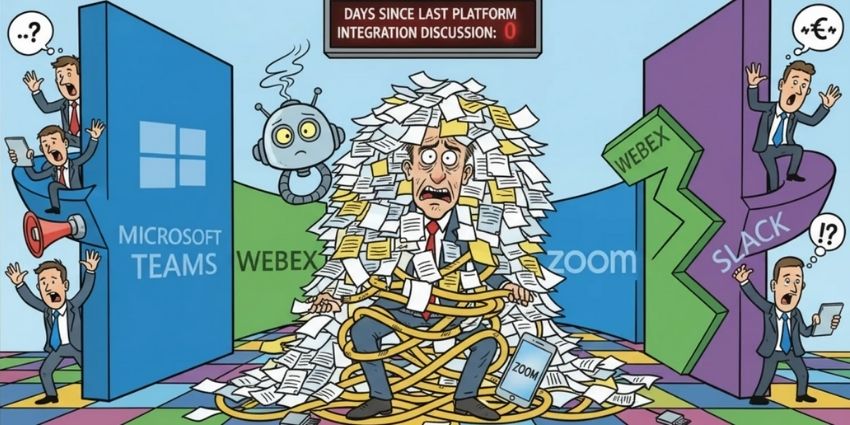
I've been thinking about something rather odd lately. For years, we've been watching UC vendors build ever-higher walls around their platforms. Microsoft wants you living entirely in Teams. Zoom wants to be your everything. Cisco insists Webex is all you need. Meanwhile, the rest of us have been cobbling together workarounds, copying messages between platforms, and maintaining separate presence indicators like we're running multiple personalities.
But here's the thing. We're nearly in 2026, and this situation has become rather untenable.
The Microsoft Teams Reality
Perhaps we should start with the elephant in the room. According to IDC, 45.6% of the global UC&C market now belongs to Microsoft. Nearly half. That's not just market leadership, it's approaching dominance.
You get the sense that this changes everything about the conversation. When one vendor controls almost half the market, the battle is no longer just about features. It's about ecosystems. About whether the industry will consolidate around a single platform or fragment into walled gardens that occasionally acknowledge each other's existence.
Microsoft has achieved this position through a rather clever strategy. They didn't just build a better mousetrap. They bundled Teams with Office 365, made it nearly free for existing customers, and integrated it so deeply into the Microsoft ecosystem that extracting it would require organizational surgery.
It worked. Brilliantly. And now we're left with an interesting question:
What happens when half the market lives in one vendor's ecosystem while the other half is scattered across competitors?
The Walls We've All Built
Walk into most organizations today, and you'll find something rather messy. Marketing uses Slack because that's where their workflows evolved. The development team insists on their own tools. Sales lives in Zoom because that's what customers know. Corporate IT has deployed Microsoft Teams, which everyone uses for some things, sometimes, when they remember.
And between all these platforms? Walls. Tall ones. With barbed wire on top.
It's a bit like expecting everyone in London to only ride the Tube and never take a bus. Logical from Transport for London's perspective, perhaps, but completely ignoring how people actually move through a city.
The problem is that these walls aren't accidental. They're deliberate architectural choices designed to keep users trapped within specific ecosystems. Microsoft wants you to use Teams for everything. Zoom wants to be your complete collaboration platform. Slack insists it's the hub for all your work.
And when one vendor controls 45.6% of the market, those walls become particularly expensive for everyone else.
What These Walls Actually Cost
I began to wonder what all this platform separation actually costs organizations. Not in licensing fees, though those are substantial enough. But in something harder to measure and far more expensive.
Consider this scenario, which happens thousands of times daily across the business world: you're collaborating with your team in Slack when someone needs to bring in a client. But the client only uses Teams. So you schedule a separate Teams meeting, manually copy the conversation context, and spend the first ten minutes of the call re-establishing what's already been discussed. By the time everyone's caught up, you've burned thirty minutes and three people's attention spans.
Or here's another: your calendar shows you're available because your company uses Outlook, but you're actually presenting at a Webex session that the scheduling system doesn't know about. A colleague calls you during your presentation. You look unprofessional. They feel awkward. Everyone loses.
These aren't edge cases. They're the daily texture of modern work. And they're entirely artificial problems created by vendors who profit from keeping users trapped within their ecosystems.
When Microsoft controls nearly half the market, these problems become even more acute. You can't simply avoid Teams anymore. Your clients use it. Your partners use it. Your new hires expect it. But you might have perfectly good reasons for using other platforms too.
The walls don't just inconvenience you. They actively make collaboration harder with nearly half the business world.
The Simple Truth About 2026
We're nearly in 2026. The technology to solve these problems has existed for years. APIs, federation protocols, presence standards. None of this is remotely difficult from a technical standpoint.
What's been missing is will. Vendors have been quite comfortable with the status quo because lock-in works brilliantly as a business model. Why make it easy for customers to use competing platforms when you can force them to choose?
But something's shifting. Perhaps it's regulatory pressure, particularly in Europe where interoperability is becoming a compliance requirement. Perhaps it's simply that customers are tired of paying premium prices for platforms that actively make their lives harder.
Or perhaps it's that when one vendor controls 45.6% of the market, the competitive dynamics change. Smaller players can't compete on ecosystem lock-in anymore. Microsoft has already won that battle. The only viable strategy for everyone else is to make interoperability so seamless that platform choice becomes about features and value rather than which ecosystem you're imprisoned within.
Microsoft and Zoom have already demonstrated basic calling federation. It works. Users can click a button in Teams and connect to someone on Zoom without switching applications or creating separate accounts. The technical barriers are gone. Only the business incentives remain.
And increasingly, those business incentives are pointing toward openness. Because in a market where Microsoft owns half the conversations, everyone else needs to make it easy to talk to that half.
What Open Doors Actually Means
Let me be clear about what I'm suggesting here. Not some complicated middleware solution or elaborate integration architecture. Just platforms that fundamentally respect that users exist across multiple systems and make that reality work smoothly.
Imagine clicking a contact in Slack and choosing whether to call them via Teams, Zoom, or Webex, depending on where they happen to be available. The system handles the connection automatically. No separate apps. No copying meeting links. Just a call.
Or picture your presence indicator reflecting your actual status across every platform you use. You're in a Zoom meeting, so your status shows busy in Teams, Slack, and Webex simultaneously. Simple. Obvious. Currently impossible without manual updates.
Shared calendars that understand multi-platform work realities. Federated calling that treats platform boundaries as routing decisions rather than impassable borders. Presence that actually reflects presence rather than which application happens to be open.
None of this requires revolutionary technology. It just requires vendors to stop treating other platforms as mortal enemies and start treating them as adjacent neighborhoods in the same city.
In a world where Microsoft controls 45.6% of that city, this becomes essential rather than optional. You can't wall yourself off from half the market and expect to thrive.
Why This Matters More Than You Think
There's something deeper going on here beyond mere technical convenience. The current platform separation fundamentally limits how organizations can adapt to changing work realities.
Right now, choosing a UC platform feels permanent. You're committing to an ecosystem, retraining staff, rebuilding workflows. The switching costs are so high that most organizations stick with suboptimal choices for years longer than they should.
But if platforms actually connected properly? You could use the best tool for each job without worrying about interoperability. Sales could stay in Zoom because that's where their customers are. Development could use whatever collaboration tool works best for their workflows. Corporate functions could standardize on Teams for policy compliance.
And critically, none of these choices would wall off parts of your organization from each other or from the 45.6% of the market living in Microsoft's ecosystem.
This would be rather good for productivity, one suspects.
The ecosystem battle is essentially over. Microsoft won. The question now is whether we'll have one massive walled garden with several smaller ones scattered around it, or whether we'll finally build the bridges that let people move freely between them.


