

A Perfect Storm of Technology and Space
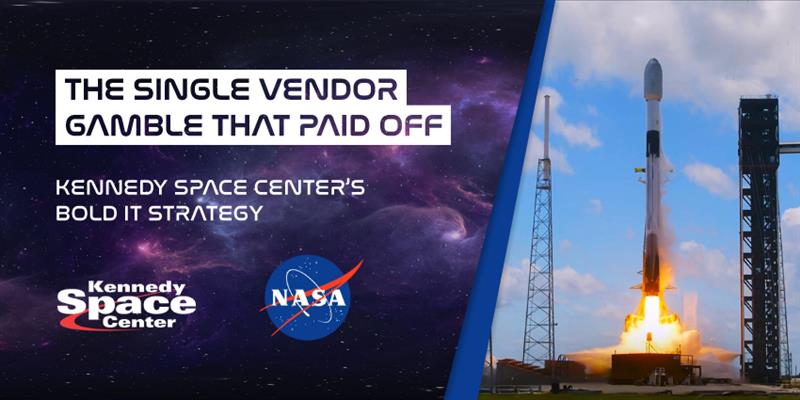
The rumble starts as a distant whisper, then builds to a thunderous roar that vibrates through the conference rooms at Kennedy Space Center Visitor Complex. IT Director Pedro Oñoro pauses mid-sentence during our interview, a knowing smile crossing his face. "That's SpaceX Falcon 9 launching Starlink 12-26," he says, pointing toward Space Launch Complex 40 at nearby Cape Canaveral Space Force Station.
It's the perfect metaphor for Pedro's week. Fresh off InfoComm 2025 in Orlando, he's back home managing the IT infrastructure for one of America's most iconic destinations. Today, Kennedy Space Center Visitor Complex will welcome thousands of visitors from dozens of countries, all hoping to witness moments like this SpaceX launch.
The complexity of Pedro's challenge becomes clear as he describes the operation: 15 major attractions across the 70-acre complex, multiple theaters, the Astronaut Training Experience, and Bus Tours to active NASA launch pads. Each experience relies heavily on audiovisual technology and seamless communication coordination.
"Every rocket launch brings its own challenges"
Pedro notes. "We'll have thousands of extra visitors today, international media crews, and VIP experiences that require flawless AV integration with our communication systems."
But unlike three years ago, Pedro isn't worried about his technology failing. His confidence stems from a controversial decision: betting everything on a single vendor's ecosystem.
[caption id="attachment_84885" align="aligncenter" width="1024"] The Rocket Garden outside of Gateway Deep Space Visitor Complex at KSCVC.[/caption]
The Breaking Point
Pedro's team was troubleshooting connection issues during critical meetings in the conference rooms while the executive team waited for the issues to be resolved. This wasn't an isolated incident—the IT team had become accustomed to these emergency scrambles during critical presentations.
"You have no idea how much time we spent in the middle of meetings getting to the bottom of tables to see what happened. Sometimes it was just an unplugged cable, or somebody kicked a cable, or something"
The pattern was predictable: camera vendor updates would conflict with codec firmware, audio system patches would disable microphones, display controllers would stop recognizing inputs. It was only a matter of time, The leadership wouldn't stand for frequent outages, something needed to change.
The Web of Complexity
Pedro's conference rooms had become a technological house of cards. HDMI extension modules seemed brilliant in isolation but became weak links when camera firmware updates arrived. Smart TVs promised advanced features but became security nightmares when users discovered they could download apps.
"Sometimes we would need to extend the HDMI with a module, and then sometimes the HDMI would fail or it was flickering. We don't have that problem at all now."
The smart TV situation exemplified unintended consequences. Users would mess with inputs, deleting configurations, or download entertainment apps during meetings.
"People were messing with the inputs, deleting the inputs. Where did HDMI one go? Somebody would delete it, or somebody would download apps because it's a smart TV."
Each vendor maintained separate update schedules, creating perfect storms of compatibility issues. Pedro's team spent more time coordinating between suppliers than implementing solutions that could enhance the visitor experience.
[caption id="attachment_84883" align="alignleft" width="379"] Pedro Oñoro[/caption]
The All-In Moment
Pedro made a decision that would have made most IT directors nervous: bet everything on Cisco's ecosystem.
Pedro's reasoning was simple: Cisco's integrated approach meant camera updates were tested with codec firmware before release. Room devices were designed to work with collaboration platforms as integrated components.
"When Cisco pushes an update for the microphone or the camera, I know it's guaranteed to work with everything—with the codec, with whatever. No issues are going to happen because it's been fully tested."
By committing entirely to the Webex ecosystem and wider network infrastructure, Pedro was betting that operational simplicity would outweigh theoretical optimization. The risk was substantial, but he prioritized system reliability over individual component specifications.
The Audio Revolution
Pedro discovered that audio quality was the real game-changer for meeting success. He invested in premium microphones a strategy that seemed excessive until results became clear.
Pedro's audio-first approach stemmed from observing user behavior. Video quality rarely caused meeting failures, but poor audio destroyed productivity. Most critically, AI transcription features would fail without pristine audio input.
"If we didn't have good microphones, the transcriptions would suffer. But right now, we've solved that issue with our Cisco system."
Support Ticket Extinction
The transformation was immediate and complete. Conference rooms that previously generated multiple weekly tickets were running flawlessly.


