
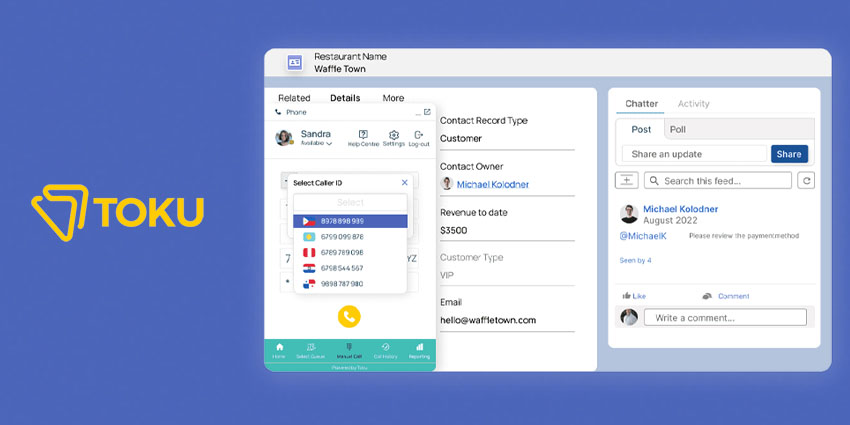
The role of the contact center is becoming more crucial by the day, making an integration between an organization's communications channels and its CRM a must. This type of integration streamlines agents' workflow and increases their productivity, which in turn empowers them to provide better customer experience.
To enable their customers a smooth integrated experience with one of the biggest CRM platforms out there, Toku recently launched their new Salesforce CTI as part of their existing contact center solution. The new Computer Telephony Integration supports both Salesforce Lightning and Salesforce Classic, the two versions used by the majority of customers.
I sat down with Toku's Head of Product, Girish Dharmaraj, to take a deeper dive into the Toku for Salesforce CTI.
The Benefits for the Contact Centre
Ultimately, a CTI is meant to integrate the business's CRM and contact center in order to empower agents to do their job optimally. According to Girish Dharmaraj, there are three main aspects that need to be addressed by a solid CTI.
1. Centralizing agent workflow
Perhaps the most critical benefit in using a CTI is allowing agents to handle all their calls within the CRM without constantly switching between multiple screens. Toku for Salesforce addresses this aspect with their click-to-call functionality.
"So, this click-to-call capability is slightly different from our browser functionality of the same name," Girish Dharmaraj explains.
"By using the Salesforce CTI widget, an agent can simply click on any number stored in the CRM to make an outbound call. This is by far one of the most productivity-inducing features the Toku for Salesforce CTI offers."
2. Automated data extraction
A CTI should also help the contact center use the huge amounts of data coming from the CRM in an intelligent way. This can be done by automatically extracting it from the CRM and making it easily accessible to agents.
"We do this using what Salesforce refers to as 'insight cards' – automatically pulling data from Salesforce, whether it's contact information, recent tasks or issues created for a particular contact or call, etc.," Girish Dharmaraj says.
For agents, this effectively means they don't need to collect this information manually, which enables them to focus their attention on the customer's need.


