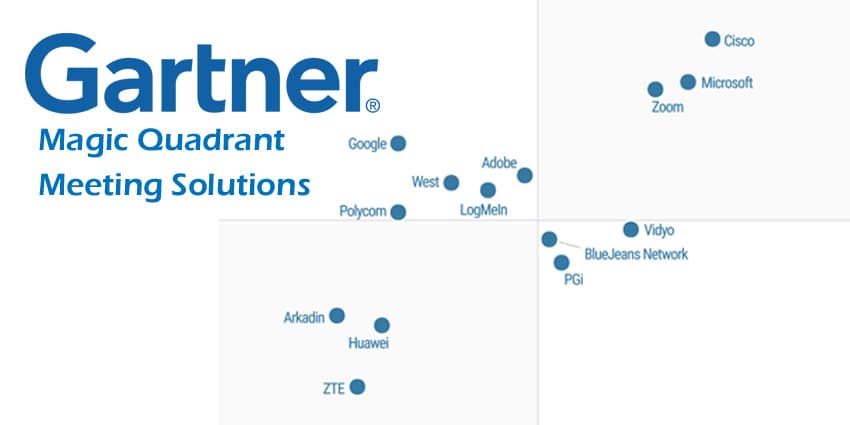
Gartner considers "Meeting Solutions" to be communication strategies that blend content, collaboration, and communication to allow for real-time productivity in the workforce. With its Magic Quadrant, the analytics firm hopes to draw attention to the vendors that have the most potential in the meeting room space.
Here, we'll take a look at the leaders, challengers, niche players, and visionaries that Gartner has highlighted for 2017, and their respective strengths and weaknesses.
Gartner Magic Quadrant Leaders
The "leaders" in the meeting room magic quadrant are the vendors that lead the pack in terms of completeness of vision, and ability to execute their innovations. Gartner suggests that the leaders in the Magic Quadrant must have significant market share, as well as a strong ability to respond to the needs of their customers. This year, we have:
Cisco
Cisco delivers Cisco WebEx, Spark, and Meeting Server for its cloud, hybrid, and on-premise deployments. According to Gartner, Cisco delivers some of the broadest solutions available for collaboration, with features perfect for a range of endpoints. However, Cisco's product portfolio also contains offerings that overlap in terms of functionality, which can make choosing solutions more complex for customers.
Microsoft
Microsoft's meeting solution is "Skype for Business", there's also Skype for Business online, and Microsoft Teams. Microsoft supports vertical industries across the world more deeply than any other competitor, with options for almost every sector. However, the ease of deployment for Microsoft options can depend on applications for media relay, edge, and content delivery integration.
Zoom
Zoom provides SaaS, dedicated, hybrid, and managed service deployments for meeting solutions. According to Gartner, the vendor is an innovative option for customers, moving at a rapid pace, with ongoing service consistency and reliability. However, Zoom struggles when it comes to interoperability with legacy meeting solutions.
Gartner Magic Quadrant Challengers
The "challengers" for the Gartner magic quadrant are the vendors that fell slightly short of the leader position. Although they have "operational excellence", and plenty of impact on the market, they're not as powerful as the current leading vendors. This year, we have:
Google provides Hangouts Chat and Hangouts Meet for SaaS. Google has exceptional market awareness for Hangouts, thanks to a re-energised focus on the enterprise, and the re-engineering of meeting experiences through Jamboard. Unfortunately, it's best for teams with fewer than 50 endpoints, which means it may not be ideal for larger companies.
West
West offers managed service deployments and SaaS for the "Intercall Conferencing" and Intercall Unified Meeting 5 products. West provides exceptional service consistency, reliability, and audio quality. However, the vendor is currently moving at a relatively slow pace in terms of innovation and development.
Polycom
Polycom offers a hardware-based infrastructure for on-premise deployment, as well as RealPresence for SaaS. Polycom has a rich channel ecosystem which allows for the sale of meeting solutions across a range of global regions. However, it relies on partnerships with Zoom for VaaS functionality.
LogMeIn
LogMeIn delivers GoToTraining, GoToMeeting, GoToConference, and GoToWebinar, as well as Join.me for SaaS. LogMeIn provides popular meeting solutions for businesses and enterprise, at a scale much larger than many competitors. However, it's "InRoom" link meeting service is a young solution in a field brimming with mature competitors.
Adobe
Adobe provides managed service deployments, on-premise, and SaaS solutions for Adobe Connect. The Adobe strategy addresses the customisation needs of the education, healthcare, and finance sectors, as well as the US government. However, the vendor has fewer subscription models than some of its competitors.